










































When small business owners talk about AI, the conversation usually starts in the same place.
Chatbots.
Marketing copy.
Customer service replies.
Social media captions.
Email automation.
Those tools can be useful, but they are not where the biggest opportunity is.
For many small businesses, especially businesses that deal with physical products, inventory, equipment, local services, logistics, repairs, resale, or eCommerce, the real AI opportunity is not writing better text. It is making better operational decisions.
That is the part most people are still missing.
A small business does not usually fail because the owner cannot write another email. It struggles because the daily workflow becomes too manual, too fragmented, and too dependent on memory. Orders are handled in one place. Photos are stored in another. Inventory decisions happen in someone’s head. Pricing is checked manually. Customer issues interrupt the process. Employees repeat the same small decisions all day long.
Eventually, the business grows, but the system underneath it does not.
That is where AI can become much more powerful than a simple productivity tool. It can become an operating layer.
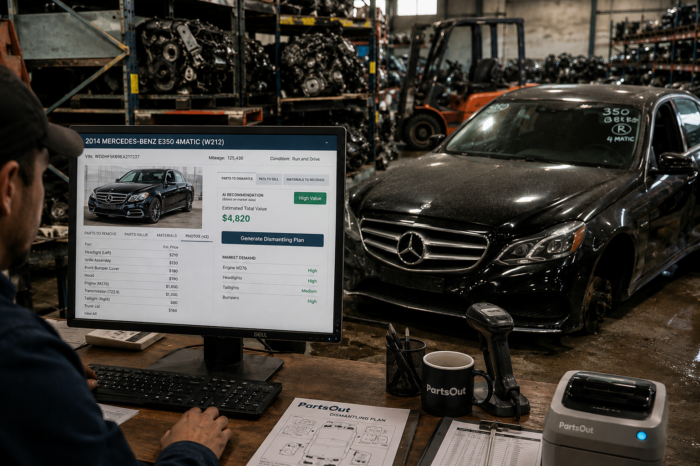
In my work with automotive recycling, reusable OEM parts, scrap recovery, and high-volume eCommerce, I have seen this problem very clearly. On the surface, automotive recycling looks like a physical business. Vehicles come in. Parts are removed. Materials are separated. Inventory is stored. Items are photographed, listed, sold, packed, and shipped.
But underneath that physical work is a constant stream of decisions.
Which vehicle is worth buying?
Which parts should be removed first?
Which items should be listed online?
Which parts are likely to sell quickly?
Which items are not worth the labor?
Which materials should be separated for recovery?
How should photos become usable inventory data?
How should pricing react to demand and competition?
If every one of those questions has to be answered manually every time, the business becomes limited by human attention. The company may still function, but it becomes difficult to scale without adding confusion.
AI for Small Business: Turning Daily Decisions Into Better Systems
This same pattern exists in many home-based and small businesses.
A seller managing physical inventory has to decide what to list, how to describe it, how to price it, how to store it, and how to fulfill it. A repair business has to route jobs, manage parts, estimate labor, and communicate with customers. A small warehouse or resale operation has to process products, track demand, update listings, and avoid wasted labor. Even service businesses have repeated decisions that are often handled manually because no system has been built around them.
The problem is not that people are lazy or disorganized. The problem is that the business is asking people to repeatedly rebuild the same decisions from scratch.
AI should help change that.
The strongest use of AI for small businesses is not to replace the owner’s judgment. It is to support that judgment with structure. A good AI-supported workflow can help collect information, classify inputs, compare options, prioritize work, and suggest the next best action.
How AI Improves Operations Beyond Marketing and Automation
For example, in a product-based business, photos should not only be stored in folders. They can become part of the inventory workflow. A system can help identify what is in the image, connect it to product attributes, support listing creation, and reduce the time between receiving inventory and making it available for sale.
In an eCommerce business, pricing should not depend only on occasional manual checks. A stronger system can review marketplace competition, demand, age of inventory, similar listings, and margin targets. The business owner still makes the final strategic decisions, but the repeated research does not have to start from zero every time.
In a physical operations business, employees should not always need to ask what to do next. A better system can provide clearer instructions based on the type of item, job, customer, material, or priority level. That reduces mistakes and helps the team move faster.
This is especially important for small teams.
Large companies can sometimes hide inefficiency by adding more people. Small businesses usually cannot. If the workflow is broken, hiring more people may only spread the confusion. The better solution is often to make the workflow smarter before making the team bigger.
Building Smarter Workflows With AI for Small Businesses
That starts with a simple question: which decisions are repeated every day?
Every small business owner should write those decisions down. Not the big strategic decisions, but the small operational ones: what gets processed first, what gets listed, what gets ordered, what gets followed up on, what gets discounted, what gets stored, what gets ignored, and what gets escalated.
Those repeated decisions are where AI can help.
Once the repeated decisions are visible, the owner can begin turning them into rules, checklists, data points, prompts, automations, or software workflows. The goal is not to make the business robotic. The goal is to stop wasting human energy on decisions that should already have a structure.
This is where many people misunderstand AI. They think the choice is between human judgment and automation. In reality, the best systems combine both. People understand context, exceptions, relationships, and responsibility. AI helps organize information, reduce repetition, and keep the workflow consistent.
That combination is powerful.
In traditional industries, the future will not belong only to companies with the most employees or the largest inventory. It will belong to businesses that can turn daily experience into repeatable operating logic.
That is true whether the business is selling auto parts, managing a home-based product brand, running a repair operation, processing used goods, handling logistics, or operating a small eCommerce store.
The next generation of small business AI will not only be about writing faster.
It will be about deciding better.
Small businesses that understand this early will have a serious advantage. They will process work faster, make fewer mistakes, train employees more easily, price more consistently, and scale without turning every new layer of growth into chaos.
AI is not just a marketing tool.
For the right business, it can become the system that helps the company think.
Author: Vladimir Sainciuc is an entrepreneur and systems builder focused on AI-supported operations,
Short Author Bio
Vladimir Sainciuc is an entrepreneur and systems builder focused on AI-supported operations, workflow design, automation, automotive recycling, reusable OEM parts, scrap recovery, and high-volume eCommerce. His work focuses on turning fragmented manual workflows inside traditional industries into scalable operating systems.
FAQs
1. How Can Small Businesses Use AI to Improve Operations?
Small businesses can use AI to improve operations by analyzing information, prioritizing tasks, supporting inventory decisions, creating product listings, monitoring pricing, routing jobs, and identifying the next best action. Unlike using AI only for content creation, operational AI helps businesses reduce repetitive work, improve consistency, and make better day-to-day decisions.
2. What Is Operational AI for Small Businesses?
Operational AI refers to using artificial intelligence to support the repeated decisions and workflows that keep a small business running. It can help with inventory management, pricing, order processing, customer communication, job prioritization, product classification, and workflow automation. The goal is not to replace human judgment but to give employees better information and more structured processes.
3. Can AI Help Small Businesses Make Better Inventory and Pricing Decisions?
Yes. AI can analyze inventory data, product attributes, demand, competitor pricing, inventory age, and profit targets to help small businesses make more informed inventory and pricing decisions. For eCommerce, resale, automotive parts, and other product-based businesses, this can reduce manual research, identify products that should be prioritized, and help prevent inventory from becoming stagnant.
4. How Can Small Businesses Use AI Without Replacing Human Decision-Making?
Small businesses can use AI as a decision-support system rather than a replacement for human judgment. AI can collect and organize information, identify patterns, classify products, prioritize tasks, and recommend actions, while business owners and employees remain responsible for reviewing recommendations and handling exceptions. This combination of AI efficiency and human judgment can create more reliable and scalable workflows.
Find a Home-Based Business to Start-Up >>> Hundreds of Business Listings.


