







































A parking lot camera can look fine at 3 p.m. and fail at 11:40 p.m. Headlights wash across wet pavement. A car pauses near the gate for two seconds. The footage shows motion, maybe the vehicle shape, but not the plate or the person who walked away from it.
That is the real test for parking lot security cameras. The question is not simply whether a camera has night vision. It is whether the lens, resolution, mounting height, lighting, housing, weather rating, network plan, and storage window match the part of the lot you actually need to prove later.
This guide focuses on parking lots and parking garages, where distance, glare, vandal risk, and 24-hour recording make camera selection less forgiving than a porch or small storefront.
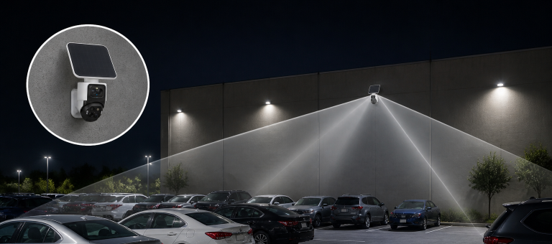
Security camera monitoring a nighttime parking lot with cars.
Table of Contents
- Start with the evidence you need at night
- Use pixel density before trusting night vision distance
- Read IK and IP ratings as real-world limits
- Match the lens to open lots and parking garages
- Plan camera names and IP addresses early
- Size storage for loop recording instead of guessing
- Conclusion
Start with the Evidence You Need at Night
Before choosing an outdoor parking camera security setup, decide what the footage must answer. A camera watching overall movement near a gate has a different job from a camera that must capture a plate at the exit lane.
For most parking areas, the jobs are split into three layers:
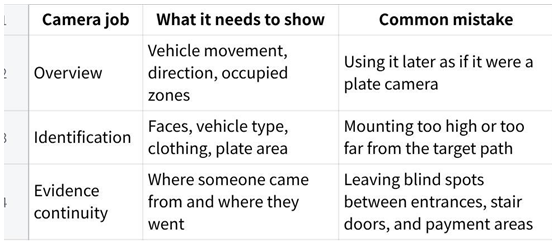
Trying to make one camera do all three usually leads to disappointment. A wide view catches more of the lot, but each car takes up fewer pixels. A tight view may read plates, but it misses what happened two spaces away. Parking lots need assigned camera jobs.
Use Pixel Density Before Trusting Night Vision Distance
Night vision range sounds like the obvious number to compare. It is not enough. A camera may see a vehicle 100 feet away and still not give you a usable plate image, especially if the lens is wide and the plate is only a few dozen pixels across.
Use a simple planning check:
pixels per foot = horizontal video pixels/width of the scene in feet
A 4K camera has about 3840 horizontal pixels. If that view covers 80 feet of driveway width, the result is about 48 pixels per foot. Narrow the same view to 30 feet, and the result rises to about 128 pixels per foot. Same resolution. Very different evidence.
License plates usually need a tighter, more controlled shot than general vehicle detection. Treat these ranges as planning checks, not guarantees:
- Broad movement awareness can work at lower pixel density if the goal is direction and timing.
- Vehicle details become more useful when the target lane fills more of the frame.
- Plate capture needs a narrow view, a suitable angle, enough shutter control, and lighting that does not blow out reflective plate material.
Angle matters too. A plate camera aimed steeply down from a tall pole often gets a distorted view. A lower side angle near an entry or exit lane may do better, even if the camera looks less impressive on a site map. Footage beats symmetry.
Read Ik and Ip Ratings as Real-world Limits
Vandal housing ratings and weather ratings answer different questions. Mixing them up is common.
IK ratings describe impact protection under IEC 62262. IK10 is the high-end commonly discussed for vandal-resistant camera housings, meaning the enclosure is tested against a defined mechanical impact. It does not mean the camera cannot be damaged. It means housing has passed a specific impact test.
IP ratings describe dust and water protection under IEC 60529. IP66 usually points to dust-tight protection and resistance to powerful water jets. IP67 adds temporary immersion protection under defined test conditions. Neither rating says much about impact from a thrown object, a pry attempt, or a vehicle clipping a pole.
Parking lots often need both lines of thinking:
- Open lots need weather protection for rain, snow, wind-driven dust, and heat.
- Public garages need protection from hands, tools, carts, and low ceiling contact.
- Payment areas and stair doors may need a camera position that is harder to reach, not just a stronger housing.
- Exposed cable runs need conduit or protected routing, because a strong camera body does not help if the cable is easy to cut.
If vandalism is a known risk, ask for the actual IK rating in the camera or housing documentation. If the product page does not list an IK rating, do not treat the camera as IK10 by assumption.
Match the Lens to Open Lots and Parking Garages
Open lots and parking garages create different night problems. In an open lot, the camera may be fighting distance, rain, fog, and uneven pole lighting. In a garage, it may be fighting concrete glare, low ceilings, headlights, and dark corners beside bright ramps.
For an open lot, a wide-angle camera works well for context near entrances, dumpsters, pedestrian paths, and rows of parked cars. Use narrower views at chokepoints where cars must slow down. Entry lanes, exit gates, payment machines, and speed bumps are better plate opportunities than the middle of a large lot.
For a security camera for parking garage use, watch the reflective surfaces. Polished concrete can bounce headlights straight into the lens. Wet ramps do the same thing. If the image blooms whenever a car turns in, try a different angle before blaming the camera. Sometimes moving the camera a few feet sideways fixes what a spec sheet cannot.
HDR can help with headlights and bright backgrounds, but it is not magic. Infrared can help in low light, but reflective plates can flare. Color night vision can preserve vehicle color when there is some light to work with. The right answer changes by zone.
For sites comparing outdoor options, the eufy outdoor security cameras collection keeps weather-rated hardware, outdoor mounting, and night monitoring features in one place.
Plan Camera Names and Ip Addresses Early
Small parking systems get messy once the second row of cameras goes in. One camera is easy. Twelve cameras, two switches, a recorder, and remote viewing can become a problem if nobody knows which camera is which.
Keep the plan plain:
- Reserve a fixed IP address or a DHCP reservation for each camera.
- Name cameras by location, such as north gate, west stair, or level two ramp.
- Keep a simple map with the camera name, IP address, switch port, and viewing purpose.
PoE helps because one Ethernet cable can carry power and data, but it does not replace a camera map. The person troubleshooting a failed camera six months later will not remember which cable was the temporary one.
Size Storage for Loop Recording Instead of Guessing
Parking lot incidents are often reported late. Someone notices a dent in the morning. A tenant checks the car after a weekend away. A payment dispute comes up days after the vehicle left. If the system overwrote the footage last night, the camera did its job, and the storage plan failed.
A rough storage calculation looks like this:
storage = camera bitrate x recording time x number of cameras x retention days
The bitrate changes with resolution, frame rate, compression, motion, and night noise. A dark scene with rain or moving headlights may need more data than a quiet daytime wall. If the site is moving toward wired 24-hour coverage, compare power, local recording, and storage expansion before choosing the storage size.
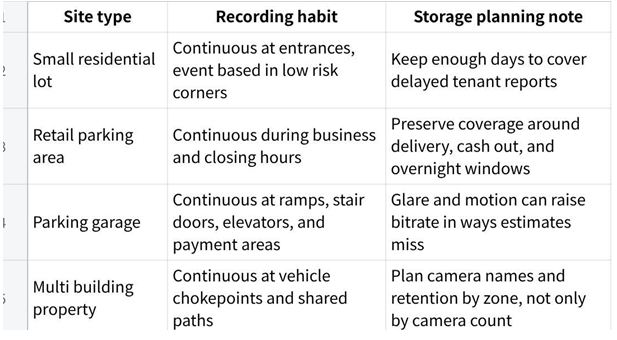
The storage window also changes by property type. A small residential lot may need enough days to cover delayed tenant reports, while a garage ramp or retail lot may need continuous footage around predictable high-risk hours.
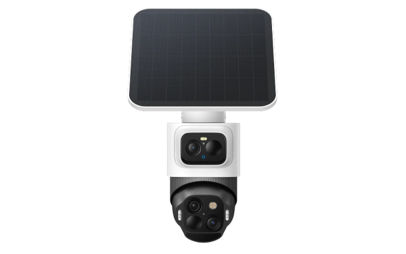
For a small lot entrance or a wide driveway edge, one camera may need to do two jobs at once: hold the broad scene and still follow motion far enough to be useful. The single eufyCam S4 fits that kind of spot when the mounting point cannot cover both the gate and the row beside it. Its 4K bullet view keeps the wider approach visible, while the 2K PTZ view can track and auto frame movement at a distance. In areas where tampering is a serious concern, pair the camera choice with a separate plan for housing, conduit, and mounting height.
Loop recording is useful only when the loop is long enough. If the needed window is 14 days, do not size the system for a perfect 14 days under clean lab conditions. Real parking lots are noisier than that.
Conclusion
Good parking lot security cameras are planned backward from evidence. Start with what must be identified at night, then work through pixel density, lens angle, lighting, housing risk, weather exposure, network addresses, and storage days.
The spec sheet still matters, but it should answer site questions rather than replace them. A wide-angle camera can capture movement. A tighter lane camera can help with plates. An IP67 body can handle weather, while IK rated protection may still be needed where people can reach the camera. Parking lots punish vague plans. A few measured choices up front make the footage much easier to trust later.
Find a Home-Based Business to Start-Up >>> Hundreds of Business Listings.