









































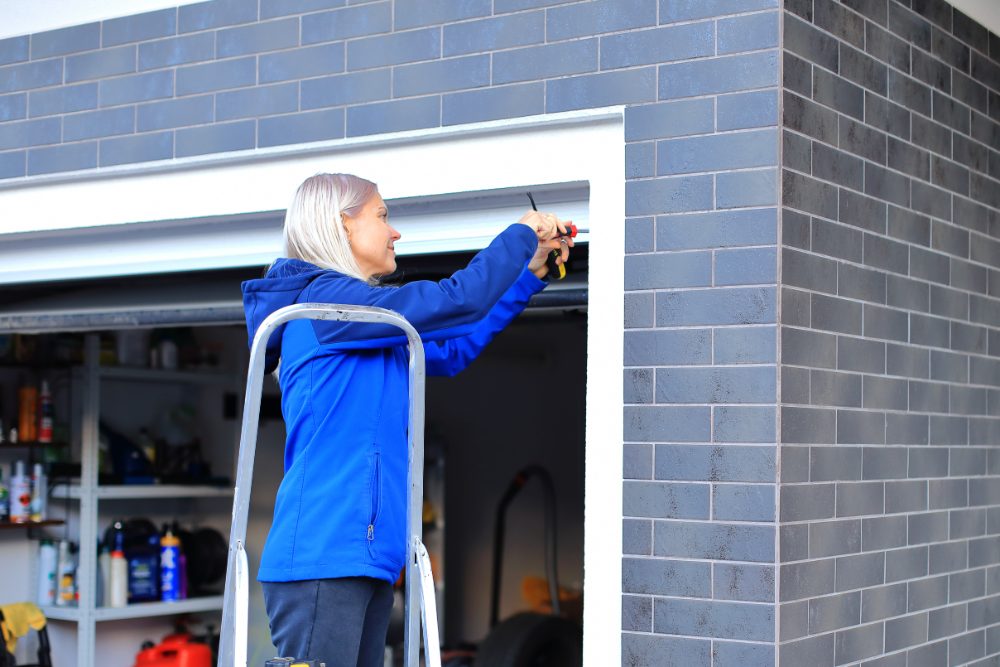
A very large number of small businesses run out of a garage, making garage door security an important part of protecting inventory, equipment, and business operations.
E-commerce operators storing inventory. Tradespeople with tools and stock. Makers with equipment. Consultants who converted the space into an office because the spare bedroom became a nursery. Garage door security matters for all of them. It is the default expansion space for a business that has outgrown a desk and cannot yet justify commercial rent.
Which means the garage door has quietly changed job. It used to be the thing that kept a car dry. Now it is the perimeter of your stockholding, the loading dock for every inbound and outbound consignment, and, if you have converted the space, the largest thermal weak point in your workspace.
Nobody rewrites the risk assessment when this happens, because nobody writes one in the first place.
The Security Assumption That Does Not Hold
Domestic garage doors are designed to keep weather out and to deter casual entry. They are not designed to protect stock.
That distinction matters more than it sounds, because garage door security changes completely once there is inventory inside. A residential garage that contains a lawnmower and some paint tins attracts opportunists. A residential garage that receives regular courier deliveries and has boxes visible whenever the door opens attracts something more deliberate.
Three vulnerabilities are worth knowing about specifically.
The Emergency Release
Every automatic door has a manual release so you can open it in a power cut. On many older installations, that release can be reached from outside by hooking a wire through the gap at the top of the door. It is a known technique and it is fast. Shield kits exist and are inexpensive.
Rolling code Age
Older remote systems use fixed codes, which can be captured and replayed. Anything installed before the mid-2000s is worth checking. Modern rolling-code systems change the code on every use and close this off entirely.
The Side Door
Most garages have a pedestrian door, and it is very often the weakest point in the building, fitted with hardware nobody has looked at since the house was built. It is also the door your insurer will ask about.
The Insurance Conversation You Should Have Had
This is the part that catches people, and it catches them at the worst possible moment.
Standard home and contents policies are written for domestic contents. Business stock, business equipment and business liability are frequently excluded or heavily limited. Discovering that a policy caps business property at a token amount, after a break-in that took your entire seasonal inventory, is a genuinely common way for small operations to fail.
Two things worth doing this week.
Call your insurer and ask directly whether business stock and equipment stored in the garage are covered, and to what limit. Get the answer in writing.
Ask what garage door security they expect for that cover to hold. Insurers often specify conditions, and a garage door that does not meet them can invalidate a claim even where the entry point was elsewhere.
This is a fifteen-minute phone call that either confirms you are fine or reveals a gap while you can still do something about it.
Downtime Is Now An Operational Risk
When the garage door was just a car door, a failure was an inconvenience. Now it is a stoppage.
If your outbound consignments live behind that door and it jams on a Thursday, you are not shipping on Thursday. If a customer is collecting and the door will not open, that is a customer experience problem. If your work vehicle is behind it and you have jobs booked, the whole day goes.
Garage doors also fail in a specific and unhelpful way: they fail closed, with everything inside, and usually at the start of the day when the first cycle happens.
The mitigation is not complicated. It is knowing how to operate the manual release, which is a two-minute thing to learn and a genuinely bad thing to learn under pressure. And it is servicing the door on a schedule rather than waiting for it to stop.
The Cycle-Count Problem Nobody Anticipates
Here is the thing that catches home businesses specifically, and it is worth understanding properly.
Garage door components are rated in cycles, where one cycle is one open and one close. A typical residential spring assembly might be rated somewhere around 10,000 cycles.
A household using the door twice a day reaches that in roughly fourteen years, which is why residential doors feel like they last forever.
A home business is not using it twice a day. Between courier pickups, deliveries, your own vehicle movements, customer collections and every trip to fetch something from the shelves, ten to twenty cycles a day is entirely normal.
At fifteen cycles a day, a 10,000-cycle assembly is finished in under two years.
This is why so many home business operators find themselves calling for a spring replacement on a door that is “practically new”. The door is not defective. It was specified for domestic use and is being used commercially, and the arithmetic is unforgiving.
If your usage has genuinely stepped up, the answer is to specify heavier-duty components at the next replacement rather than repeatedly replacing domestic-rated ones. The price difference is modest. The difference in service life is not.
If You Have Converted The Space
For anyone who has turned the garage into an office, workshop or studio, the door becomes a thermal and acoustic problem rather than a security one.
An uninsulated door is typically the single largest weak point in the envelope. In a hot climate, a west-facing metal door in afternoon sun makes the space genuinely unusable without running cooling constantly, which is a real operating cost.
Insulation panels retrofit onto most sectional doors, and the payback is usually fast. But there is a detail worth knowing before you fit them: insulation adds weight, and the springs were balanced for the original door weight. Adding panels without rebalancing means the opener is now lifting more than it was set up for, which shortens its life considerably.
Weather seals matter too, and they are cheap. Perimeter and bottom seals cut draughts, dust and noise, and on a door that opens onto a street they make a measurable difference to whether you can take a call while a truck goes past.
Location Changes All Of This
Deterioration is not uniform, and generic maintenance intervals are why so many operators get caught out.
Coastal exposure is the big one. In a city like Perth, where the metro area runs along an exposed western coastline and the afternoon sea breeze carries salt well inland, garage door hardware corrodes considerably faster than the panels do. The failure is at the rollers, bearings, springs, cables and fixings, which is precisely why a door can look perfectly presentable and be running on components in poor condition.
Heat is the second factor. Extreme surface temperatures on a west-facing door fatigue springs faster than the manufacturer’s rating assumes and degrade seals on a converted space.
Stack coastal exposure, western aspect and fifteen cycles a day on top of each other and you have a door on a materially shorter interval than the two-yearly service most households never get around to anyway.
Slide and Glide covers garage door servicing, security upgrades and repairs across the Perth metro area from bases in Osborne Park and Yangebup, working across Merlin, B&D, Steel-Line, Gliderol, Centurion, Jaytech, Superlift and Avanti systems, and the pattern on high-cycle residential doors is consistent: components rated for domestic use, being worked commercially, failing early and surprising the owner.
The Practical List
If you are running anything out of your garage, work through these.
Call your insurer and confirm business stock and equipment cover, plus any security conditions attached to it. Get it in writing.
Check the emergency release can not be reached from outside. Fit a shield if it can.
Check your remote system age. Anything pre-mid-2000s may be fixed-code and worth upgrading.
Look at the side door. It is usually the weakest point and the one your insurer will ask about.
Count your actual daily cycles. If it is over ten, you are running a commercial duty cycle on domestic components and should plan accordingly.
Learn the manual release now, not during a power cut with a customer waiting.
Book a service. Annual if you are coastal or high-cycle, two-yearly if you are neither.
If you have converted the space, price insulation and seals, and have the springs rebalanced if you add panel weight.
The Point
A garage door is a five-hundred-dollar-a-decade component that, once a business moves in behind it, is suddenly holding your inventory, gating your fulfilment and forming the envelope of your workspace.
It did not get any stronger when your business moved in. Everything you are now asking of it changed on the same day, and nothing about the door did.
Fifteen minutes on the list above is a reasonable amount of attention for something carrying that much of your operation.
Find a Home-Based Business to Start-Up >>> Hundreds of Business Listings.