










































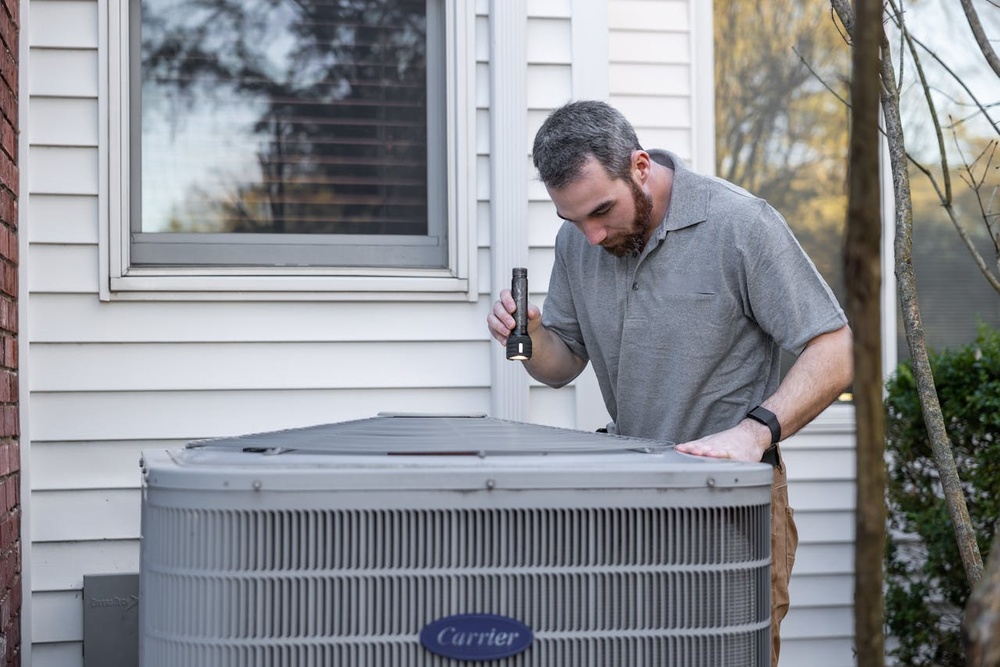
When your air conditioner starts acting up, the decision isn’t always obvious. Some problems are quick, affordable fixes. Others are a slow drain on your wallet — and your sanity. Understanding the difference between a unit worth saving and one past its prime can save you thousands.
For homeowners in the Pacific Northwest dealing with aging systems, professional ac repair is often the smarter short-term move than full replacement — but only when the numbers support it. Conrad Heating and Cooling offers diagnostic evaluations that take the guesswork out of that decision entirely.
The Age Factor
HVAC technicians often cite the 10-year mark as a turning point. Most residential central air units last 15 to 20 years with proper maintenance — but efficiency starts declining well before that. A unit installed before 2010 almost certainly runs on R-22 refrigerant, which the EPA phased out. Recharging those systems today costs significantly more than it used to, and the supply keeps shrinking.
So age alone doesn’t settle the question. But it shifts the math.
The $5,000 Rule
There’s a practical formula widely used in the HVAC industry: multiply the repair cost by the age of the unit (in years). If that number exceeds $5,000, replacement starts making more financial sense.
Here’s why the formula works:
- A $600 repair on a 6-year-old system = $3,600 → repair
- A $400 repair on a 14-year-old system = $5,600 → consider replacing
- A $1,200 repair on a 12-year-old system = $14,400 → replace
This isn’t a hard rule — context matters — but it gives you a defensible starting point before you call anyone.
Signs That Point Toward Repair
Not every problem means the end of the road when considering AC repair or full replacement. Some failures are isolated and inexpensive to fix, even on older equipment.
If your unit shows any of these, a targeted repair is usually worth it:
- Faulty capacitor or contactor (common, inexpensive)
- Refrigerant leak on a newer system with no corrosion
- Clogged drain line or dirty evaporator coil
- Blower motor failure on a system under 8 years old
These are component-level problems. Fixing them doesn’t imply the rest of the system is failing.
Signs That Point Toward Replacement
Some symptoms indicate systemic decline — the kind where fixing one thing leads to fixing another six months later.
A compressor failure is the big one. Replacing a compressor on a system over 10 years old rarely makes sense. The compressor itself costs 50–70% of what a new unit runs, and you’re still left with an aging coil, aging refrigerant lines, and aging everything else. That costs more to ignore than to address.
Other red flags: utility bills creeping up despite no change in usage, uneven cooling across rooms, the system short-cycling (turning on and off rapidly), or visible corrosion on refrigerant lines. Any combination of these on an older unit is worth taking seriously.
Efficiency and Long-Term Costs
Modern central air units carry SEER2 ratings (Seasonal Energy Efficiency Ratio) of 15 to 22. Systems from 2005 to 2012 often ran at 10 to 13 SEER. That gap is significant — roughly 30–50% more energy consumed to move the same amount of heat. At current electricity prices in the Pacific Northwest, that difference shows up clearly on summer utility bills.
This is where the total cost-of-ownership argument comes into focus. A new system at $4,000 to $7,000 installed isn’t cheap. But if it saves $40–$70 per month in energy costs and eliminates recurring repair bills, the payback period is often 5 to 7 years — well within the expected lifespan of a new unit.
How Conrad Heating and Cooling Approaches This Decision
This is where having the right service partner matters. Conrad Heating and Cooling serves the Beaverton and greater Portland area with diagnostic assessments that go beyond “it needs this part.” Their technicians evaluate system age, refrigerant type, compressor health, coil condition, and energy efficiency together — not in isolation.
What that means in practice: you get a clear picture of your system’s remaining useful life, not just a repair quote. If a fix genuinely extends a system’s viable lifespan by several years, Conrad recommends the repair. If the system is already showing multiple failure points, they’ll tell you that directly.
Making the Call
A few final decision anchors worth keeping:
If the system is under 8 years old and the repair is under $800 — fix it. If it’s over 12 years old, running on R-22, and facing a major component failure — the full replacement conversation is worth having than the AC repair works. Everything in between needs a real assessment, not guesswork.
Conrad Heating and Cooling makes that assessment straightforward. If your system is showing warning signs — rising bills, weak cooling, unusual cycling — reach out for a professional evaluation before the heat of summer forces a rushed decision. Getting ahead of it always costs less.
Find a Home-Based Business to Start-Up >>> Hundreds of Business Listings.




