








































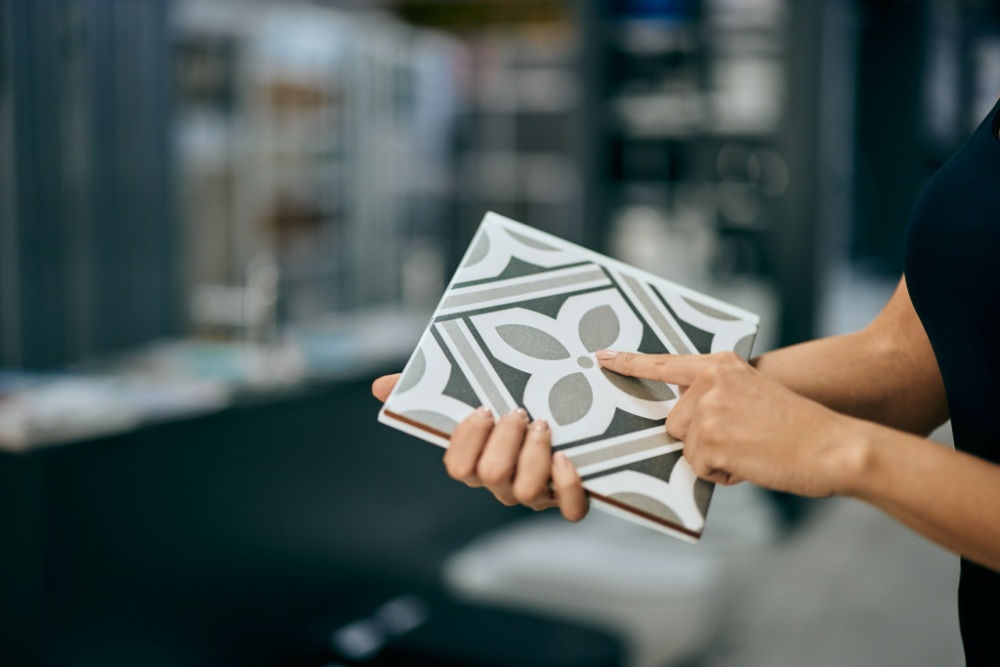
If tile still registers as something chosen after the cabinets, paint and plumbing fixtures, clé has spent more than a decade making the case for the opposite.
For founder Deborah Osburn, tile has never been simply a protective surface. Her background is in sculpture, and her interest in tile began with seeing it used architecturally and decoratively in ways that felt far more ambitious than the standard ceramic options then familiar to many American homeowners.
In a 2026 interview with California Home Design, she described one of the original gaps she saw in the U.S. market as a lack of awareness that tile had historically been used not only for function, but as ornament, architecture and art.
That idea still explains clé better than any single material can.
Today, the brand’s most interesting work is less about preserving one traditional tile type than about asking what else a surface can become when artists, designers, ceramicists and material specialists are invited into the process.
Tile as a Medium, Not a Finishing Touch
Osburn’s view of tile is fundamentally artist-led. She has spoken about living in two creative worlds: making through enthusiasm for materials, then watching designers interpret those materials in their own way.
That distinction matters because the most interesting tile installations often do not begin with a question like, “What color works with this room?”
They begin with composition.
A repeated geometric tile can set the rhythm of a hall. A stone mosaic can function almost like an inlaid rug. A metallic surface can alter light rather than simply add color. Even a relatively restrained field tile can become more architectural when scale, grout, orientation and repetition are treated as design decisions.
It is the same reason texture can make an interior feel more layered. A room does not always need more furnishings or decoration. Sometimes the permanent surfaces can do more of the work.
Collaboration Is Part Of The Design Process
One of clé’s clearest points of difference is how often it looks outside conventional tile design for ideas.
The brand has worked with artists and designers including Ruan Hoffmann, Erica Tanov, Serena Dugan, Cristina Celestino and Frances Merrill of Reath Design, among others. Maison clé is explicitly positioned around this intersection of tile, art and experimental design, with collaborations treated as a core part of the collection rather than occasional capsules.
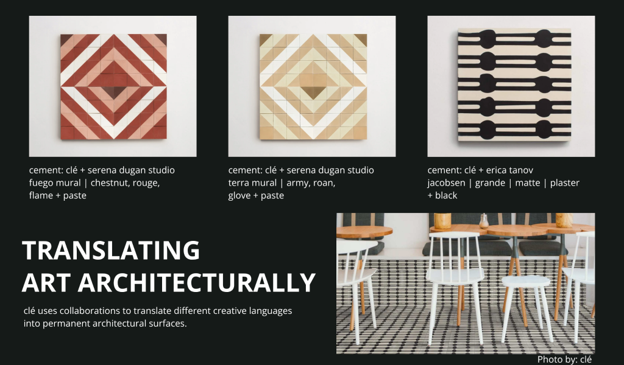
The approach is especially visible in the three cement collaborations that clé released in August 2026 with Serena Dugan, Erica Tanov and Reath Design.
Dugan translated her textile sensibility into rhythmic mural compositions. Tanov revisited motifs from her fashion and home archives.
Reath Design worked with poured pigments inspired by marbled papers and historic stone compositions. The same base material becomes three entirely different visual languages.
That is more interesting than simply asking an artist to create a pattern.
The material imposes its own rules, and the designer has to work within them. Color must survive as part of a surface. Repetition has to function across a floor or wall. A motif that looks beautiful on paper has to remain convincing when repeated across 100 square feet.
For clé, collaboration is not decoration added to tile. It is a way of seeing what tile can do when another discipline pushes against its usual boundaries.
Where Artistry Has To Meet Performance
A brand can talk about tile as art, but a shower floor is where the philosophy has to survive real life.
It has to tolerate repeated use, cleaning and water. The floor needs to follow the pitch toward the drain, and the selected surface needs to be appropriate under wet feet.
That makes clé tile for shower floors an interesting extension of the brand’s wider approach. The collection brings decorative and natural materials into an application where technical suitability is just as important as visual impact. clé’s current site specifically frames shower-floor selection around slip-resistant performance, durability and wet-area use.
This is also where scale becomes functional. Smaller pieces can follow changes in the shower plane more comfortably than oversized formats, while additional grout joints can affect footing. Waterproofing, drain detailing and substrate preparation still belong to the installation system below the visible tile.
The surface may be the part everyone notices, but its success depends on work that disappears once the shower is finished.
That relationship between material choice and long-term performance is equally important when thinking about bathroom remodeling beyond appearance alone.
The clé Guild Turns Experimentation Into Production
There is another, less visible side to that experimentation: the clé Guild.
Osburn describes the Guild as having grown from the search for a particular glazed thin brick into a larger operation where ceramicists and material experimenters could develop glazes, test ideas and solve production problems. Today, research and development, product development and artisanal production sit much closer together.
That matters because ceramic beauty is partly chemistry.
Glaze depth, color, firing behavior and surface response all depend on combinations of minerals, heat and timing. The aesthetic result may appear effortless once installed, but getting there involves repeated testing and technical control.
Osburn’s description of the process is revealing: the goal was not simply to manufacture more tile, but to find a way of combining “science, art and fire” to create surfaces with depth.
It is a useful reminder that handcraft and technology are not opposites. Contemporary craft can be strengthened by better testing, tighter development and a deeper understanding of how materials behave.
Artists Can Change The Scale Of What Tile Is Allowed To Be
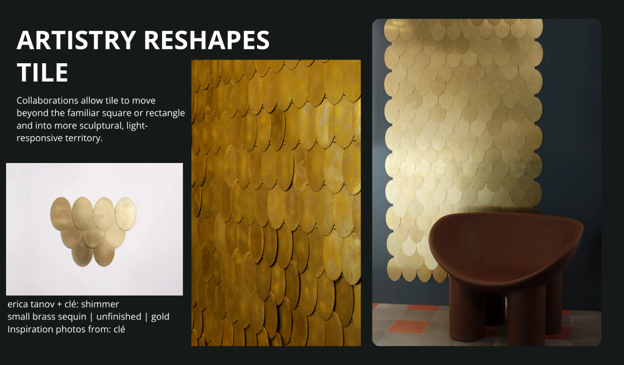
Some of clé’s collaborations push even further from the conventional idea of tile.
Erica Tanov’s Shimmer collection, for example, uses nested brass ovals that overlap across a wall to create a metallic, light-catching architectural surface. It functions less like a traditional tiled wall and more like a field of sequins scaled up into architecture.
Cristina Celestino’s work with clé’s Lapidary stone collection takes another route, using bespoke marble and stone mosaics to combine geometry with the natural movement of the material. Her patterns draw on the everyday geometry of Milan, translating architectural references into floors and walls.
These projects make a larger point: durability does not require visual conservatism.
A permanent surface can be expressive precisely because it is permanent. Unlike a cushion or wallpaper panel, tile is expected to remain part of the architecture for years. That gives pattern, scale and material choice greater consequence.
Stone Is Being Treated Less Like A Building Product
Stone is one of the clearest examples of clé’s broader design philosophy.
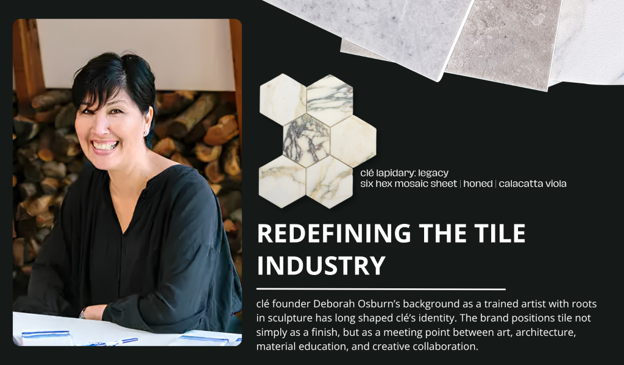
Osburn has argued that the industry too often reduces stone to a generic building material. Her Lapidary collection takes the opposite view, drawing attention to veining, color shifts, fossils and geological formation, then presenting those characteristics through mosaic and sculpted formats.
The inspiration is deliberately broader than interiors. Osburn has said clé looks to fashion, art and cinematography when considering how stone might be presented.
That is a useful design lesson in itself. Instead of specifying stone only because marble feels luxurious or limestone feels neutral, look closely at the actual slab or tile. What direction does the veining create? How much contrast is present? Does a mosaic break the stone into something graphic, or would a larger format better preserve its geological movement?
The material should be doing something specific.
The Point Is Not Imperfection For Its Own Sake
It would be easy to reduce the renewed interest in handmade and artist-designed tile to a reaction against mass production.
clé’s work suggests something more useful.
The value is not simply that something looks handmade. It is that the making process can create possibilities standardization cannot: deeper glaze, unusual geometry, layered pigment, geological variation, metallic movement or a pattern that carries an artist’s recognizable point of view.
Osburn shared, looking back, she might have leaned even further into artist collaborations and material experimentation, reflecting that the future of handmade tile, then, may not depend on preserving an old aesthetic.
It may depend on giving artists, designers and material specialists enough freedom to keep changing what tile can be.
Find a Home-Based Business to Start-Up >>> Hundreds of Business Listings.