









































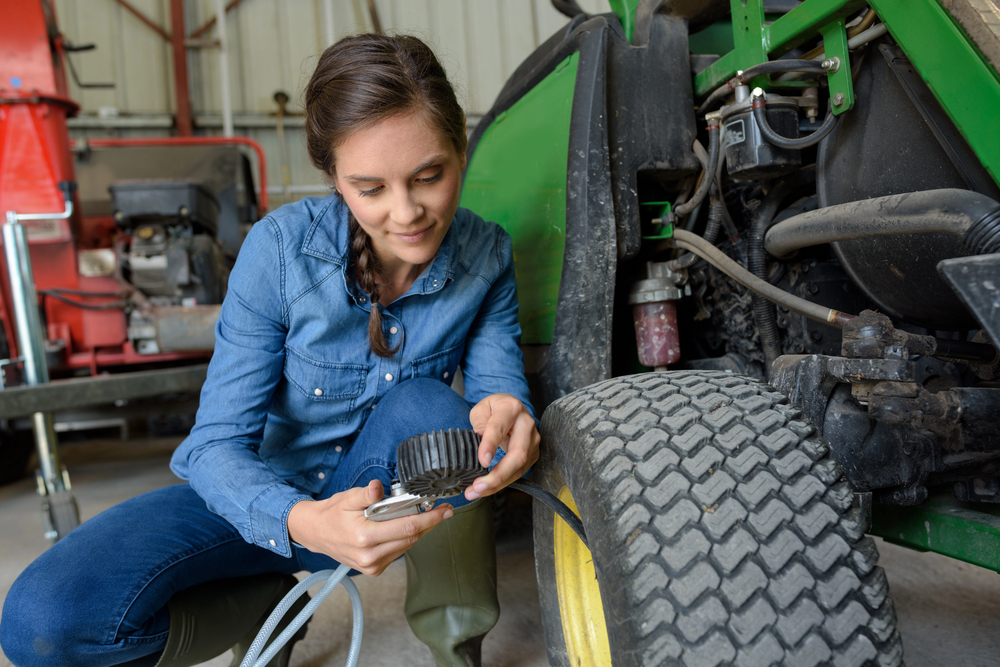
A John Deere lawn tractor that won’t start can stop your whole day. This guide will help you get moving again. We’ll walk through the steps in order, starting with the easy checks before moving to harder ones. By going step by step, you can find out exactly what’s wrong with your tractor and fix it. Let’s get your machine running.
What Happens When You Turn the Key?
The first step is to listen and watch what your tractor does when you turn the key. What you see and hear tells you where to look. When you turn the key, does the engine spin (try to turn over) but never actually start? Or do you hear just a click, or nothing at all? Your answer puts the problem into one of two groups: an electrical problem, or a fuel and spark problem.
3 Reasons Why Your John Deere Won’t Crank
If you turn the key and hear a click or complete silence, the problem is almost always electrical. The engine isn’t getting enough power to turn over. Pay attention to the sound first: complete silence usually means a safety switch or a dead battery, while a single click usually means a weak battery or a bad solenoid. Here are the three most common causes of why your John Deere lawn tractor won’t work.
1. Is the Battery Dead?
A dead or weak battery is the number one reason a tractor won’t crank. The battery has to hold enough power to spin the starter motor. Over time, batteries wear out, especially after sitting all winter or if you left a light on by accident.
“A healthy battery is the heartbeat of your tractor’s electrical system.”
To check it, use a multimeter set to DC voltage. A fully charged battery should read 12.6 volts or higher when it’s just sitting there. A reading between 12.4 and 12.6 volts means the battery is only partly charged but may still start the engine. Below 12.0 volts, the battery is too weak to crank the starter and needs charging or replacing. Also check the battery terminals for any white or green build-up. Clean, tight connections are a must for power to flow.
2. Are Your Safety Switches Engaged?
Your John Deere has several safety switches that stop it from starting by accident. If even one of these isn’t set right, the tractor won’t crank. This is on purpose — it keeps you safe. The main safety switches are:
- PTO (Power Take-Off) Switch: Must be off or disengaged.
- Brake Pedal: Must be pushed down all the way.
- Seat Switch: You must be sitting firmly in the seat.
Before you think something big is broken, always double-check these first. A switch can also wear out and fail on its own. If you think a switch is bad, you can test it with a multimeter for continuity. When a small part like a safety switch or ignition switch stops working, using reliable aftermarket John Deere parts is a smart way to fix the problem without spending too much.
3. What About the Starter Solenoid?
The starter solenoid is a small part that works like a switch between your battery and the starter motor. When you turn the key, the solenoid sends a big burst of power to the starter. If the solenoid is bad, you’ll often hear one sharp “click” when you turn the key, but the starter won’t spin. That click is the solenoid trying to work, but not making it. Testing a solenoid takes a bit more work, but if your battery checks out fine and your safety switches are set correctly, the solenoid is the next thing to look at.
3 Reasons Why Your John Deere Cranks But Won’t Start
If your engine spins with plenty of energy but never actually fires up, the problem is with one of the three basics needed to run: fuel, spark, or air.
1. How to Check for Fuel Problems?
Your engine needs a steady supply of clean, fresh gas to run. Fuel problems are very common, especially if your tractor has been sitting for a while.
Start with the easiest check: is there gas in the tank? If yes, is it old? Gas can go bad in as little as 30 days. It loses its power to burn and leaves behind sticky gunk that clogs up the fuel system. If the gas is old, drain it out and put in fresh gas. Next, check the fuel filter. This small part keeps dirt out of the carburetor. If it looks dirty or blocked, swap it out. A clogged fuel filter is a common cause of a John Deere riding mower starting problem. Finally, the tiny holes inside the carburetor can get plugged up with old fuel gunk. Cleaning the carburetor often fixes starting issues that don’t go away after new gas and a new filter.
2. How to Verify You Have Spark?
The spark plug is what lights the fuel and air mix inside the engine. If there’s no spark, or the spark is weak, the engine won’t start.
“No spark, no start. It’s that simple.”
The easiest and safest way to check for spark is with a spark tester tool. You connect it to the plug wire and ground it to the engine. When you crank the engine, the tester will light up or flash if there is spark. This is much safer than the old trick of holding the plug against the engine by hand, since ignition coils can push out over 20,000 volts. If there’s no spark, the problem could be a dirty spark plug, a bad ignition coil, or a damaged plug wire. Changing a spark plug is easy. If you find that the ignition coil is the problem, using quality aftermarket John Deere parts is a good way to get a lasting fix.
3. Is the Engine Getting Enough Air?
The last thing your engine needs is air. The air filter keeps dust, grass, and other junk from getting sucked into the engine. Over time, this filter gets clogged and can choke the engine, blocking the air it needs to start. Just pop off the air filter cover and take a look. If the filter looks dirty, packed with grime, or damaged, put in a new one. This is one of the cheapest and easiest fixes for an engine that won’t start.
Conclusion
By carefully checking the battery, safety switches, fuel, spark, and air, you can solve most starting problems on a John Deere lawn tractor. This step-by-step method helps you find the problem yourself, saving both time and money. If you’ve been through all these steps and your tractor still won’t start, the problem may be deeper, like low engine compression or a wiring fault further inside. At that point, it’s a good idea to bring in a professional mechanic.
Find a Home-Based Business to Start-Up >>> Hundreds of Business Listings.