










































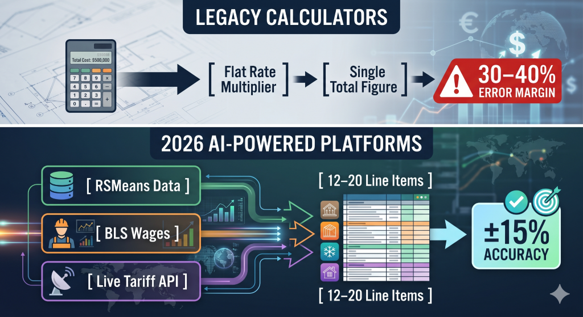
If you are relying on a traditional cost-per-square-foot construction calculator in 2026, your estimates may not fully reflect current material costs, labor conditions, or project complexity. Relying on those legacy, flat-rate formulas means your upfront estimates are likely missing true project execution realities by 30% to 40%. Traditional calculators use a frozen, static math structure that completely breaks under macro supply chain pressures.
Several AI estimating platforms expanded their capabilities in 2026. These next-generation construction cost calculator are designed to improve conceptual budgeting by incorporating labor data, material pricing, and project-specific variables. These advanced tools generate conceptual budgets that may fall within approximately ±15% to ±25% of final project costs when provided with sufficient project information.
By analyzing the market’s current tariff landscape, these platforms instantly account for severe material shifts:
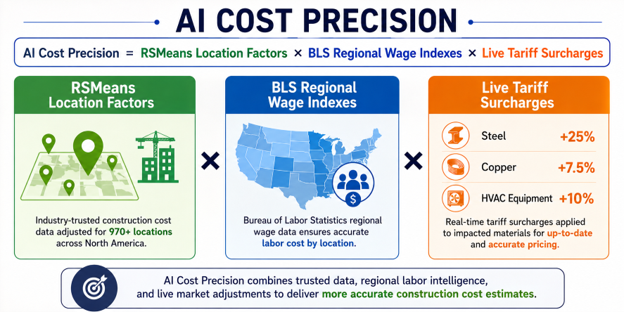
2026 Tariff Surcharges: Structural steel up 25%, raw copper up 7.5%, and commercial HVAC equipment up 10%. On a standard 2,000-square-foot residential build, these specific regulatory burdens inject an unexpected $8,000 to $22,000 penalty that traditional tools completely ignore.
Breakdown: Legacy Formulas vs. 2026 Document Intelligence
To understand why traditional estimators fail—and how AI calculators help—we must look at how data is processed. Legacy software flattens market volatility into a national average, forcing the contractor to absorb the real-world variance.
Side-by-Side Architectural Blueprint Performance
| Budgeting Metric | Legacy Core Calculators | AI-Powered Systems (2026) |
| Bidding Accuracy | 30% to 40% baseline error | 15% to 25% tight precision |
| Output Granular Depth | 1–2 vague, total project sums | 12–20 independent line items |
| Generation Speed | Instantly pulled from flat data | Under 60 seconds via document upload |
| Tariff Integration | ✗ No live trade adjustment data | ✓ Automated (Steel, copper, HVAC tracking) |
| Geographic Filtering | Static state-level adjustments | 51+ US municipal cost models |
The Anatomy of a 2026 Cost Failure
Relying on old calculation models exposes preconstruction teams to structural project failures driven by three primary market realities:
1. Geopolitical Inflation Spikes:
Recent energy-market volatility and supply-chain disruptions have contributed to construction cost uncertainty.
2. Extreme Regional Variances:
Standard residential base builds swing aggressively by territory, sitting at $110 to $160 /sq ft across Midwest jurisdictions while climbing to $120 to $180 /sq ft in Southern regions. Generalized calculators erase these margins.
3. The Ripple Effect:
Missing an early tariff spike doesn’t just lower your immediate margin; it ruins client trust through surprise change orders, delays procurement, and increases your overall exposure to budget overruns before a shovel ever touches the dirt.
The Three-Tier Architecture Behind AI Precision
Modern AI calculators don’t use arbitrary algorithms; they demonstrate how AI calculators help by processing conceptual figures through dynamically filtering project files across three distinct industry data layers:
-
Layer 1: RSMeans Cost Data:
Connects directly with the sector’s most reliable cost indexing network, utilizing more than 30,000 hours of specialized annual research mapped across 970 North American hubs.
-
Layer 2: Bureau of Labor Statistics (BLS):
Dynamically tracks regional adjustments across unionized and open-shop trade labor categories.
-
Layer 3: Live Market APIs:
Actively applies current macro regulatory adjustments to materials like steel, copper, and primary mechanical assemblies.
Industry advocates argue that AI-assisted estimating can improve consistency by combining construction cost databases, labor benchmarks, and current material pricing into a single workflow.
Inside the AI Feature Set: What Estimators Need
If you are updating your front-office workflow this year, look for tools that incorporate these five features:
-
Auto-Refreshed Material Indices:
Live pricing tables capture intra-month market spikes, preventing major bid-day shocks if copper or structural lumber costs jump unexpectedly.
-
Tariff-Adjusted Logistics:
The tool automatically isolates components subject to trade penalties and itemizes their exact dollar impact on your bill of materials.
-
Multi-Jurisdictional Localization:
Adjusts baseline labor burdens, equipment rental dynamics, and regional permit fees across 51 major US metropolitan areas.
-
Granular Component Breakdowns:
Instantly organize your initial project data into a clear layout separating direct labor, raw materials, field equipment, and soft permit fees. This speeds up early project evaluations by 70% to 80% compared to a traditional manual takeoff.
-
Document Intelligence Interface:
Allows teams to drop project specs or early drawing sheets directly into a secure browser window to extract an actionable budget breakdown in under 60 seconds.
Preconstruction Protocol:
These AI-generated calculations are purpose-built for fast conceptual planning, early feasibility reviews, and initial client discovery calls. They are not final bids. Final fixed-price agreements must always be verified using binding, localized subcontractor quotes.
2026 Preconstruction Tool Landscape
The following tools represent examples of AI-assisted estimating platforms that demonstrate how AI calculators help streamline estimating workflows. Features, pricing, and accuracy claims should be independently verified before adoption.
| Platform Tool | Launch Timeline | Estimated Variance | Primary Target Fit | Cost Structure |
| Contractor+ | Upgraded 2025 | 15% to 25% | Specialty Subcontractors | Free utility trial plus custom tiers |
| BuildStackHub | April 2026 | 15% to 25% | Fast Conceptual Planning | Freemium; $\$199$ specialized reporting |
| Buildxact AI | Established 2024 | 15% to 25% | Residential Custom Builders | Fixed monthly subscription tiers |
| BUILDWISE | Released 2026 | 15% to 25% | Light Commercial Projects | Scalable per-user structures |
| BuildCost.io | Released 2026 | 15% to 25% | 50-State Property Developers | Free public engine access |
Your 3-Step Action Plan to Prevent Budget Blowouts
To safely implement AI-driven cost calculation without disrupting your core business operations, follow this phased integration plan:
1. Execute a Controlled Back-Test
Before deploying any new software in front of a client, run a verification test using completed projects:
[Select 3 Completed Projects] ──> [Upload Original Proposal Data] ──> [Verify AI Variance is Within ±8%]
If the tool’s generated metrics align within 8% of your actual historical costs, it is mathematically stable enough to handle your initial customer intake calls.
2. Transition Early Budgeting to AI
Stop spending hours manually building spreadsheets for clients who are just testing the waters. Use 12-to-20 line-item AI estimates to qualify leads, establish realistic budgets, and set expectations in under 60 seconds.
3. Deploy Material Escalation Clauses
Never let a market spike eat your profits after you win a project. Protect your estimates by pairing your real-time AI data with standard protection clauses (such as the ConsensusDocs 200.1 amendment) for volatile commodities like steel and fuel.
Many industry observers expect leading software tools to narrow the remaining gaps in detailed automated unit pricing by late 2026. Firms that begin evaluating AI-assisted estimating workflows and modern construction cost calculator solutions today may be better positioned to benefit from future advancements in construction technology and understand how AI calculators help improve pricing accuracy and decision-making. The choice isn’t whether you will integrate AI data workflows—it is whether you will do it before your competitors out-price you.
Find a Home-Based Business to Start-Up >>> Hundreds of Business Listings.