









































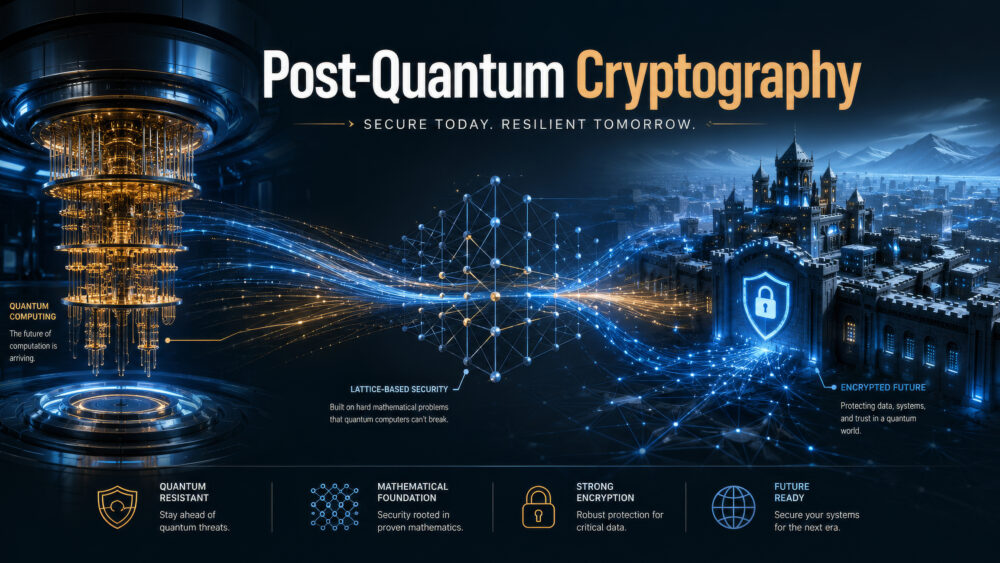
Only a small percentage of small businesses nowadays are worried about the imminent danger that quantum computing poses to their security.
They’re also not wrong for thinking this way. The term “Quantum computing” usually leads most SMB owners to imagine a supercomputer stored in a government safehouse. Typically, this is a big-company problem for them.
But the reality is different, and quite uncomfortable.
Attackers don’t care about the size of your company. Whether you’re running a five-people team or a 5000-strong enterprise, all attackers care about is how easy your system is to crack. With the IT world moving toward a time where quantum computers will rule, Post-Quantum Cryptography (PQC) becomes everyone’s problem.
The public-key distribution model, which sets the standards for today’s digital security, is running on borrowed time. When quantum computing takes over, security as we know it today will be outdated.
Here’s what’s important for small businesses in today’s IT landscape, where the agility of your security is the utmost need.
“Harvest Now, Decrypt Later” Is Already Happening
There’s a strategy circulating in cybercriminal circles called “Harvest Now, Decrypt Later” (HNDL). The idea is simple and deeply unsettling.
Attackers steal your encrypted data today, even though they can’t read it yet, and they wait. They store it. They sit on it until quantum computers become powerful enough to crack the encryption wide open.
Think about what that means in practice:
- A boutique financial firm’s client tax history.
- A regional manufacturer’s proprietary product designs.
- A small clinic’s patient records go back years.
This data looks useless to an attacker right now. Give it five years? It becomes a goldmine.
This isn’t theoretical. It’s already a documented concern flagged by U.S. intelligence agencies. Harvesting is underway now, even though decryption is still a few years away.
Why is PQC Becoming More Important?
Public-key cryptography, which sets the standard for today’s security, is quickly becoming outdated. That’s not simply a rumor. Experts across the national security and cryptography spaces share this opinion.
Security based on public-key cryptography could be broken somewhere around 2029 or 2031. Some estimates push that window earlier.
For a small business, a five-year window sounds comfortable. But, it’s not. Here’s why:
So, if your business is buying a networking appliance or a firewall today that isn’t quantum-ready, you’re locking yourself into hardware that will need a forklift replacement ahead of its expected lifecycle. That’s expensive and disruptive, and it’s entirely avoidable if you make smarter purchasing decisions right now.
Additionally, compliance requirements are starting to shift. Regulations like HIPAA, PCI-DSS, and a growing wave of state-level data privacy laws are beginning to reference NIST-approved post-quantum cryptography (PQC) standards.
What is now a best practice can soon become a legal obligation for small businesses and enterprises alike. Cyber insurance providers are watching this closely, too. Businesses that ignore the transition could find themselves uninsurable or non-compliant within the decade.
You Don’t Need an Enterprise Budget to Get This Right
The good news is that preparing for post-quantum threats doesn’t require hiring a cryptographer or exhausting your IT budget. There’s a practical playbook for small businesses, and it starts with three straightforward moves.
Focus On Your Most Sensitive, Long-Lived Data First
Not everything you store carries equal risk. Historical client PII, long-term contracts, proprietary designs, and financial records that span years; these are your highest-priority targets. Identify what an attacker would love to have in ten years, and protect that first.
Look For Crypto-Agility In The Tools You Buy
Crypto-agility basically means your security setup can swap out encryption methods without rebuilding your entire network from scratch. Think of it like upgrading the engine in a car without having to buy a whole new vehicle.
When evaluating firewalls or VPN solutions, ask your vendor whether their platform supports algorithm upgrades without forklift hardware changes.
Let Your Security Vendor Do The Heavy Lifting
This is the most underrated advantage small businesses have. You don’t need to understand lattice-based cryptography. You need a vendor that bakes quantum-resistant algorithms into the tools you already use.
How PQC Is Becoming More Accessible for Small Businesses
One of the biggest shifts in cybersecurity is how accessible the benefits of post-quantum cryptography have become for small businesses. Modern security platforms now integrate PQC directly into their core systems, eliminating the need for expensive add-ons or complex upgrades.
A key advancement is hybrid encryption, which combines classical methods like Diffie-Hellman with post-quantum algorithms such as ML-KEM. This ensures continuous protection, even if one method faces compatibility issues.
Performance concerns are also being addressed through hardware acceleration, allowing businesses to adopt post-quantum cryptography without slowing down VPNs or network operations.
Finally, user-friendly dashboards make it easy to configure quantum-safe settings without deep expertise.
For SMBs, this means adopting future-ready encryption without risking operational disruption or relying entirely on unproven algorithms.
Ultimately, the barrier to entry for post-quantum readiness is falling. SMBs no longer need to wait or assume this is a “future problem.” With integrated platforms, hybrid encryption models, performance optimization, and simplified management, preparing for the quantum era is becoming both practical and achievable, starting today.
Start Now, Not When Everyone Else Panics
Post-quantum readiness for small businesses functions as a long-term risk safeguard. But starting early into the transition allows enterprises to gradually integrate upgrades into their regular hardware refresh cycles. This process keeps the costs manageable and disruptions at bay.
On the contrary, delaying action until the end of the decade, when urgency peaks, can result in rushed, expensive replacements alongside widespread market demand, driving up costs and stretching timelines.
A practical first step is to assess whether the current security infrastructure supports crypto-agility and hybrid key exchange for VPNs. In many cases, these capabilities can be enabled through configuration updates rather than new hardware.
Once considered complex and costly, quantum-safe security is becoming more accessible, enabling small businesses to achieve strong protection without extensive resources or large IT teams.
Cyber threats do not depend on company size; security readiness should not either.
Find a Home-Based Business to Start-Up >>> Hundreds of Business Listings.