









































When entrepreneurs look for their next venture, they tend to chase whatever is new — apps, AI, e-commerce. Yet some of the most durable businesses are built the opposite way: by taking a very old industry and quietly fixing the part of it that everyone else accepts as broken. Shipping is a textbook case and presents a significant opportunity in crew management. Vessels have carried goods across oceans for centuries, but the way ships find their crews remained, until recently, a slow craft of phone calls, fax machines, and layers of local agents.
That gap is where Marine MAN found its business. Founded by entrepreneur Pavel Manchenko, the company began as a classic ship and crew management firm and has spent nearly two decades placing officers and ratings on vessels around the world. What makes its story interesting for anyone building a business today is not the maritime setting itself, but the playbook: deep niche expertise first, technology second.
Learn the Industry Before You Try to Disrupt It
Many founders attempt to modernize a market from the outside and discover that they never understood why it worked the way it did. Manchenko took the opposite route. Marine MAN operated for years inside the traditional crewing model — verifying seafarer certificates, arranging contracts and travel, planning crew rotations — before attempting to digitalize any of it. By the time the company built its own platform, it knew precisely which steps in the process created delays and which safeguards could never be automated away.
That operational knowledge is baked into the services the company offers today. Its Crew Management practice covers the full employment cycle of a seafarer: sourcing and vetting candidates, checking qualifications against international requirements, handling contracts and payroll, organizing visas and flights, and lining up a qualified replacement before each contract runs out. In shipping, where an idle vessel burns money by the hour, this kind of reliability is the actual product — the software is just how it gets delivered.
The Platform: Jobmarineman.com
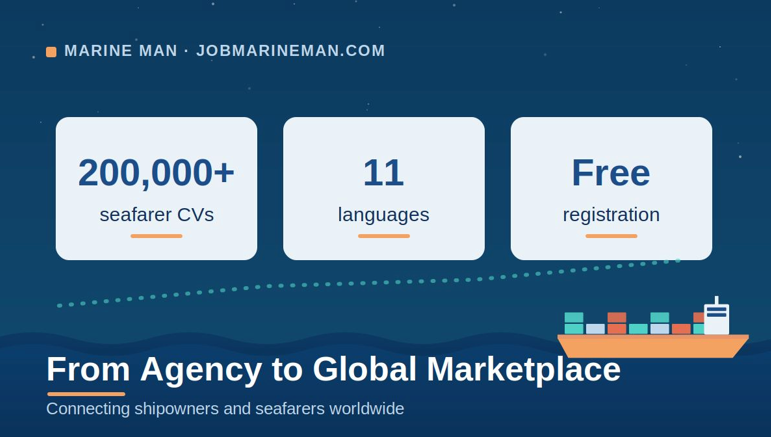
The digital arm of the business is jobmarineman.com, an online crewing marketplace that connects vessel operators directly with seafarers. The numbers illustrate how much demand was waiting for a better tool: the platform hosts a talent pool of roughly two hundred thousand seafarer profiles, works in eleven languages, and covers every rank and vessel category, from cargo fleets to offshore and cruise ships. Signing up costs nothing for either side, a deliberate choice that lets small operators and individual mariners try direct recruitment without any upfront commitment.
For Marine MAN, the platform also solved a scaling problem familiar to any service entrepreneur: a traditional agency grows only as fast as it can hire recruiters, while a marketplace grows with its user base. The company still provides hands-on management for clients who want it, but the database now does the heavy lifting of matching people to ships.
Lessons for Business Builders
Three takeaways from the Marine MAN story translate well beyond shipping. First, unglamorous industries hide the best openings — the less a market has been touched by software, the more value the first well-built tool creates. Second, trust is a feature you cannot skip: in crewing, a single unverified certificate can ground a vessel, so document verification became the core of the product rather than an afterthought. Third, going multilingual early widened the funnel dramatically; a seafarer in Indonesia and a shipowner in Northern Europe meet on the same platform because neither has to work in a foreign language.
Manchenko’s venture also shows that longevity itself compounds. Two decades of relationships with shipowners, training centers, and maritime administrations demonstrate the opportunity in crew management, giving Marine MAN a moat that a newly funded startup cannot copy with capital alone.
An Old Market, Still Wide Open
Find a Home-Based Business to Start-Up >>> Hundreds of Business Listings.