






































Home-business owners running a home office face a recurring question. Should they spend modestly on flat-pack furniture and replace every 4 to 6 years, or invest once in custom solid wood that lasts 20 years? The right answer depends on the work, the workspace, and the tax position. The framework below covers when custom solid wood furniture earns its premium.
A home-office build-out is the fit-out decision a home-business owner makes when transitioning from a kitchen-table setup to a dedicated workspace. Most owners weigh flat-pack chains against custom makers like Parkman Woodworks when sizing the budget. The trade-off is real and worth thinking through deliberately.
Why Does Office Furniture Choice Matter for Home-Business Owners?
A home-business office is the workspace a sole proprietor or small-team operator uses daily. The custom wood office furniture decision affects three things: posture, productivity, and total cost of ownership.
Posture sets the daily quality of the work. A well-built desk at the right height, paired with an ergonomic chair, prevents the slow accumulation of back and shoulder strain that quietly degrades focus across a 6-month stretch. OSHA’s computer workstations ergonomics overview covers the framework workers should reference.
Productivity tracks the workspace’s psychological signal. A workspace that reads like a business reinforces the operator’s identity as a business owner. Coverage of creating a high-performance home office explores the same effect. The dressed-up effect is small per day but compounds across the year.
Total cost of ownership combines the purchase price with replacement cycles and tax treatment. Custom solid-wood office furniture sits at the higher end of the upfront curve but rarely needs replacing inside 15 years.
What Are the Practical Differences Between Custom Wood and Flat-Pack Furniture?
Five differences recur across the comparison.
- Custom solid-wood pieces use mortise-and-tenon, dowel, or dovetail joinery built to last. Flat-pack relies on cam locks and particleboard that loosen across 2 to 4 years of daily use.
- Solid hardwoods (walnut, oak, maple, cherry) gain character with age. Particleboard and MDF degrade visibly, particularly around screw holes and edges.
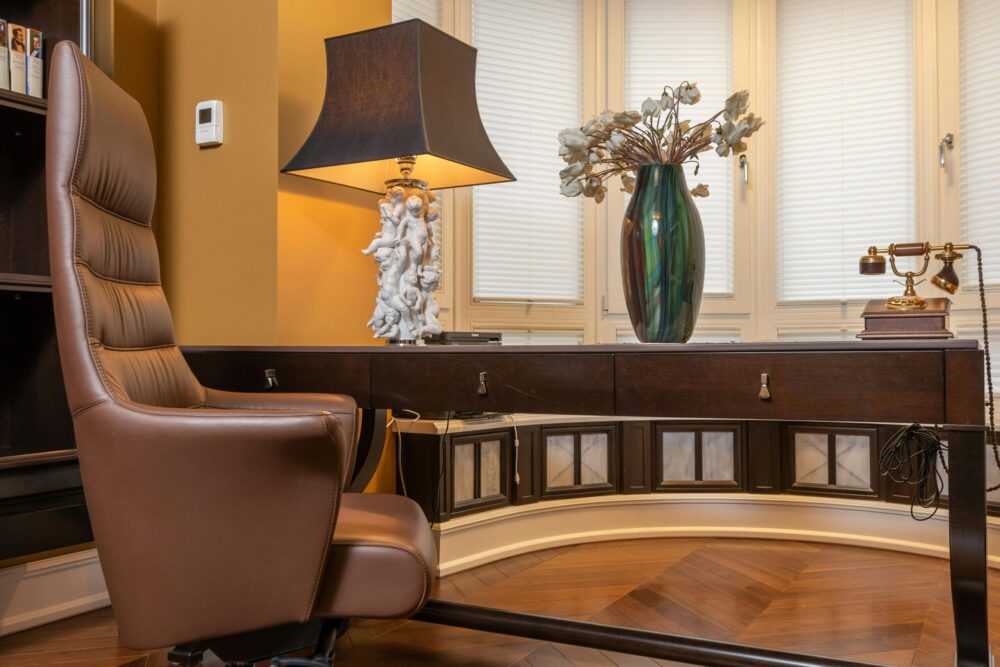
- Custom makers build to exact dimensions, surface finishes, and integrated cable management. Flat-pack offers fixed sizes only.
- A solid-wood desk can be sanded, refinished, and repaired indefinitely. A failed flat-pack joint usually means replacement.
- Custom solid-wood pieces hold 50 to 70 percent of value on the second-hand market. Flat-pack typically resells for under 20 percent.
How Should a Home-Business Owner Size the Furniture Budget?
A side-by-side view of the total-cost picture across a 15-year operating run sharpens the decision, particularly for owners elevating a home office for the new WFH reality.

| Factor | Flat-Pack Approach | Custom Solid-Wood Approach |
| Upfront cost (desk + storage) | $400 to $900 | $2,500 to $6,500 |
| Replacement cycles (15 years) | 3 to 4 cycles | 0 to 1 cycle |
| Total 15-year spend | $1,600 to $3,600 | $2,500 to $6,500 |
| Annual depreciation potential | Limited | Available under tax rules |
| Resale value at year 15 | Under $200 | $1,500 to $3,500 |
| Posture and ergonomics | Variable | Built to dimension |
The 15-year total is closer than the headline upfront prices suggest. The IRS’s home office deduction overview covers the tax framework home-business owners should reference when modeling the deductibility of furniture as a business expense.
What Are the Common Furniture-Selection Mistakes?
A furniture-selection mistake is a decision that creates avoidable friction across the daily work or the long-run cost picture. Five recur for home-business owners.
The first is the wrong-size desk. A desk too small for the actual work surface forces clutter, slows task switching, and reduces the workspace’s usability. Measuring the planned workflow before ordering prevents the issue.
The second is the wrong chair pairing. A premium desk paired with a budget chair undermines the ergonomics investment. The chair often deserves more weight in the budget than the desk does.
The third is the cable-management afterthought. Custom desks can integrate cable trays, grommets, and routing channels. Flat-pack rarely does, and aftermarket cable kits read messy.
The fourth is the lighting mismatch. Natural light and task lighting both shape how the workspace feels across the day. Custom builds can accommodate the lighting plan; flat-pack imposes its own constraints.
The fifth is the storage shortfall. A desk without integrated drawers or matching credenza forces visible clutter or a second-purchase scramble. Planning the full setup before ordering avoids the gap.
A Quick Reality Check Before the Furniture Purchase
- Measure the workspace twice and the planned workflow once before ordering
- Pair the desk investment with a chair budget that matches its quality tier
- Confirm the maker’s lead time before committing to a project deadline
- Document the purchase for the home-office tax deduction
- Plan the lighting and cable management alongside the furniture
The Honest Bottom Line on Home-Office Furniture
Custom solid-wood office furniture earns its premium under three conditions. The home business is operating for the long haul, the operator works at the desk daily, and the workspace doubles as a client-facing or video-call environment. The break-even point usually sits around year 8 to 10 against repeated flat-pack replacement cycles. Home-business owners who buy once at the upfront premium almost always look back at the decision favourably across a decade of daily use. The discipline is in choosing a maker that builds to the planned workflow rather than imposing a stock configuration.
Frequently Asked Questions
How Long Does a Custom Wood Desk Take to Build?
Most custom makers quote 6 to 14 weeks from order to delivery, depending on the wood species and the complexity of the build. Plan the order timing around the actual workspace transition.
Can a Home-Business Owner Deduct Office Furniture Purchases?
Yes, in most cases. Furniture used exclusively for the home-business operation generally qualifies as a deductible business expense or capital purchase. The exact treatment depends on the operator’s tax structure and is worth confirming with a CPA.
What Wood Species Holds Up Best for Daily Office Use?
Walnut, oak, and maple are the three most common choices for daily-use desks. Walnut reads warmer and shows scratches less. Oak handles heavy use without denting. Maple is the most uniform finish and matches modern interiors cleanly.
Is Custom Furniture Worth It for a Two-Year Home-Business Run?
Usually not. The break-even on the upfront premium sits around year 8 to 10. A short-run operation is better served by mid-tier flat-pack or refurbished commercial-grade furniture from the secondary market.
Find a Home-Based Business to Start-Up >>> Hundreds of Business Listings.