











































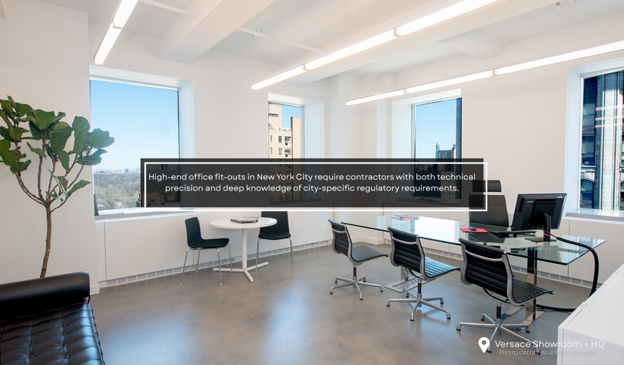
Office fit-outs fail for predictable reasons. Subcontractors show up out of sequence. Permits stall because no one tracked the approval window. The general contractor goes quiet for three days during a critical phase. By the time leadership notices, the project is two weeks behind and the lease clock is already running.
Signing a commercial lease in New York City is the easy part, but as any business owner researching the factors to consider before signing a commercial lease will know, the real complexity begins once the space has to be planned, permitted, built, and delivered on time.
And these problems compound fast. Building management has rules. The Department of Buildings has requirements. Neighboring tenants have attorneys.
A fit-out that runs smoothly in another market can fall apart here without the right contractor managing it.
This guide is for business owners, operations leads, and developers evaluating NYC office fit-out contractors and the top NYC contractors, and what to look for before you sign.
What an Office Fit-Out Contractor Actually Does
The term “fit-out” covers a wide range of scope. At the basic end, it means reconfiguring an existing space, moving walls, updating finishes, installing new lighting.
At the complex end, it means building a fully custom office from raw shell, coordinating every trade from framing through the final punch list.
In either case, the contractor’s job is execution. That means:
- Managing subcontractors across electrical, mechanical, plumbing, carpentry, and specialty trades
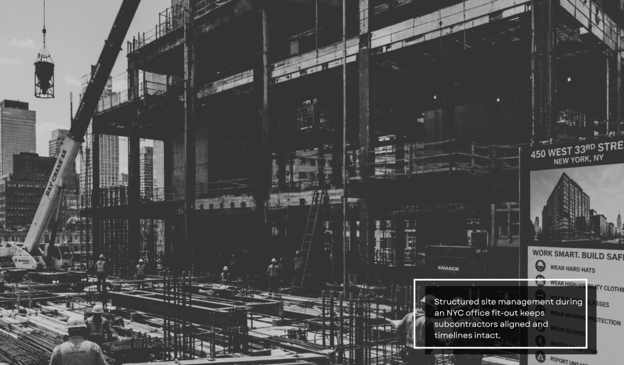
- Coordinating on-site sequencing so each trade works in the right order without blocking the next
- Tracking materials and lead times to keep deliveries aligned with installation schedules
- Communicating with building management on access, freight elevator reservations, noise restrictions, and after-hours work approvals
- Pulling permits once filings are approved by the architect of record
- Troubleshooting in real time when something in the field doesn’t match the drawings
1. Blueberry Builders: Fit-Outs for High-Standard Commercial Spaces
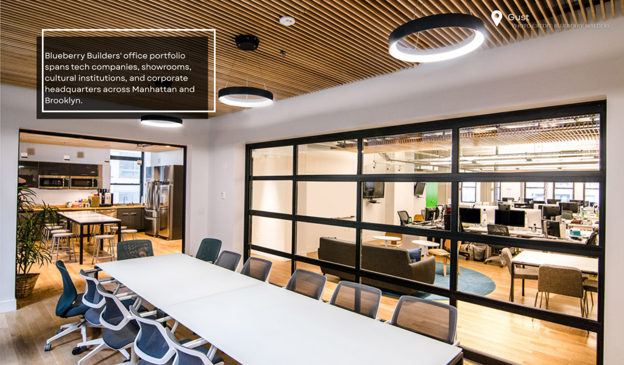
For businesses and developers who need a office fit-out contractor that executes to a high standard without the overhead of a large national firm, Blueberry Builders occupies a well-defined position in the NYC commercial construction market.
Blueberry Builder’s track record of commercial construction NYC developers trust spans luxury retail, office, hospitality, and adaptive reuse projects across Manhattan and Brooklyn. The remaining four entries cover complementary specialisms across the contractor market.
The office portfolio reflects the breadth of what that looks like in practice.
Projects include the Versace showroom build-out, the HG Stones showroom and office, Grovo, Gust, the Brooklyn Historical Society, and Zeta Global, spanning technology companies, high-end retail environments, cultural institutions, and corporate workplaces.
Each project involves a different set of spatial, regulatory, and brand requirements, and the consistency of execution across that range is what establishes confidence for a prospective client.
From a compliance standpoint, Blueberry Builders carries strong insurance coverage accepted in most NYC commercial buildings, including Action-Over coverage with no Labor Law exclusion, and site supervisors hold OSHA 62-hour SST certification.
For developers and tenants in class-A Manhattan buildings with specific insurance requirements, this is a practical qualification that shortens the vetting process considerably. The firm operates across Manhattan neighbourhoods including Tribeca, FiDi, Greenwich Village, and Midtown, as well as select Brooklyn locations including DUMBO, Downtown Brooklyn, and Williamsburg.
Best for: Growing businesses moving into new commercial space, developers fitting out tenant improvement projects, and brands requiring precise execution of architect-specified interiors in Manhattan and Brooklyn.
2. JRM Construction: Enterprise-Scale Fit-Outs for Major Tenants
JRM Construction Management is a well-established name in the NYC commercial interior market, with a client base that includes Fortune 500 corporations, major law firms, media and technology companies, luxury retailers, and financial services firms.
The firm operates primarily at the enterprise end of the market, handling large and complex projects where coordination between multiple trades, architects, and building management teams is a central operational challenge.
JRM’s project approach emphasises preconstruction planning, detailed cost management from schematic design through to construction documents, and full accountability for construction activities including subcontractor management and schedule reporting.
For large businesses relocating to new headquarters or fitting out major floor plates, their experience with tenant improvement projects of this scale is a meaningful differentiator.
The firm’s design-forward positioning reflects in its portfolio: a strong emphasis on biophilic elements, collaborative workspace design, and high-end interior finishes characterise their recent work.
Businesses that are scaling into larger commercial space and need a office fit-out contractor in NYC who can manage complexity and communicate clearly at the executive level will find JRM well-positioned for that conversation.
3. Shawmut Design & Construction: Multi-Market Expertise with Depth
Shawmut Design and Construction operates from offices in Boston, Chicago, New York, Miami, Las Vegas, and Los Angeles, and brings multi-market experience that benefits NYC clients with multi-location buildout programmes.
The firm has handled corporate interiors, broadcast studios, and institutional projects across New York, including work on Associated Press headquarters that earned LEED Gold certification and received recognition at the NYCxDESIGN Awards.
For growing businesses with a sustainability mandate or tenants pursuing WELL or LEED certification on their office fit-out, Shawmut’s credentialing in this area is a practical advantage. Their preconstruction process is structured around scheduling, cost transparency, and client communication, which suits clients who need regular reporting to internal stakeholders or board-level oversight.
Shawmut is better positioned for mid-to-large office projects rather than boutique or design-intensive smaller fit-outs.
For businesses at the stage where they’re fitting out multiple floors, coordinating with landlords and city agencies simultaneously, and need a contractor with institutional-grade project management infrastructure, the firm has the capacity and the systems to support it.
4. Structure Tone: Renovation and New Build Across Commercial Sectors
Structure Tone has been operating in New York since 1971 and covers a broad range of commercial construction sectors including retail, corporate interiors, healthcare, cultural institutions, and educational facilities.
Their experience with major project types includes work on Unilever’s headquarters and the Macy’s flagship store, reflecting capability at scale and complexity.
What makes Structure Tone relevant for growing businesses is their approach to renovation in occupied spaces.
Managing an office renovation or fit-out while a business continues to operate from the same building, or adjacent floors, requires specific sequencing, dust and noise control, and communication protocols that not all contractors manage effectively.
Structure Tone’s long history in this environment means those processes are embedded rather than improvised.
The firm’s sector breadth also makes them a practical choice for businesses in regulated industries such as healthcare, finance, or media, where construction work intersects with compliance requirements beyond standard DOB permits.
For developers fitting out mixed-use commercial properties, their ability to work across multiple building types within a single project scope is a practical efficiency.
5. Vanguard Construction: Experienced General Contractor for Diverse Commercial Scopes
Founded in 1986, Vanguard Construction operates as a New York City-based general construction and construction management firm across commercial, institutional, healthcare, hospitality, residential, and ground-up project categories.
Their long operating history in the city gives the firm familiarity with NYC’s regulatory environment and building management dynamics that can meaningfully reduce friction on complex commercial fit-outs.
Vanguard’s stated approach centres on proactive communication, daily site reporting, and advocating for clients in contractor and subcontractor relationships rather than simply managing them.
Businesses that lack an internal construction or facilities team, this orientation toward client representation rather than just execution is a practical advantage: the client has an informed advocate rather than a transactional vendor.
The firm’s breadth across project types means they bring relevant comparative experience to most commercial scenarios. A business fitting out a new office while also considering a future retail or hospitality space will find Vanguard capable across those categories without the need to build separate contractor relationships for each.
What to Look for in an NYC Office Fit-Out Contractor
When evaluating contractors for a commercial office fit-out in NYC, the criteria go beyond portfolio and price.
● Demonstrated Experience with Commercial Interiors in NYC
Office fit-outs sit at the intersection of technical construction and operational complexity. The contractor should have direct experience with commercial interior projects in New York City; not just residential work or ground-up construction. Ask about specific projects, building types, and neighborhoods. Vague answers are a signal.
● A Clear Process for Communication and Reporting
Construction phases can feel opaque to clients who are not on-site every day. A well-run contractor has a defined system for keeping decision-makers informed. That means regular updates, clear documentation of decisions and changes, and a single point of contact who knows the project in detail. Communication should be proactive, not reactive.
● Organizational Structure That Matches Your Project’s Scale
A solo operator handling a 1,000-square-foot suite and a mid-sized firm managing a full-floor build-out for a 200-person team are operating at different levels. The contractor’s organizational capacity should match the scope and complexity of your project. That includes staffing, subcontractor relationships, and the ability to manage multiple moving parts without dropping one.
● Transparency about Scope, Schedule, and Budget
Scope creep and budget overruns are not inevitable. They are usually the result of unclear agreements and poor documentation at the start. A reliable contractor defines scope precisely, identifies risks early, and communicates changes before they become problems. If a contractor is vague about how they handle change orders or schedule shifts, that vagueness will cost you later.
● Familiarity with the Filing and Permitting Process
Contractors cannot file with the Department of Buildings, that is the architect’s role. But a knowledgeable contractor understands the filing process well enough to stay coordinated with the design team, anticipate approval timelines, and avoid starting work that hasn’t been permitted. Ask how they handle the handoff between the architect’s filing and the start of construction.
How Construction Management Fits into an Office Fit-Out
For larger or more complex office projects, construction management adds a layer of oversight beyond standard general contracting.
The construction manager’s role is coordination and accountability across the full project. They work with the architect, the client, and every subcontractor to keep the schedule moving, surface problems before they compound, and ensure the finished space matches the design intent.
In New York City, that role is particularly valuable. The regulatory environment, the physical constraints of the city, and the pace of commercial real estate mean that projects without dedicated on-site leadership tend to drift. Construction management is how organized firms keep that from happening.
Blueberry Builders operates as both general contractor and construction manager for high-end commercial interior projects in New York City. The firm does not handle DOB filings, but works closely with architects and design teams throughout the build phase to keep execution on track
Questions to Ask Before Hiring
Before signing with any NYC office fit-out contractor, get clear answers to these:
- What commercial interior projects have you completed in New York City, and can you provide references?
- How do you manage communication with the client and the architect during the build phase?
- How do you handle changes to scope or schedule once construction is underway?
- What is your process for coordinating with building management?
- How do you stay aligned with the filing and permitting process without acting as the filing party?
- Who is the on-site point of contact, and how often will we hear from them?
The answers reveal how a contractor operates under pressure, which is when it matters most.
See how a structured construction process supports better execution.
The Standard Worth Holding
Office fit-outs in New York City are not simple projects. The regulatory environment is demanding, the physical constraints are real, and the financial stakes are significant. A contractor who treats the role as administrative coordination will not perform at the level the city requires.
The right contractor brings structure, accountability, and direct construction knowledge to every phase of the build. They communicate clearly, coordinate precisely, and protect your timeline as a professional obligation.
That standard exists in this market, and it is worth holding to when you are evaluating who to trust with your space.
Find a Home-Based Business to Start-Up >>> Hundreds of Business Listings.


