









































Every notification your team receives during deep work costs more than the second it takes to read it. Research consistently shows that after an interruption, even a brief one, it takes several minutes to return to full concentration on the original task. Multiply that by the average number of notifications a knowledge worker receives per day, across chat messages, email alerts, approval requests, and calendar reminders, and the attention tax your team is paying becomes one of the substantial invisible costs in your operational budget. The organizations that have solved this problem have not done it by asking people to be more disciplined. They have done it by building a workspace where every tool is designed to protect attention rather than fragment it. That starts with project management tools that give team members structural control over when and how they are interrupted.
Structured Notification Control with Lark Messenger
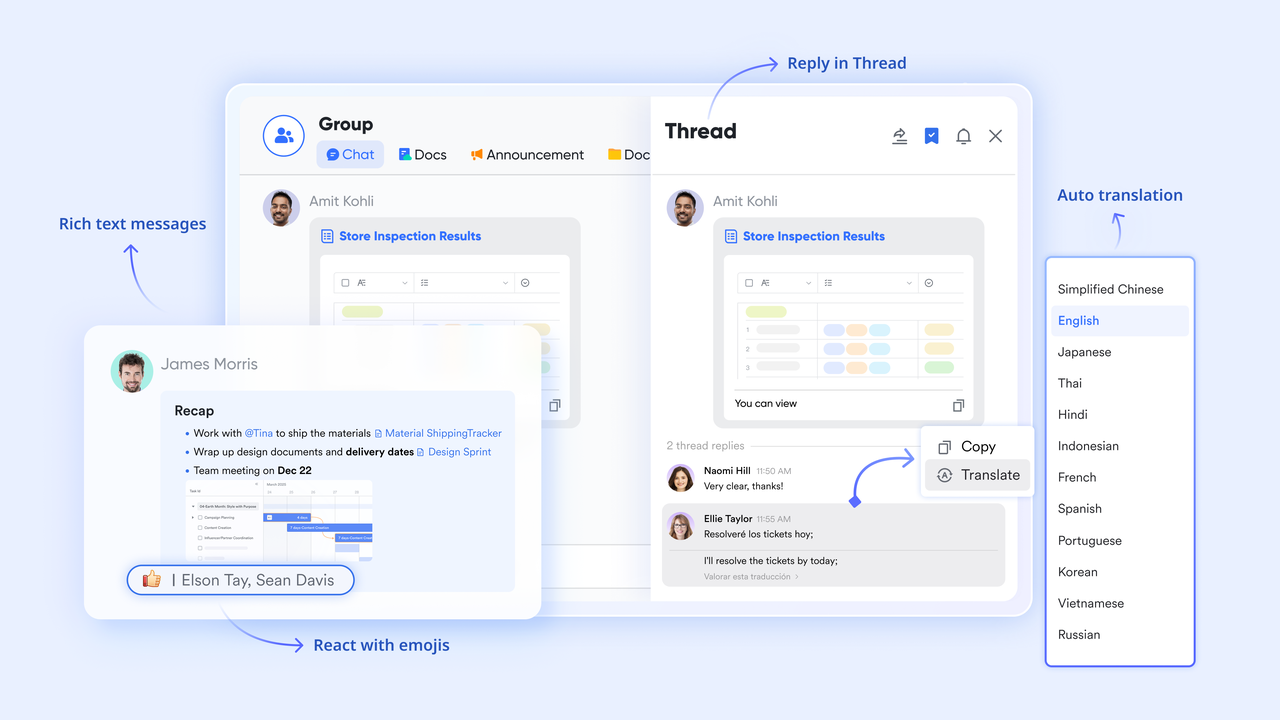
- Group folder organization with independent notification rules. Lark Messenger allows teams to organize every chat group into labeled folders, with separate notification settings for each folder. A team member can set urgent client folders to notify immediately while setting internal social channels to deliver summaries at set times, replacing an undifferentiated stream of alerts with a prioritized information flow that matches their working pattern.
- “Scheduled Messages” for time-aware communication. Team members can compose messages when a thought arises and schedule them to arrive at the recipient’s most useful moment, reducing the attention tax for your team. This breaks the implicit pressure to respond immediately to a message sent at an inconvenient time, allowing both parties to communicate on their own terms.
- “Read/Unread Status” replacing the follow-up ping. When a sender can see whether a message has been read, the reflexive follow-up message asking “did you see this?” becomes unnecessary. One notification replaces two, and the recipient is not interrupted twice for the same piece of information.
Replacing the Perpetual Data Refresh with Lark Base
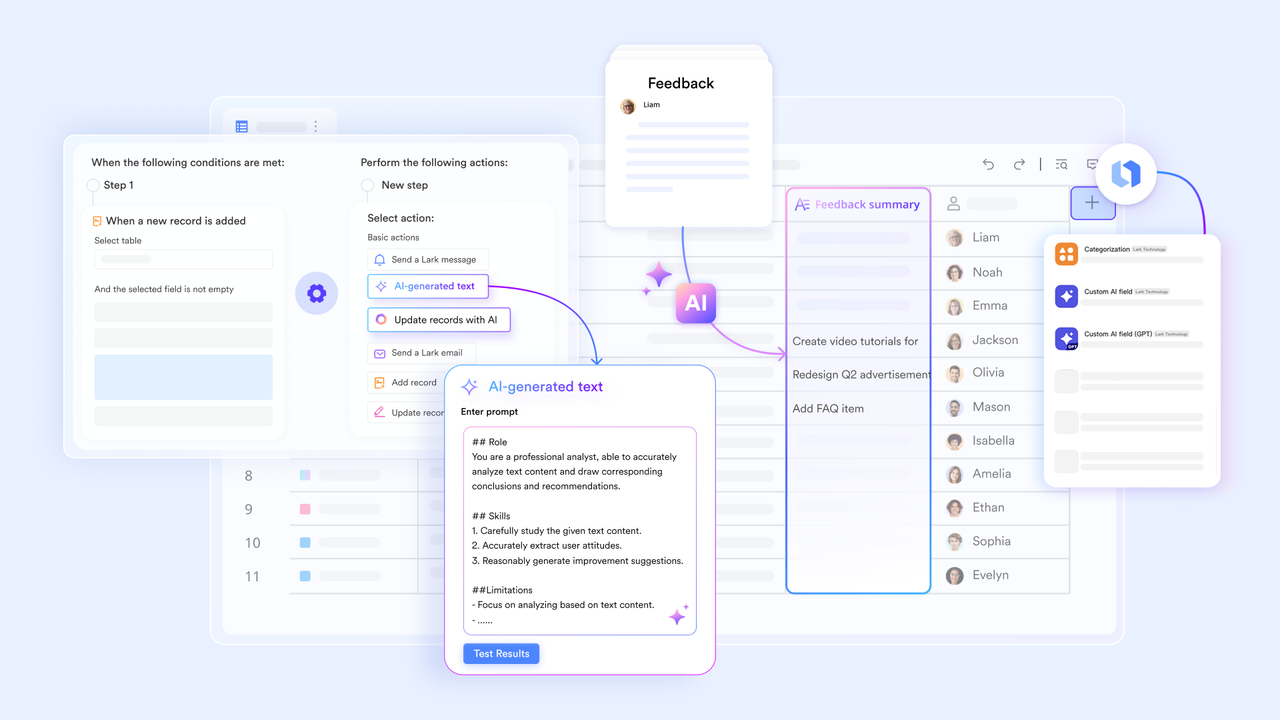
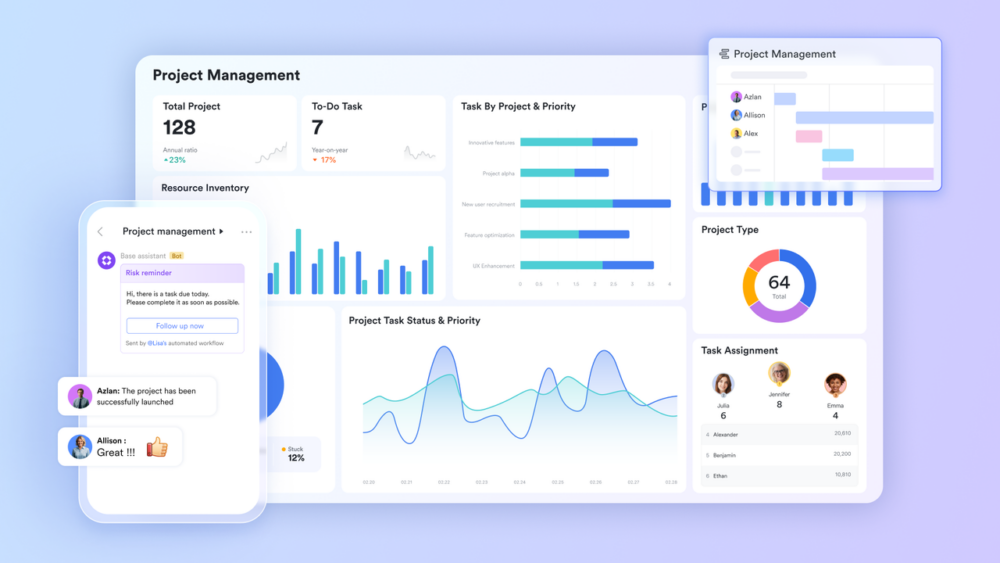
- Shared live dashboards removing the manual check-in cycle. When operational data updates itself in a shared Lark Base dashboard, team members stop refreshing spreadsheets and chasing status updates. The information they need is always current without them needing to interrupt a colleague to get it.
- Automated status-change notifications replacing manual broadcasts. When a record moves to a new stage in Lark Base, the system notifies exactly the right person automatically. The team member who needs to act on the change receives one targeted notification rather than a broadcast message to a whole group.
- “Personal task views” for distraction-free individual workflow. Each team member can maintain a personal filtered view of the shared operational database showing only their own current tasks. The noise of other teams’ records does not compete for their attention while they are focused on their own work.
Replacing Calendar Overload with Lark Calendar
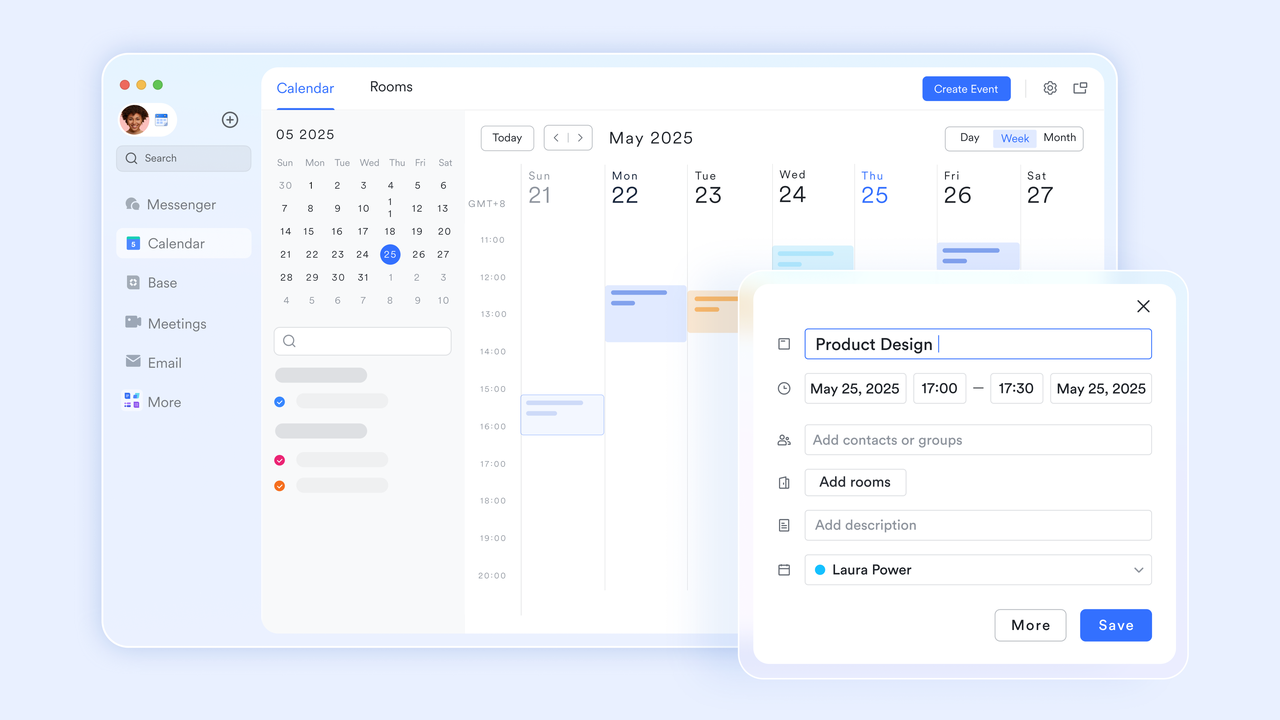
- “Calendar Subscription” replacing individual meeting invitations. When team members subscribe to a shared calendar rather than receiving individual invitations for every event, the volume of calendar notification emails drops dramatically. The schedule is always visible without a notification for each update.
- “Schedule in Chat” replacing the scheduling email chain. Finding a meeting time directly within a conversation thread removes the three to five email exchanges that typically generate as many notifications as the meeting itself. The coordination overhead that fragments attention before the meeting even happens is reduced to a single action.
- “Meeting Groups” replacing pre-meeting message scatter. Every calendar event generates a single linked group chat where all pre-meeting context is shared. Agendas, pre-reads, and links arrive in one place rather than as a sequence of individual messages in multiple channels in the days before the meeting.
Making Documentation a Focus-Friendly Activity with Lark Docs
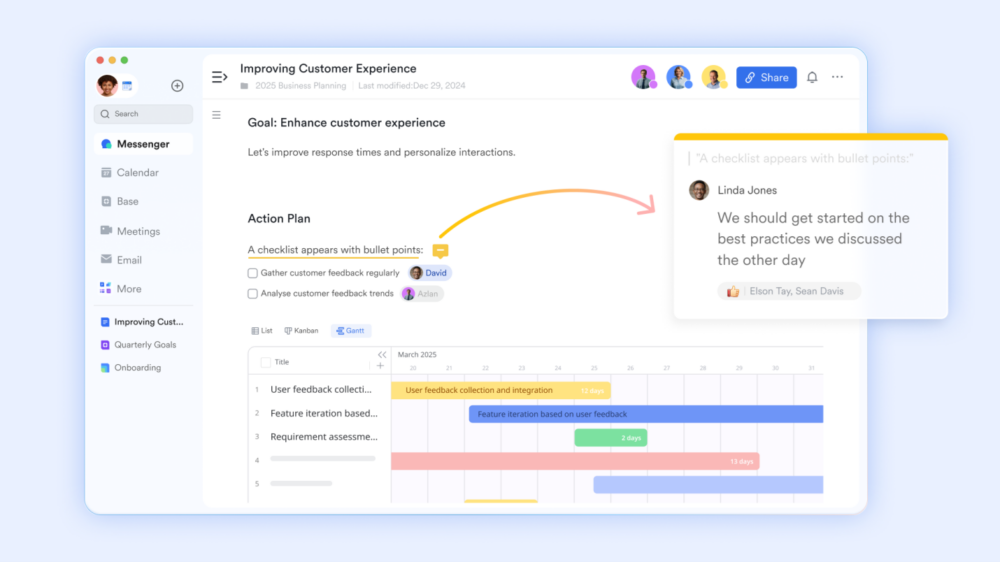
- Real-time co-editing replacing feedback request messages. When multiple contributors work in the same document simultaneously, the cycle of sending a draft, waiting for feedback, and receiving a notification for each reply is replaced by a single collaborative session. The document conversation happens in context rather than generating a parallel notification thread.
- “Comment” threads replacing out-of-context feedback messages. Reviewers leave comments on the specific part of the document they are addressing rather than sending a general message describing what they mean. The recipient gets one notification with full context rather than a message requiring them to find the relevant section before they can act on it.
- Document templates replacing the blank-page startup cost. When every standard document type has a template, team members spend zero time setting up structure before they can begin the actual work, reducing the attention tax for your team. The cognitive friction of starting a document from scratch, which often generates distraction-seeking behavior, is removed before it starts.
Keeping Strategic Clarity Visible Without Continuous Updates with Lark OKR
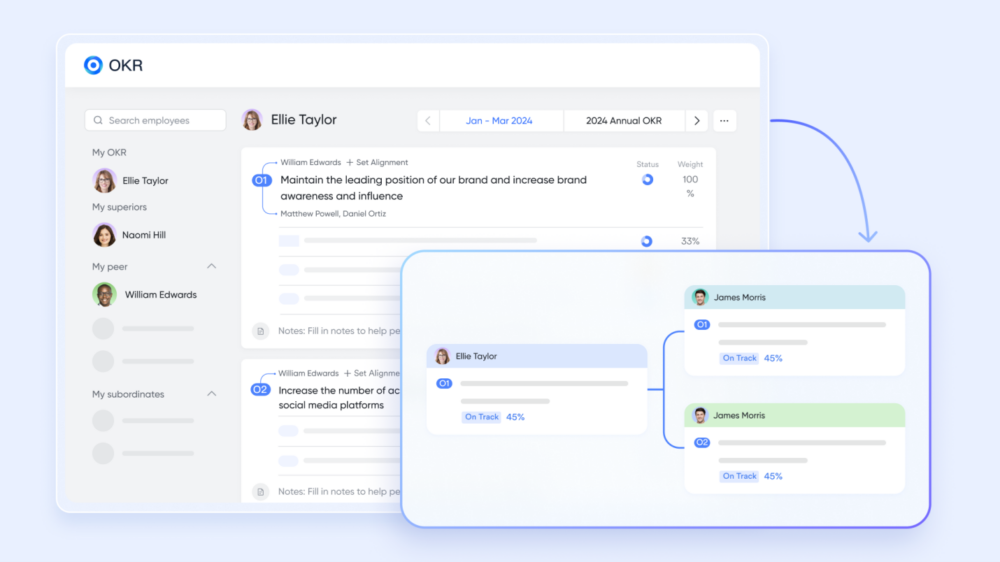
- Company-wide objective visibility replacing the strategy briefing message. When every team member can see the company’s current objectives and key results at any time in Lark OKR, the recurring message cycle of reminding people what the priorities are becomes unnecessary. The information is always there.
- Linked key results replacing the progress report request. When key results are connected to live data in Lark Base, progress updates automatically without anyone needing to ask for a report or send one. The notification for a key result update replaces the request and the response combined.
- Individual check-in cycles replacing ad hoc performance check-in messages. Structured check-in prompts within the OKR cycle replace the irregular manager messages asking how things are going. Communication happens on a predictable schedule rather than whenever anxiety about a team member’s progress triggers a message.
Bonus: Why Popular Team Chat Tools Make the Attention Problem Worse
The most widely used communication tools, including Slack, Microsoft Teams, and similar platforms, were designed to maximize communication frequency rather than communication quality. The notification default is on, the channel structure encourages broadcasting, and the implicit norm is rapid response. These design choices are good for the tool’s engagement metrics and poor for the team’s cognitive performance.
Organizations that have tried to solve the attention problem within these platforms, by creating channel norms, requesting that people set their status to “focus mode,” or adding third-party notification management tools, consistently find that the underlying design reasserts itself. Looking at Google Workspace pricing and comparable platforms reveals that the attention management problem is treated as a user behavior problem rather than an infrastructure problem, which is why the solutions offered are typically guidelines rather than structural controls.
Lark treats notification management as a design responsibility rather than a user discipline problem. The folder organization, the scheduled messages, the read receipts, and the personal task views are structural features that give teams the tools to protect their attention without relying on everyone having the discipline to enforce their own boundaries against a system designed to override them.
Conclusion
The attention tax for your team is real and it is measurable. Every unnecessary notification your team receives during focused work is a withdrawal from the cognitive account that produces your organization’s best output. A set of productivity tools designed to give team members structural control over their attention is not a quality-of-life improvement. It is one of the highest-return investments a knowledge-intensive organization can make.
Find a Home-Based Business to Start-Up >>> Hundreds of Business Listings.


