








































Running a lean Shopify shop means you’re wearing ten hats at once. One moment you’re ringing up an order; the next you’re elbow-deep in packing peanuts hunting for a missing SKU. The Shopify App Store lists 485 inventory apps, and Shopify will retire its in-house Stocky tool on August 31, 2026. That combination, choice overload plus a disappearing safety net, has merchants hunting for the best inventory automation software, not another fluffy roundup. This guide fills that gap: it shows where Shopify Flow still falls short and compares 12 tools that truly automate forecasting, purchasing, and barcode receiving.
What Shopify Flow Can Automate and Where It Stops
The Seven Inventory Triggers Flow Offers Today
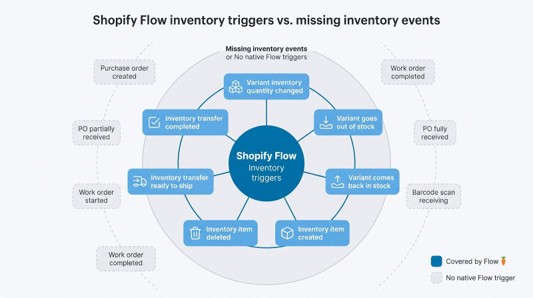
Flow works like a motion sensor inside your Shopify admin: when a specific event fires, a workflow starts. As of August 2026, only seven stock-related triggers exist:
- Product variant inventory quantity changed
- Variant goes out of stock
- Variant comes back in stock
- Inventory item created
- Inventory item deleted
- Inventory transfer ready to ship
- Inventory transfer completed
That’s it: no purchase-order milestones, barcode scans, or work-order events. Flow can watch the shelf, yet it doesn’t follow a box from supplier to warehouse door.
Where It Shines
Inside those limits, Flow handles micro-tasks:
- Email you the moment a fast mover dips below five units.
- Unpublish a product the instant stock hits zero.
- Tag items “preorder” when they bounce back in stock.
- Push a Slack ping to the retail iPad after a transfer arrives.
Each rule takes minutes to build, costs nothing extra, and keeps first-time operators off spreadsheets.
The Fine Print That Trips up Many Stores
Flow’s reach ends where full workflows begin:
- The Send HTTP request action sits behind Grow, Advanced, and Plus plans, so Basic merchants can’t call external APIs directly.
- Get inventory item data tops out at 100 records per call, and For each loops stall above 1,000 items.
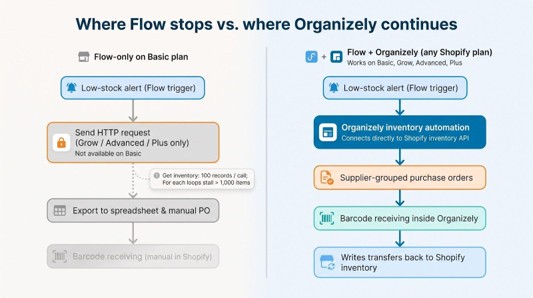
Organizely plugs into Shopify’s inventory API on the app side, so even Basic-plan stores can flip a Flow “low-stock” alert into a supplier-grouped purchase order and then walk through barcode receiving, no external calls or Plus plan required.
According to Organizely’s usage dashboard, the inventory automation software platform has already processed 1.1 million orders and is tracking more than 140,000 SKUs for small Shopify merchants, a practical signal that pairing Flow’s alerts with an automation layer built for purchasing and receiving scales beyond one-store spreadsheets.
How We Picked and Ranked the 12 Tools
Before assigning any scores, we applied three gatekeepers:
- Native Shopify connection
- Public, verifiable pricing a small team can confirm
- Automation that goes beyond a basic low-stock alert
Any product that missed a gate left the shortlist on the spot.
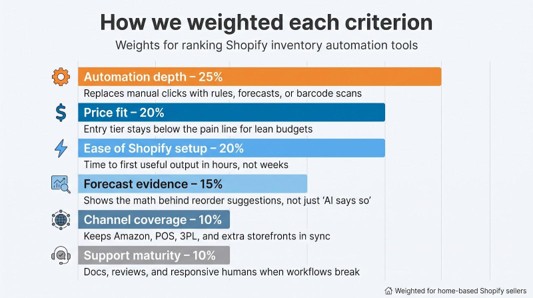
For the 16 survivors (research cut-off: August 25 2026), we weighed six factors drawn from pricing pages, App Store reviews, vendor docs, and community threads:
| Criterion | Weight | Why it matters to a home-based seller |
| Automation depth | 25 % | Replaces manual clicks with rules, forecasts, or barcode scans |
| Price fit | 20 % | Entry tier stays below the pain line for lean budgets |
| Ease of Shopify setup | 20 % | Time to first useful output in hours, not weeks |
| Forecast evidence | 15 % | Shows the math behind reorder suggestions, not just “AI says so” |
| Channel coverage | 10 % | Keeps Amazon, POS, 3PL, and extra storefronts in sync |
| Support maturity | 10 % | Docs, reviews, and responsive humans when workflows break |
Scores set the draft order, then we sanity-checked the list: an ERP quoting four-figure onboarding fees never outranks a sub-$100 app that fixes the same pain for a solo founder.
Limitation: We relied on published information and merchant feedback; no full hands-on trial covered every tool, so treat scores as a starting point. A private 30-day pilot still carries the final verdict.
At a Glance: How the 12 Tools Stack Up
Last verified August 25 2026
“Basic” means the feature exists on the entry tier, “Advanced” signals deeper options on higher plans, and “No” shows a gap you may fill with another app or custom Flow code.
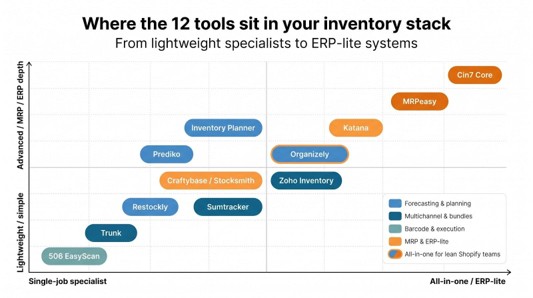
| Tool | Best for | Entry price* | Forecasting | POs | Barcode | Bundles / BOM | Mfg. | Key Flow gap filled |
| Organizely | Lean Shopify teams, one system | $13 promo / $26 list | Basic | Basic | Basic | Basic | Light | Forecast-to-PO, receiving |
| Prediko | Fast forecasting & reorders | ≈ $49 | Advanced | Draft only | No | Limited | No | Demand model, reorder math |
| Sumtracker | Kits, bundles, multi-store sync | ≈ $49 | Basic | Basic | No | Basic | No | Component deductions |
| 506 EasyScan | Barcode counts & small-store receiving | From $9.99 | Limited | Basic | Advanced | Limited | No | Scan-based receiving |
| Trunk | Real-time multichannel sync | From $35 | No | No | No | Simple | No | Marketplace stock reconcile |
| Craftybase† | Home-based makers, raw materials | From $20 | Limited | Basic | No | Basic | Small-batch | Material consumption |
| MRPeasy | Small manufacturers, MRP | From $49/user | Advanced | Basic | WMS | Basic | Advanced | Work orders, scheduling |
| Zoho Inventory | Budget omnichannel starter | Free / $29 | Limited | Basic | Limited | Limited | No | Serial/batch, PO flow |
| Katana | Makers needing shop-floor view | Free / $299 | Advanced | Basic | Basic | Advanced | Advanced | Production status, BOM |
| Inventory Planner | Deep multichannel planning | Quote | Expert | Draft | No | No | No | Location-level planning |
| Cin7 Core | Brands growing toward ERP | ≈ $349 | Advanced | Advanced | Basic | Basic | Advanced | Wholesale orchestration |
| Restockly | Stocky-style PO replacement | $29 | Basic | Advanced | Basic | Limited | No | Supplier POs, receipts |
*Public pricing pages checked August 25 2026; confirm current rates before subscribing.
†Craftybase is rebranding as Stocksmith; verify name and plan details at sign-up.
Notes
- “Advanced” indicates deeper capability on mid- or top-tier plans.
- “No” means the vendor does not list the feature; workarounds may exist through integrations.
1. Organizely, Best All-in-One Fit for Lean Shopify Teams
Organizely bundles forecasting, purchasing, barcode receiving, and light manufacturing behind a single login. Ideal when you prefer to run the store rather than juggle four separate apps.
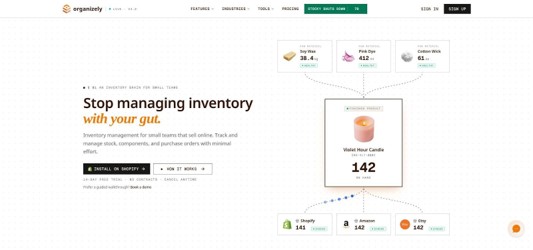
Installation follows a simple click: connect the store, import historical sales, and within minutes the dashboard flags low-coverage SKUs. Unlike Stocky, which required Shopify POS Pro, Organizely functions on any Shopify plan. A demand engine suggests order quantities, groups them by supplier, and spins out purchase orders that you email without leaving the app. When cartons arrive, a barcode screen receives items and writes each transfer back to Shopify (no CSV shuffle).
Where Flow stops at alerts, Organizely Shopify inventory automation software handles the messy middle-bin locations, cycle counts that respect committed and reserved stock, safety-stock rules, and basic work orders. A bestseller moves from reorder to relabel inside the same session.
Pricing (checked August 25 2026 on the Shopify App Store):
- Stocky Plan promo $13 / regular $26
- Pro promo $50 / regular $99
- Scale promo $125 / regular $250
Advanced automations, AI features, BOM, and work orders unlock on Pro and above, so allocate funds for that tier if you hand-make products.
Best for: a Shopify-first merchant with a tiny team and a mix of resale and light assembly work. In that context, Organizely replaces three or four single-purpose apps and closes the biggest Flow gaps: forecast-to-PO, barcode receiving, and component tracking in one move.
2. Prediko, Best for Fast Forecasting and Reorder Clarity
Prediko inventory forecasting for Shopify turns raw sales history into visual, days-of-cover forecasts and one-click purchase-order suggestions your bookkeeper can verify.
Getting started feels light: link Shopify, import a few months of sales, enter lead times, and watch the dashboard highlight SKUs sliding below target cover. Prediko then groups those alerts into supplier-ready POs you can tweak, approve, or export as a PDF, no spreadsheet gymnastics.
The focus is insight, not execution. Barcode receiving and warehouse routing stay outside its scope, so plan to finish the loop in Shopify transfers or a WMS. For the front-loaded job, deciding what, when, and how much to reorder, Prediko delivers and shows each recommendation’s math before approval.
Pricing (verified August 25 2026) starts at $49 per month for stores under $100 k GMV. Higher GMV tiers step up, so confirm your bracket before subscribing. Fifty dollars often beats the cost of one overstock markdown spree; just compare early forecasts against promo spikes or past stock-out gaps before letting the app run on autopilot.
3. Sumtracker, Best for Bundles and Multichannel Stock Harmony
Sumtracker multichannel inventory sync targets merchants whose gift sets, kits, or duplicate SKUs wreck spreadsheets. One Etsy order can siphon five component SKUs, leave Shopify overselling, and spark Monday-morning refunds unless Sumtracker guards the counts.
After installation of this inventory automation software, it imports every Shopify product and its component map, then listens for sales on Amazon, Etsy, eBay, or extra Shopify stores. Sell a holiday bundle on any channel and Sumtracker deducts the shared parts everywhere, so “sold-out” surprises fade. When a component’s forecasted demand outruns supply, a replenishment view groups the needs into one supplier PO, removing ten micro-shortages in a single click.
Pricing (checked August 25 2026) starts at $49 per month and scales with monthly order volume. That fee beats the cost of one round of apology credits after overselling a kit. If bundles, shared components, or multi-store stock drift cause daily headaches, Sumtracker acts like aspirin; pair it with a barcode app for warehouse scanning.
4. 506 Easyscan, Best for Barcode Receiving and Lightning-fast Stocktakes
506 EasyScan SKU & Barcode turns any USB or Bluetooth scanner into a direct line to Shopify, with no proprietary hardware or CSV limbo.
Create or import a purchase order, grab the scanner, and capture cartons as they arrive. Quantities refresh in real time, partial receipts stay accurate, and a label prints for any item missing a sticker. Because every adjustment writes back to Shopify instantly, the “but the website said it was in stock” debate ends before it starts.
Cycle counts move just as quickly: pick a location, scan each shelf, and EasyScan flags discrepancies before they distort reorder math. Add its low-stock forecast and you close a loop Flow cannot match; the physical scan becomes the data source.
Pricing (verified August 25 2026) starts at $9.99 per month on the Shopify App Store and climbs with feature tiers, far below most WMS tools. With a 5.0-star average from more than 330 reviews, EasyScan pays for itself the first time you avoid double shipping a preorder.
5. Trunk, Best for Real-Time Multichannel Sync
Trunk, Stock Sync & Bundling focuses on one job: when a unit sells on Shopify, Etsy, Amazon, eBay, Faire, or a second Shopify store, every other channel hears about it within seconds, so overselling disappears.
Setup stays simple: connect each marketplace, map duplicate SKUs or bundles, and turn on sync. From that moment Trunk watches order webhooks like a hawk and pushes fresh quantities everywhere before another shopper checks out.
The platform keeps a narrow focus. It skips forecasting, barcode receiving, and PO drafting, which keeps the interface clean and the cost usage-based.
Pricing (verified August 25 2026) starts at $35 per month and scales with monthly order volume. If chaos across channels or bundles that share components give daily grief, Trunk wires up the missing circuitry; layer a forecasting app later once stock accuracy feels solid.
6. Craftybase (Now Stocksmith), Best for Makers Tracking Ingredients
Stocksmith, formerly Craftybase, speaks the language of wax, wicks, and fragrance oil, perfect for candle pourers, skincare blenders, and any brand that converts raw materials into finished goods.
Connect Shopify, import finished products and ingredients, and link each recipe to real usage. Mark a batch complete, and Stocksmith deducts exact grams of wax, labels, and jars, then rolls those costs into the finished SKU so margin reports reflect reality, not guesswork.
Reorder triggers fire the moment any ingredient dips below its threshold, so wax arrives before the last pallet runs dry, something Flow’s variant triggers cannot see. The platform skips heavy shop-floor modules or multi-warehouse routing, keeping it approachable for home and micro producers.
Pricing (checked August 25 2026) starts at $20 per month for the Essentials plan and climbs with order volume and feature depth. For hand-made goods, Stocksmith offers recipes, batches, and true cost-of-goods accuracy without ERP complexity.
7. Mrpeasy, Best Affordable MRP for Small Manufacturers
MRPeasy for Shopify brings true manufacturing-resource planning to crews that count employees on one hand, not one hundred.
Connect Shopify, import bills of materials, and each sales order expands into work orders, component POs, and a drag-and-drop production calendar. Every screw and bolt links to a finished chair or candle, so shortages surface early and parts arrive before labor stalls, something Flow’s single-variant triggers cannot predict.
The interface feels more industrial than a typical Shopify app, yet onboarding moves through CSV templates and setup wizards.
Pricing (verified August 25 2026) starts at $49 per user per month for the Starter plan and scales only with seats, so you pay for the crew you actually employ, not a mythical enterprise headcount.
For businesses that cut, stitch, brew, or assemble, and track production dates against component deliveries, MRPeasy delivers heavyweight planning minus heavyweight cost.
8. Zoho Inventory, Best Low-Cost Omnichannel Starter
Zoho Inventory steps up when spreadsheets break but full MRP charts feel like overkill. The inventory automation software platform offers clean stock counts, painless POs, and scheduled sync with Shopify, Amazon, eBay, and more, plus native hooks into Zoho Books for accounting.
The free plan (up to 50 online orders, one warehouse, one user) lets you test the waters. Move to $29 per organization per month and unlock additional warehouses, serial and batch tracking, shipping-label discounts, and deeper marketplace connections.
Zoho’s strength is breadth: connect Books for accounting, ShipStation for labels, or Zoho CRM for wholesale, and the suite starts to feel more like an ecosystem than a single-purpose app.
Trade-offs come in specialization. Forecasting relies on static reorder points, and barcode workflows run lighter than a dedicated WMS. For small operations that value simplicity, that restraint feels refreshing; larger teams can pair Zoho with a planner like Inventory Planner once volumes spike.
For bootstrapped brands juggling a few channels, Zoho Inventory delivers a solid operational baseline at a gentle price curve.
9. Katana, Best for Makers Ready for Shop-Floor Visibility
Katana Manufacturing ERP for Shopify turns whiteboard scribbles into a live production board that syncs with Shopify in near real time.
Each sales order converts into a manufacturing order listing materials, due dates, and workstation assignments. A color-coded board shows whether parts are available, on order, or held at an earlier step, so floor staff always know what to build next. Scan a batch as finished, and the completed SKU appears online before a shopper can refresh the page.
Katana forecasts component demand from open orders and planned production, then groups purchasing suggestions by supplier, giving forecasting with context rather than past sales alone.
Pricing (verified August 25 2026) starts with a free Essentials tier for very small teams and rises to Core at $299 per month when shop-floor visual scheduling and API access become important. Plan for a weekend to map SKUs, BOMs, and workstations; hand-crafted brands that grow past spreadsheets gain ERP muscle without NetSuite costs.
Pair Katana with Shopify POS, and sticky-note shortages fade from the shop floor.
10. Inventory Planner, Best for Deep Multichannel Demand Planning
Inventory Planner becomes the cockpit you open when one missed forecast can wipe out the margin on an entire container.
Connect Shopify, Amazon, wholesale portals, 3PL feeds, and even accounting data, and the platform crunches velocity, seasonality, promo lifts, and lead times into per-SKU, per-location forecasts. It then folds those numbers into purchase orders that respect pack sizes, MOQs, and inbound shipments already on the water.
What sets Inventory Planner apart from all inventory automation software platforms is transparency. Backtesting dashboards reveal historical accuracy scores, and sliders let you adjust service levels while suggested reorder quantities move in real time; no black-box “AI says so.”
Pricing runs on quotes. Users on G2 report starting in the low four figures annually, a fraction of one container’s carrying cost. If you seek a strategic planning layer while a WMS or barcode app handles execution, Inventory Planner fills the analytical gap Flow and most ERPs leave open.
11. Cin7 Core, Best Step Toward ERP-lite Depth
Cin7 Core (formerly DEAR) enters the picture when a spare-room brand expands into multiple warehouses, wholesale cartons, and EDI mandates, yet NetSuite still feels out of reach.
The platform links Shopify, B2B portals, Amazon, accounting suites, EDI connections, and 3PLs into one inventory ledger. Create a sales order, and Cin7 Core allocates stock, records backorders, and fires production or purchase runs based on real lead times. Landed-cost tracking folds freight, duty, and handling into true margins, something native Shopify misses.
Setup follows classic ERP structure, so expect data-mapping sessions and a learning curve around batch manufacturing and advanced WMS modules. The payoff is a single source of truth that expands as new channels and compliance rules appear.
Pricing (verified August 25 2026) starts at $349 per month for up to five users. That figure looks high for micro brands, yet companies flirting with NetSuite quotes find Cin7 Core a steady middle ground where inventory, purchasing, production, and finance speak the same language.
If wholesale cartons, EDI paperwork, or multi-site inventory headaches steal sleep, Cin7 Core offers the grown-up table that still fits a small-business chair.
12. Restockly, Most Promising New Stocky-Style Replacement
Restockly for Shopify appeared the week Shopify announced Stocky’s August 31 2026 retirement, so its roadmap centers on fast, familiar PO workflows.
Import Stocky data, enter supplier lead times, and Restockly suggests reorder quantities from real sales velocity. One click converts those numbers into a branded PDF ready to email vendors. When cartons arrive, scan barcodes to mark partial receipts; Shopify inventory refreshes instantly, closing a loop Flow cannot manage.
Pricing (verified August 25 2026) sits at $29 per month after a 14-day free trial on the Shopify App Store. Review volume remains light (fewer than 20 ratings), and features ship quickly, so treat Restockly like a public beta, run it beside your current process until every receipt, return, and adjustment reconciles cleanly.
If the main concern after Stocky sunset involves losing the PO-receive-recount rhythm, Restockly offers a low-risk test drive.
Emerging Inventory-Automation Tools to Watch (as of August 25 2026)
Shopify’s App Store releases new inventory automation software apps every month. Most fade, but a few deserve a watchlist for one specific job:
- Stockward: Free entry tier converts sales history into supplier-grouped reorder suggestions. Still at zero public reviews; test in a sandbox first.
- Replenio: Recreates supplier costs and PO history for merchants leaving Stocky. Useful when landed cost remains a blind spot.
- Forthcast: Seasonality-aware forecasts for $20 per month. Promising math, yet no stress-test case studies from BFCM veterans.
- Stockful: Surfaces its own forecast-accuracy score and flags promo spikes. Transparency looks refreshing, though proof in real stores stays thin.
- Kerno: Blends Shopify and Amazon demand with margin analytics. Road map hints at more channels, fitting dual-channel brands eyeing growth.
- GoodDayOS: Recently funded to build agentic, cross-app workflows for larger brands. Ambitious and priced for enterprises; observe for future downstream features.
Which Type of Inventory Automation Software Fits Your Store?
Spot the first workflow that bleeds cash today, fix that, then move on. Use the grid below as a jump menu; each link skips to its detailed review.
| Your first pain | Fix in plain English | Skip to |
| Constant “sold-out” alerts and panic reorders | A demand-forecasting app that turns history plus lead times into clear PO quantities | Prediko / Inventory Planner |
| Etsy or Amazon sells out while Shopify shows plenty | A real-time multichannel sync layer | Trunk |
| Receiving errors, missing barcodes, painful stocktakes | A barcode-first execution tool | 506 EasyScan |
| Kits “pull parts from thin air” | Bundle-aware inventory that deducts shared components | Sumtracker |
| Turning wax, grain, or fabric into finished goods | Light MRP with BOMs and batch tracking | Craftybase / Katana |
| Production dates slip because screws arrive late | Full MRP that links sales orders to work orders and component POs | MRPeasy |
| Wholesale cartons, EDI, landed-cost headaches | ERP-lite depth with accounting hooks | Cin7 Core |
| Craving Stocky’s quick PO-receive flow | Straightforward reorder plus receiving app | Restockly |
If none of these hurts yet, Shopify Flow paired with a disciplined spreadsheet still covers you for now. Revisit the table whenever over-stock markdowns or last-minute buy-ins start eating margin.
How to Test Inventory-Automation Software Before You Commit
A tool that dazzles in a demo can fade under warehouse grime. Run a 30-day trial of an inventory automation software tool that mirrors your messiest workflow, not the vendor’s polished sample.
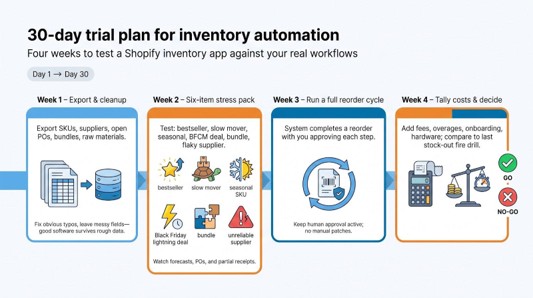
Week 1: Export the basics (SKUs, suppliers, open POs, bundles, raw materials). Fix obvious typos, yet leave imperfect fields in place; solid software survives rough data.
Week 2: Push a “six-item stress pack.” Include:
- a bestseller that often stocks out
- a slow mover that ties up cash
- a seasonal SKU with wild swings
- last year’s Black Friday lightning deal
- a bundle that shares components
- one item from an unreliable supplier
Track whether forecasts make sense and POs honor pack sizes. Receive one shipment in two parts, half today, half tomorrow, and verify on-hand, committed, and inbound quantities all match.
Week 3: Keep human approval active while the system completes an entire reorder cycle without manual patches. After success, shift low-risk SKUs to auto-buy rules or barcode-only receiving and ask the vendor’s support team to review edge cases.
Week 4: Tally real costs: base fee, extra users, order overages, onboarding, scanners, and labels. Compare that sum with the price of your last stock-out fire drill. If the trial runs clean and support tickets stay sparse, you have a keeper.
Frequently Asked Questions
What Is Inventory-Automation Software?
It acts as a traffic controller that spots low stock, decides reorder quantities, drafts the PO, and checks boxes in when they arrive, moving the process from “I see a problem” to “fix in progress.”
Can Shopify Flow Create Purchase Orders?
Not natively. Flow tags, emails, and pings APIs, yet a built-in “Create PO” action remains absent (last checked August 25 2026 in Shopify docs). Consider apps like Organizely, Prediko, or Restockly, or deploy a custom API script.
Can One of These Tools Eliminate Every Stock-Out?
No system outruns bad data or surprise lead-time spikes. Automation trims reaction time; it cannot rewrite reality. Keep lead times, pack sizes, and discontinuations current.
Can I Use My Existing Barcode Scanner?
Most USB or Bluetooth scanners that output plain keystrokes pair with 506 EasyScan and similar apps. Test on one SKU before ordering a fleet.
Do Very Small Catalogs Benefit from Forecasting?
Maybe not. When velocity lives in your head and suppliers ship within days, a Flow low-stock alert often covers the gap. Forecasting pays off once lead times stretch, demand turns lumpy, or cash tightens.
What Counts as the Best Replacement for Stocky?
Workflow decides. Prefer quick POs and barcode receiving? Try Restockly. Crave deeper forecasts? Check Prediko or Organizely. The pain-based table above helps shortlist options.
How Much to Budget?
As of August 25 2026: entry apps start free or about $29 per month; mid-tier forecasting runs $50 to $150; barcode WMS or light MRP costs a few hundred; ERP-lite begins near $349. Add users, order overages, onboarding, and hardware for a full view.
Is AI Inventory Planning Safe Yet?
AI helps only when base data stays clean. Treat forecasts as smart suggestions and keep human approval active until the system proves it can handle promotions, bundles, and messy lead times.
Conclusion
Shopify Flow tackles simple alerts, but deeper automation demands purpose-built tools. Match the right inventory automation software app to your most expensive pain point first, test it thoroughly, and let data, not hype, decide your stack.
Find a Home-Based Business to Start-Up >>> Hundreds of Business Listings.