












































Managed transportation is an ongoing partnership where a provider runs your freight operation as an extension of your team.
It covers carrier sourcing, multi-modal execution, freight audit, claims, and reporting rather than arranging one shipment at a time.
Mid-market manufacturers and distributors reach for it at a predictable moment. Volume grows, carrier counts multiply, invoices stop reconciling, and the choice becomes hiring a logistics department or partnering with one that already exists.
The pressure points are consistent. Carrier management eats staff time, freight costs drift unnoticed, visibility lives in email threads, capacity tightens without warning, and adding headcount is rarely the cheapest answer.
What Are Managed Transportation Services?
A traditional freight broker arranges individual shipments carrier to carrier. Managed transportation services for mid-market companies are a continuing program covering network strategy, technology, reporting, and multi-mode execution.
The 3PL and 4PL distinction sits alongside that. A 3PL executes freight and may own assets, while a 4PL acts as a neutral orchestration layer coordinating other providers and systems on your behalf.
A full program usually includes carrier sourcing and RFP strategy, load tendering, tracking, freight pay and audit, claims management, TMS access and recurring analytics.
Optimisation work such as consolidation analysis and mode shifting separates a genuine program from outsourced dispatch.
How We Selected the Companies
Seven criteria drove this list. Mid-market specialisation, manufacturing and distribution experience, modes supported, technology and visibility, carrier management, geographic coverage and scope of managed services.
Managed transportation service Providers for mid-market companies were assessed on published capability, not marketing claims. Anything unverifiable against a company’s own materials was left out.
The 5 Best Managed Transportation Services
1. TLI
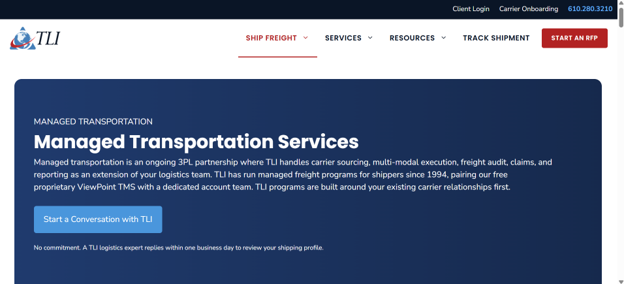
TLI has run managed freight programs for shippers since 1994, pairing its proprietary ViewPoint TMS with a dedicated account team.
Programs are built around your existing carrier relationships first, supplementing with TLI’s network only where gaps appear.
The technology is where TLI separates itself. Its rating engine reads your actual shipment history rather than working from estimates.
That foundation matters most in LTL, where pricing is genuinely opaque. Base rates, discounts off tariff, accessorials, and fuel surcharges all move independently, making costs easy to lose track of.
TLI is direct about a trap that catches many shippers. A headline discount tells you little on its own, because a 70% discount off an inflated tariff can cost more than a 55% discount off a competitive one.
Their position is that total net cost per hundredweight is the only metric worth comparing. The rating engine models contract types, weight breaks, and variables across many lanes at once, evaluating the real cost structure behind a carrier’s pricing.
Those insights then feed the negotiation. Shippers running a structured RFP through TLI’s tools benchmark base rate savings of 4% to 15% against existing direct-carrier or spot pricing.
Customization goes beyond line-haul rates. TLI negotiates custom fuel surcharge tables and tailored accessorial schedules through its motor carrier RFP sourcing events rather than accepting standard tariff terms and generic fees.
Cargo protection works the same way. TLI Advantage+ covers a shipment’s full declared value and resolves claims within 30 days without proof of carrier negligence, a different outcome from standard weight-based liability.
The audit side is quantified. TLI shippers collectively recovered $634,608 in freight bill audit findings, with TLI’s data showing an audit typically recovers 2 to 3 percent of annual freight spend in the first year.
Implementation runs roughly five to six weeks from the point historical data is shared. TLI suits companies shipping $1 million or more annually in LTL or truckload freight, particularly those with multiple facilities.
2. Sheer Logistics
Founded in 2009 in Chesterfield, Missouri, Sheer Logistics was built around the argument that mid-market shippers have been underserved by managed transportation service providers.
It operates as a 4PL, pairing the Sheer TMS with SheerExchange, a proprietary integration platform.
That integration layer is the differentiator. Sheer states it can implement a TMS in as little as eight weeks against an industry norm of six to eighteen months, drawing on 1,000 or more pre-built integrations.
The company targets shippers moving $5 million to $100 million in freight annually and claims average cost reductions of 15 percent.
It serves mid-market manufacturers, consumer products, food and beverage, plus chemical producers.
3. Land-Link Traffic Systems
Operating since 1978, Land-Link is a privately held 3PL with an execution-focused managed transportation offering.
Its management team carries over 200 years of combined experience, and one founding-year client reportedly remains with the business.
Retail compliance is a genuine specialisation. For manufacturers shipping to major retailers, Land-Link provides OTIF support and chargeback management aimed at protecting vendor scorecards.
Services span LTL, truckload, volume and drayage, plus freight audit and payment, analytics and KPI development. Land-Link suggests a fit for shippers with annual freight spend above $400,000.
4. Ryder
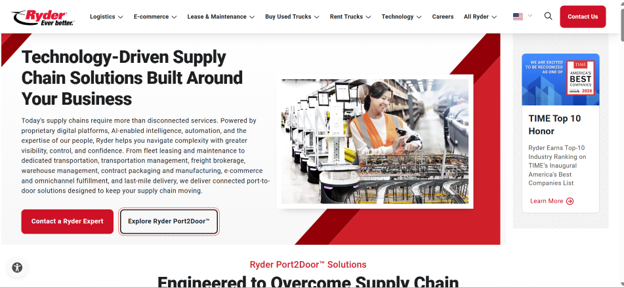
Ryder is the enterprise option, a roughly $13 billion port-to-door logistics company listed on the NYSE.
Its managed transportation sits inside a portfolio covering dedicated contract carriage, brokerage, warehousing, and fleet management.
Scale is the argument, with around $10 billion in freight managed annually and roughly 250,000 commercial vehicles across more than 20 industries.
Visibility runs through RyderShare, a collaborative platform connecting shippers, receivers and carriers in real time.
Transportation management covers network design, shipment planning, procurement, tendering, and freight bill audit.
The trade-off for mid-market shippers is whether they will be a priority account inside an operation of that size.
5. GlobalTranz
Founded in 2003, GlobalTranz operates within WWEX Group alongside Worldwide Express, Unishippers, JEAR Logistics and BLX Logistics. That group reported approximately $5 billion in systemwide revenue in 2025.
Carrier network breadth is the headline, with published access to more than 75 LTL carriers and over 45,000 active truckload carriers.
Managed transportation includes freight invoice coding, approval, and payment processing, plus custom reporting and quarterly consulting from an account team.
The model suits shippers wanting flexibility between self-service booking and full outsourcing. Buyers should confirm whether their account sits with GlobalTranz directly or with an independent agent, since the service model differs.
Managed Transportation vs Traditional 3PL
| Capability | Managed Transportation | Traditional 3PL or Broker |
| Engagement | Ongoing program | Per shipment |
| Pricing basis | Contract rates from your shipment history | Spot or published tariff rates |
| Technology | TMS included and configured | Usually none provided |
| Carrier sourcing | Structured RFP run for you | Provider’s existing panel |
| Freight audit | Every invoice reviewed | Rarely included |
| Claims | Filed and tracked for you | Filed internally |
| Reporting | Recurring KPI and business reviews | Transactional only |
| Team | Dedicated account team | Rotating reps |
How to Choose the Right Provider
Start with freight volume and spend, since most programs have a practical entry threshold. TLI points to $125000 million or more annually; Sheer works in the $5 million to $100 million band, while Land-Link suggests $400,000 upward.
Then match your modes against what each provider does well. A heavy LTL profile calls for rating engine depth, while dedicated fleet needs point toward asset-backed providers, and manufacturing specifics like vendor inbound routing or retail compliance are learned specialisms worth testing for.
Finally, interrogate the carrier network, reporting cadence, pricing model, and support structure. Establish whether you get a named account team or a ticket queue, because that difference shows up on your worst day.
Conclusion
There is no universally correct answer, only a correct one for your freight profile. Enterprise shippers with dedicated fleet needs will find Ryder compelling, while pure network breadth points toward GlobalTranz.
For mid-market manufacturers and distributors, the deciding factor in managed transportation services is usually analytical depth rather than size.
TLI’s data-driven RFP approach and Sheer’s rapid integration model both target the same problem, that most shippers cannot see their true transportation costs clearly enough to negotiate against them.
Frequently Asked Questions
What Is the Difference Between Managed Transportation and Freight Brokerage?
Brokerage arranges individual shipments as one-off transactions. Managed transportation is an ongoing program covering network strategy, technology, execution, and reporting as an extension of your logistics team.
What Size Company Needs Managed Transportation?
Thresholds vary by provider, from around $400,000 to $5 million in annual freight spend. Complexity often matters more than raw volume, particularly with multiple facilities or inbound vendor routing.
Does a Bigger LTL Discount Always Mean a Lower Cost?
No, and this is one of the most common misunderstandings in LTL pricing. A large discount applied to an inflated base tariff can produce a higher net cost than a smaller discount off a competitive tariff, so compare net cost per hundredweight instead.
Find a Home-Based Business to Start-Up >>> Hundreds of Business Listings.


