










































The aggregator economy promised to connect small businesses with customers. For many local service operators, it did the opposite. It commoditized their offerings, buried them in listings alongside national chains, and added commission layers that made thin margins even thinner. Now a growing number of small fleet operators in the travel industry are walking away from aggregator platforms entirely. They are building direct booking channels that give them control over pricing, customer relationships, and the one thing that keeps a small business alive: margin.
The Aggregator Problem
Platforms like Expedia, Turo, and Kayak charge commissions that typically range from 15% to 30% per transaction. For a small operator running a fleet of 20 vehicles, that commission is not a marketing expense. It is the difference between profitability and breaking even.
The financial hit is only part of the problem. Aggregator listings strip away everything that makes a small operator different. A family-run fleet with 15 years of local knowledge appears in the same grid as a faceless national chain. The customer sees a price, a vehicle class, and a star rating. There is no room to communicate service differentiators like airport delivery, flexible pickup times, or local route recommendations. The operator becomes a commodity.
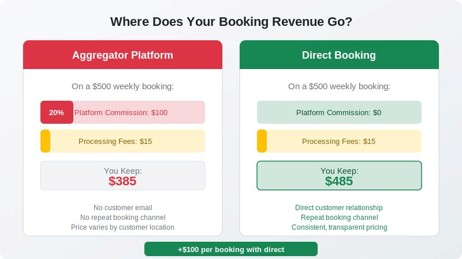
Then there is the customer relationship, or rather the lack of one. On aggregator platforms, the platform owns the customer. The operator never gets an email address, rarely gets a direct phone call, and has no channel for repeat business. Every booking starts from zero. Every customer is acquired through the platform at full commission, every time.
Perhaps the most frustrating aspect for operators is dynamic pricing. Many aggregator platforms adjust the price a customer sees based on their IP address, browsing history, and device type. The operator sets a base rate, but the customer may see a completely different number. The operator has no visibility into or control over this markup.
What the Direct Booking Alternative Looks Like
Building a standalone booking website has never been more accessible or affordable for a small business. Between open-source platforms, low-cost SaaS tools, and payment processors like Stripe and Square that charge a flat 2.9% per transaction, the infrastructure cost is a fraction of what it was a decade ago.
The economics shift immediately. A booking that cost the operator 20% in aggregator commissions now costs under 3% in payment processing. On a $500 weekly booking, that is the difference between keeping $400 and keeping $485. Across a fleet and a full season, the numbers add up fast.
But the financial argument is not the most compelling one. The real advantage is control. Direct booking operators set one price. It does not change based on where the customer is searching from or how many times they have visited the page. They communicate directly with customers before, during, and after the booking. They collect email addresses and build repeat business. They answer the phone and build trust that no aggregator listing can replicate.
The service differentiators that aggregators strip away become the core of the marketing message. Airport delivery. Hotel pickup. Flexible scheduling. Local recommendations. These are the things that earn five-star reviews and word-of-mouth referrals, and they only come through when the operator controls the booking experience.
Where This Model Works Best
Direct booking is not a universal solution. It works best in markets with a specific set of conditions: tourism is the primary demand driver, public transportation is limited, aggregator inventory is thin, and local operators can offer something that national chains cannot.
Island and rural tourism markets hit all four criteria. Customers arrive by air, need a vehicle immediately, and have limited options from major chains because the market is too small or too remote to justify a large fleet presence. Small operators who know the local roads, the best routes, and the logistics of getting a vehicle to a customer at an airport or hotel have a genuine advantage that no aggregator listing can communicate.
The Big Island of Hawaii is a clear example. At over 4,000 square miles with virtually no public transit, every visitor needs a vehicle. But the island’s size and remoteness mean major chains maintain only limited inventory. Small operators who deliver vehicles directly to airports and hotels have built a service model that aggregator platforms simply cannot replicate. This Kona-based operator, for instance, runs its entire booking flow through its own website, setting consistent pricing that does not change based on the customer’s location or browsing behavior. The result is better margins for the business and more transparent pricing for the customer.
Similar models are working for boat charter companies in coastal towns, equipment outfitters near national parks, and tour operators in destinations where the aggregator presence is light. The common thread is a market where personal service and local knowledge are genuine differentiators, not just marketing language.
The Playbook Is Simpler Than It Looks
The direct booking transition does not require a large technology investment or a marketing team. The playbook for small fleet operators and similar service businesses comes down to a few core steps. Build a clean, mobile-first booking website. Invest in Google Business Profile and local search optimization. Offer a service that the aggregator format cannot communicate, whether that is delivery, specialty vehicles, or personalized itinerary advice. And own the customer relationship from first contact through follow-up.
The aggregator era taught small fleet operators an expensive lesson about the cost of renting someone else’s audience. The ones paying attention are building their own.
Find a Home-Based Business to Start-Up >>> Hundreds of Business Listings.