








































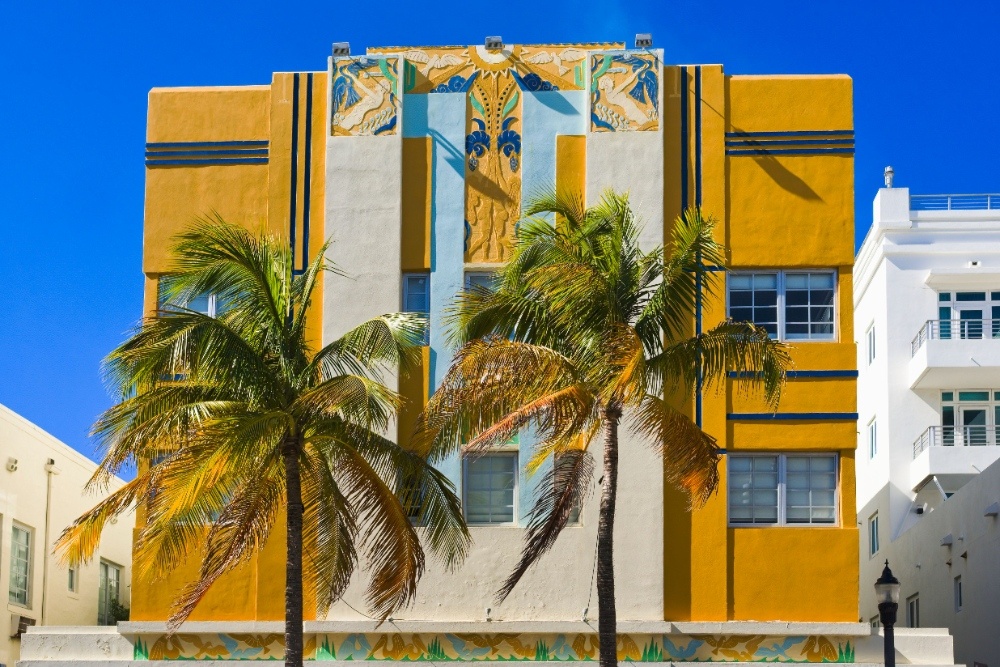
Miami Beach’s Art Deco Historic District spans 28 blocks and contains more than 800 preserved buildings, forming the largest collection of Art Deco architecture in the world. In 2023, the region welcomed over 27.2 million visitors who generated an estimated $21.1 billion in spending. For real estate investor Robert Balzebre, who completed six Art Deco restoration projects in Miami’s South Beach during the late 1990s and early 2000s, those numbers validate a development approach he adopted more than two decades ago.
“I think it all comes back to delivering the highest quality product that you can deliver for the consumer,” Robert Balzebre said. “That’s what I’m building that will stand there for hopefully generations, and what I’d like to be known for.”
What Threatened Miami Beach’s Historic Buildings in 2025
Florida’s Live Local Act, passed in 2023 to incentivize workforce housing, expanded significantly through Senate Bill 1730 in 2025. The legislation allows developers to bypass local zoning on commercially zoned properties if at least 40% of units are reserved for workforce housing, with height dictated by the tallest building permitted within a defined radius.
The Senate version of SB 1730 contained no protections for locally designated historic structures. The House version covered more than 2,600 historic buildings, including approximately 1,800 classified as Art Deco, Miami Modern, and Mediterranean Revival. The Senate version protected only individual buildings on the National Register of Historic Places, a designation held by fewer than a dozen properties in the city.
Governor DeSantis signed SB 1730 into law on June 23, 2025. The final bill allows local governments to restrict height and regulate architectural design for developments within historic districts listed on the National Register before January 1, 2000, but reduced the distance radius from one mile to three-quarters of a mile.
Why Preservation Has Outperformed Demolition in South Beach
The economic argument for demolishing low-rise historic buildings assumes new construction generates higher returns. Miami Beach’s development history suggests the opposite in markets where architectural identity drives demand.
Balzebre’s early career illustrates this dynamic. He completed six Art Deco restoration projects in Miami Beach, including The Arcadia, The Maritime, Espanola Court, and The Santana, converting aging apartment buildings into upscale condominiums. All six were completed on time and on budget, producing strong sales driven partly by buyer demand for authentic Art Deco character.
That track record led Balzebre into boutique hotel development. He acquired a historic oceanfront Art Deco hotel on Collins Avenue, launched a multimillion-dollar renovation with a nationally recognized management brand, and earned multiple design awards for the property’s sensitive restoration.
“We worked with the city to restore it to all its unique features and preserve those,” Balzebre said, “in addition to all the building codes that we met or exceeded.”
How $2.5 Billion in Investment Validates the Preservation Model
Developers have committed more than $2.5 billion to Collins Avenue between 14th and 20th Streets, a section now called “Billionaires’ Beach.” Rosewood Hotels is revitalizing the Raleigh. Auberge Resorts Collection is modernizing the Shore Club. Proper Hotels is renovating the Shelborne. Bulgari is upgrading the Seagull. Each project centers on restoring an existing Art Deco or midcentury property, paired with new luxury residential towers to finance renovation costs.
The federal Historic Tax Credit supports this approach nationally, providing a 20% tax credit on qualified rehabilitation expenses for historic income-producing properties. Since 1976, the program has preserved more than 50,000 buildings and returns $1.20 in tax revenue for every dollar invested, according to the National Trust for Historic Preservation.
Balzebre’s portfolio reflects this long-term calculation. His preference for holding rather than selling properties means the appreciation benefits of historic character compound over time.
“I am a true believer in doing things well for the art of doing them well and doing them right for the art of doing them right,” he said. “And that in the end is actually a money saver.”
What Developers Should Evaluate Before Buying in Historic Markets
The Live Local Act’s 2025 amendments created new variables for developers considering projects in historic districts:
- National Register status and listing date, since the amendments only protect districts listed before January 1, 2000, and protection applies to contributing structures within those districts
- Height calculation methodology, because the Act determines allowable height based on what is permitted within three-quarters of a mile, which can produce dramatic increases in low-rise historic neighborhoods
- Local preservation board authority, as the amended law allows municipalities to regulate architectural design but cannot use design review to restrict height, density, or floor area ratio
- Insurance and holding cost implications, given that Florida homeowners now pay an average of $14,140 annually for coverage and coastal historic properties face additional premium pressures
Balzebre has navigated these dynamics across his development career in Miami, Los Angeles, and New Orleans.
“If something is just blatantly too risky or obviously not geographically set for the long run in the right way, then I would choose not to do that development,” he said.
Why the Art Deco Centennial Changes the Conversation
The year 2025 marked the 100th anniversary of the 1925 Paris exposition that gave Art Deco its name. Miami Beach’s district, the nation’s first urban 20th-century historic district listed on the National Register in 1979, used the centennial to reassert its global significance.
Art Deco Weekend drew an estimated 50,000 visitors to Ocean Drive in January 2026. Open House Miami followed in late February, offering access to more than 100 buildings across 20 neighborhoods. Commissioner Kristen Rosen Gonzalez underscored the stakes during the Live Local Act debate by noting that the 33139 zip code produces more revenue than anywhere in Florida except Disney World.
Properties built to exceed preservation standards capture this demand most effectively. Heritage tourists spend approximately 38% more per day and stay 22% longer than other travelers, according to the Art Deco Neighborhood Association.
What Happens When Preservation Meets Housing Policy
Balzebre’s career suggests a path beyond the binary of preservation or demolition. His six condominium conversions added housing units to the South Beach market without demolishing a single historic facade. His hotel development and Art Deco restorations in Miami Beach transformed existing Art Deco structures into top-performing hospitality assets. Both increased economic productivity while maintaining the architectural identity that drives demand.
“I don’t chase every last penny,” Balzebre said. “It’s about delivering the best product.”
The developers who build that way hold assets that appreciate as the districts around them gain cultural value. Those who demolish to maximize immediate density may capture short-term returns while eliminating the very thing that made the location valuable in the first place.
Find a Home-Based Business to Start-Up >>> Hundreds of Business Listings.