







































Since the beginning of the pandemic, trading platforms have seen a strong influx of clients. Remote moneymaking is in vogue, and Forex is its major avenue. You do not need a Ph.D. in finance to reap profit from global markets. Here are the essentials of lucrative forex trading.
Overview of the Market
The foreign exchange is the biggest financial market in the world. Its daily turnover exceeds 6 trillion US dollars. Retail traders and institutions buy and sell currencies daily. This market is open five full days per week around the clock as currencies are traded across time zones.
Some key Forex terms are “Ask,” “Bid,” and “Spread”. The Ask price is valid for buyers, while sellers pay the “Bid” rate. The difference between the two, known as the “Spread,” constitutes profit for some brokers (market makers).
Suppose the Ask price for EUR/USD is 1.1440. This means you pay $1.1440 for €1. The formula is “base currency”/“quote currency”. As all rates are in flux, you can buy low and sell high.
Although “Forex” stands for foreign exchange, modern brokers offer many more instruments. Still, this is a common starting point, as the logic of exchange is familiar to almost everyone. Every national currency is dynamic — its value rises or falls based on different economic and political factors.
What Software Do I Need?
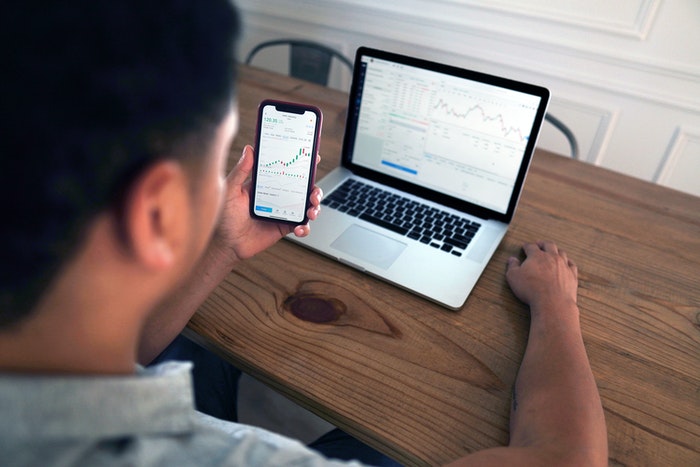
Some brokers invest in their own software development, so they have proprietary apps or desktop platforms. Others provide generic solutions like MetaTrader 4. All big brands let clients trade using laptops, tablets, and smartphones.
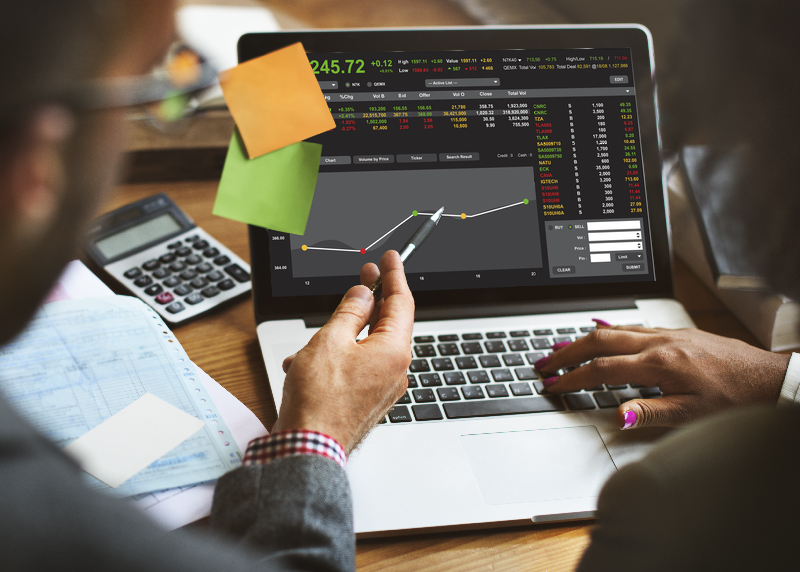
A trading terminal is an all-inclusive dashboard with price charts, indicators, and risk management tools. Traders analyze the market, make decisions and execute them in the same environment.
Key Facts
- Trading platforms have two modes — demo and live (real), so you can practice safely before making your first deposit.
- To predict trends, traders use technical indicators (moving averages, Bollinger bands, etc.) or fundamental factors (news in financial media). Both are accessible from the software.
- Every position requires automatic triggers for safer trades — Stop Loss and Take Profit.
- Different trading styles (scalping, day trading, swing trading, etc.) focus on different time frames.
- Any strategy can be profitable when applied correctly.
How Risky Is This Market?
Any form of trading is inherently risky, as financial markets are beyond anyone’s control. Risk management is an important component of profitability. In Forex, it has multiple dimensions:
- Stop Loss and Take Profit;
- Limiting volume to 1% of capital per trade; and
- Diversification.
Traders should focus on cross-market activities to protect their funds. The Loss made by trading one instrument (for example, EUR/USD) may be compensated by another asset. The choice is wide: Major, Minor, and Exotic currency pairs, precious metals, stocks, CFDs (derivatives) on stocks, commodities, market indices, and crypto. Master Forex and grow your portfolio!
Conclusion
Getting started in Forex requires more than luck — it demands knowledge, discipline, and careful planning. By understanding market basics, using reliable trading software, and implementing sound risk management, beginners can trade more confidently. Incorporating tested forex day trading strategies into your approach further increases your chances of consistent results, helping you turn your home office into a productive and profitable trading environment.
FAQs
1. What is the minimum amount needed to start trading forex for real?
Realistically, $500-$1,000 is the practical minimum, though some brokers allow less. Here’s why:
-
$100 accounts force overtrading: 1% risk = $1 → leads to excessive leverage use
-
Proper position sizing: $500 allows 1% risk = $5 per trade → manageable micro lots
-
Psychological buffer: Small losses on $500 are less emotional than on $100
-
Broker requirements: Many reputable brokers require $100-$500 minimum
Better approach: Start with demo trading for 2-3 months, then fund with $500 minimum using micro lots (0.01). Never start with less than you can afford to lose completely.
2. How do I actually make money trading forex?
You profit from exchange rate movements through these mechanics:
-
Buy low, sell high: Buy EUR/USD at 1.1000, sell at 1.1050 = 50 pip profit
-
Sell high, buy low (shorting): Sell EUR/USD at 1.1000, buy back at 1.0950 = 50 pip profit
-
Calculation: Profit = (Exit price – Entry price) × Position size × Pip value
Example: Buy 0.1 lot EUR/USD at 1.1000, sell at 1.1050. 0.1 lot = $1 per pip. 50 pips × $1 = $50 profit.
Key: Forex is zero-sum—your profit is someone else’s loss. Success requires edge + discipline.
3. What’s the difference between demo and live trading?
Demo is for learning mechanics; live is for real psychology:
-
Demo advantages: Risk-free practice, platform familiarity, strategy testing
-
Demo limitations: No emotional pressure, perfect execution, no slippage
-
Live reality: Real-money emotions, execution delays, psychological stress
Critical transition: After 2-3 months demo, start live with micro lots to experience real psychology while limiting risk. Most traders fail because demo success doesn’t translate to live performance.
4. Which currency pairs should beginners trade first?
Start with these 3 major pairs only:
-
EUR/USD: Most liquid, tight spreads, predictable movements
-
USD/JPY: Clear trends, responsive to news
-
GBP/USD: Volatile but good for learning risk management
Avoid until experienced: Exotics (USD/TRY, USD/ZAR) and minors (EUR/GBP). Majors offer: lower spreads (cost less), better liquidity (easier fills), more analysis available (easier learning).
5. How many hours per day do I need to trade successfully?
Quality over quantity—structured approach:
-
Part-time (2-3 hours/day): 30 mins pre-market analysis, 1-2 hours active trading during London/NY overlap (8 AM-12 PM EST), 30 mins review
-
Full-time (4-6 hours/day): Extended analysis, multiple sessions, deeper study
-
Weekends: 2-4 hours analysis and planning
Most important: Consistent routine beats random hours. Trading during peak liquidity (London/NY overlap) is more efficient than 24/7 trading.
Find a Home-Based Business to Start-Up >>> Hundreds of Business Listings.