








































A founder of a Central Asian restaurant group explains how to standardize technique-driven craft food without killing authenticity, using enforceable standards, trainable routines, and real time quality checks
A signature dish can get a small food business noticed, but it rarely keeps the business stable on its own. The National Restaurant Association’s 2025 State of the Restaurant Industry reports that operators are still squeezed by food and labor pressures, and stability increasingly depends on execution, not just ideas. Authentic stops being a vibe and becomes an operational claim: can you deliver the same quality on a slow Tuesday, during a rush, and with a different team on the line? The brands that endure are the ones that treat repeatability as part of the product. This article develops one practical idea for founders: to scale craft, you have to translate taste into a system that can be taught, repeated, and verified.
Gulnoza Jurayeva on Turning Craft Cooking into a Scalable Operating System
To make growth possible, Gulnoza Jurayeva treats the signature dish not as a personal performance, but as a production standard that has to survive new hires, new shifts, and new locations. She is a chef and CEO of Laghman Express, a Central Asian restaurant group built around a technically demanding flagship — hand-pulled noodles supported by an author sauce and spice system. That approach has delivered the brand strong reviews on platforms such as Google Maps and Yelp, and an active Instagram community. The Atlanta location competes annually at Halal Food Fest. The operating model has also delivered recurring paid inquiries from entrepreneurs and investors, suggesting the method is transferable beyond one set of kitchens. It has also supported high expectation service contexts, including visits by Khabib Nurmagomedov, UFC fighters such as Valentina Shevchenko, football player Fabio Cannavaro, and several Olympic champions. The brand’s ability to deliver consistent quality and reliable service at scale attracted catering orders for CUNY campuses such as Hunter College, Baruch College, and Brooklyn College, as well as Columbia University and NYU, as well as events with UN and diplomatic participation.
This article develops a practical idea for founders: to scale craft, you have to translate taste into a system that can be taught, repeated, and verified.
Many craft-focused food businesses don’t stumble because the recipe loses appeal. They run into operational limits when quality depends too heavily on the founder. In the first location, the founder is effectively the quality control system, adjusting seasoning on the fly, checking texture, and stepping in when the line starts to slip. But once the business adds new shifts, managers, or a second unit, that level of oversight isn’t scalable unless it’s replaced with a repeatable process. Without that process, output varies by staff and shift, service times become inconsistent, and leadership spends more time fixing breakdowns than building the business.
Gulnoza’s approach is to treat craft like an operating discipline, not a personality trait. She starts by identifying which elements of the product have to remain consistent and which parts can flex without changing what customers experience. For a technique-driven item like hand-pulled noodles, that means the priority isn’t simply teaching the recipe. It’s setting clear product standards and building a production process that delivers those standards reliably across different staff, shifts, and locations.
That method has three parts founders can borrow.
The Three Parts of Gulnoza Jurayeva’s Approach
First, Gulnoza turns the signature dish into standard work, not a loose set of instructions. Instead of relying on a recipe card alone, she documents the production as a controlled sequence: exact portioning rules, defined timing windows, and specific quality checkpoints that managers can verify during live service. If the team can’t check quality in real time it won’t stay consistent across shifts or locations.
“When you can measure the craft and check it the same way every shift, you stop depending on a few standout people. The line starts producing the same result because the standard is clear and it can be verified,” the expert comments.
Second, Gulnoza Jurayeva treats training as a core operating function. In a tight labor market, relying on experienced hires is inconsistent, especially when the menu depends on technique. Instead, she builds a training path that can take a new employee from entry level to station-ready with clear performance checks. Skills are broken into specific tasks, each station has defined readiness standards, and managers are taught to evaluate and coach the same way across shifts. The payoff goes beyond food quality, as staffing becomes easier to plan, shifts run with fewer disruptions, and execution stays more consistent from one location to the next.
Third, Gulnoza designs for speed without dropping freshness. Many founders assume that a complex, made-from-scratch product will inevitably slow down service. Her approach is to treat speed as a workflow decision. Gulnoza Jurayeva maps the kitchen around peak-hour conditions: how stations are set up, what gets prepped in advance, how components move from prep to assembly, and where handoffs create delays. Then Gulnoza makes explicit choices about what can be prepared ahead under strict controls and what has to be finished to order to protect quality. With those boundaries in place, service time becomes predictable because the process is built to perform under volume, not only when the founder is on the line.
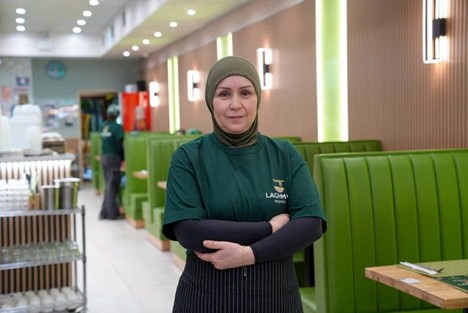
There’s a final layer that many operators overlook: make trust visible, then build operations that can sustain what customers see. Gulnoza Jurayeva uses an open kitchen where guests watch hand-pulled noodles and sauce work in real time. This way, the brand’s core claim can be evaluated on the spot. That transparency is paired with performance indicators that show repeatability at scale: the company expanded to three U.S. locations in 3 years and grew into a 100-person team. However, some challenges might appear: colleagues and competitors tend to imitate what they see, eager to reach that scale.
As the expert shares, “at a certain point, if the concept works, you start seeing copies. We reached that stage when similar places appeared in other states, using the same menu logic, presentation, and even the color scheme. Truly, surface features are easy to replicate. In this case, I recommend documenting your standards so they can be enforced and building visible signatures that only the original can perform consistently in front of guests. Copies can mimic what you look like. They struggle to match what you can execute, when the bar keeps moving.”
The business has generated sustained cash flow, enabling owner compensation above industry averages, and it has led to recurring paid inquiries from entrepreneurs and investors seeking her expertise. Investor and partner interest has translated into inbound requests to open additional locations in other states. The results of Gulnoza’s approach also support continued expansion: a fourth location is planned for 2026 on Emmons Avenue, a high-traffic waterfront corridor in Brooklyn that draws both tourists and local residents.
Once you grow past the stage where the founder is the quality system, taste stops being an advantage unless you can enforce it. Gulnoza Jurayeva’s model turns every rush into a test of control, with standards that hold when she is not on the line, training that produces station-ready performance on schedule, and a workflow that keeps speed predictable without trading away freshness.
Find a Home-Based Business to Start-Up >>> Hundreds of Business Listings.