








































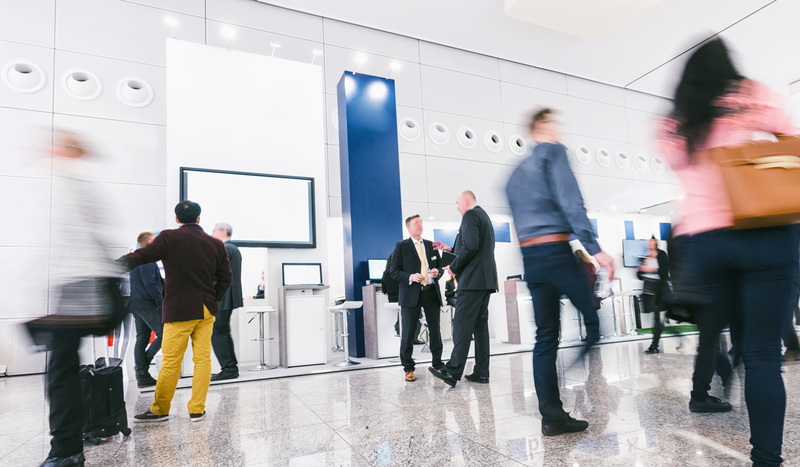
Trade shows are overwhelming by design. Step into any exhibition hall and you’ll immediately feel it- visual noise coming from every direction. Bright signage. Massive screens looping product demos. Bold graphics competing against even bolder graphics. People walking fast, scanning constantly, filtering everything they see in real time. Visitors don’t consciously evaluate every booth. They can’t.
Instead, their brains rely on rapid visual shortcuts. They look for signals of relevance, professionalism, and safety. Within seconds- sometimes less- they decide whether to approach or move on. Most booths never make it past that first subconscious filter.
It’s not necessarily because those booths lack good products. Often, it’s because their visual presentation fails to trigger attention. Attention is selective.
In environments overloaded with stimuli, the brain becomes more aggressive in filtering information. Anything that feels visually weak, cluttered, or structurally uncertain gets dismissed instantly. Visitors don’t pause long enough to analyze why. They simply continue walking. This makes visual design one of the most powerful tools available to exhibitors. Because before conversation happens, perception happens. And perception begins with what visitors see- and how that visual experience makes them feel.
The Visual Power of Modern Trade Show Displays in Shaping First Impressions
First impressions at modern trade shows are almost entirely visual.
Before visitors hear a brand name. Before they understand what a company offers. Before they interact with staff- they see the display. That visual encounter shapes everything that follows. Modern trade show displays are engineered specifically to control that moment, presenting brands through seamless graphics, illuminated surfaces, and precise structural design. This precision communicates confidence.
Smooth surfaces suggest attention to detail. Even lighting enhances color depth and clarity. Structured environments signal stability. Together, these elements create an immediate emotional response. Visitors perceive the brand as professional, reliable, and established- often without realizing why. There’s something reassuring about visual consistency.
Displays that appear intentional rather than improvised reduce uncertainty. Visitors feel more comfortable approaching structured environments. The space feels safe to enter. Predictable. Organized. And that comfort increases engagement.
Visitors who feel visually comfortable are more likely to slow down. They observe longer. They process messaging more completely. This extended attention creates opportunities for meaningful interaction.
It’s a subtle shift- but incredibly important.
Because engagement rarely begins with conversation.
It begins with visual trust.
How Lighting, Scale, and Visual Clarity Control Movement Patterns
Light influences behavior more than most exhibitors realize. Human vision naturally gravitates toward illuminated surfaces. Brightness creates contrast. Contrast attracts attention. In large exhibition halls, where ambient lighting is inconsistent, internally illuminated displays maintain visual dominance. Visitors notice them from greater distances.
This early visibility allows displays to influence movement patterns. People adjust their walking direction slightly. They approach more directly. They pause sooner. Lighting doesn’t just enhance visibility- it guides navigation.
Scale also matters.
Large, seamless visuals communicate importance. They signal that the brand has invested in its presence. Visitors interpret scale as authority. Even before reading messaging, they associate larger, well-lit displays with credibility.
Wrinkled banners, uneven lighting, or fragmented graphics introduce visual friction. That friction weakens engagement. Visitors sense imperfection immediately. They hesitate. Seamless illuminated displays remove that hesitation. They create visual calm in chaotic environments. And calm attracts attention.
Creating Emotional Comfort Through Immersive Display Environments
Trade show visitors experience cognitive fatigue quickly. After walking through dozens of booths, their ability to process information declines. They become more selective. More cautious. Less willing to engage with displays that feel visually confusing or poorly structured.
Immersive display environments counteract this fatigue. When displays use seamless visuals, structured layouts, and controlled lighting, they create spatial coherence. Visitors understand the environment instantly. They don’t need to interpret visual chaos. Their brains relax. That relaxation encourages exploration.
Visitors step closer. They remain longer. They absorb messaging more effectively. The display environment becomes an extension of the brand rather than a barrier between brand and visitor. Emotional comfort accelerates engagement.
People prefer interacting with brands that feel visually stable and professionally presented. These environments reduce psychological resistance. Conversations begin more naturally. And natural conversations create stronger connections.
The Role of Visual Consistency in Building Trust and Brand Authority
Consistency is one of those invisible forces people rarely talk about- yet everyone feels it.
When visitors approach a booth where every visual element aligns perfectly- graphics, lighting, structure, spacing- they immediately sense order. Nothing feels accidental. Nothing feels rushed. The display communicates control. And control, in business environments, translates directly into trust. Trust isn’t always earned through words.
If graphics appear stretched or lighting looks uneven, visitors may not consciously identify the flaw, but their brain registers uncertainty. That uncertainty creates hesitation. Hesitation shortens engagement time. Visitors move on.
But when everything looks precise- when images remain smooth, colors remain accurate, and structures remain aligned- hesitation disappears. Visitors feel more confident in what they’re seeing. They assume the brand operates with the same level of precision reflected in its display. It’s a psychological shortcut. Efficient. Automatic.
Visual consistency also improves brand memorability. When every element reinforces the same visual identity, visitors retain stronger mental impressions. Days later, when recalling the exhibition, they remember booths that felt visually complete. Not necessarily the loudest booths. The most coherent ones.
How Modular Display Systems Improve Interaction Opportunities
Engagement isn’t just about attracting attention- it’s about sustaining it. Modern trade show display systems are designed to support interaction, not simply observation. Modular layouts allow exhibitors to create spaces that invite movement rather than block it. Open entrances. Clear pathways. Defined zones for conversation. These structural choices influence how visitors behave within the booth. Visitors are more likely to enter spaces that feel accessible.
Closed or cluttered layouts create subtle barriers. Visitors hesitate. They remain outside the booth perimeter, observing from a distance instead of stepping inside. That distance reduces the likelihood of meaningful interaction. Modular displays eliminate that barrier.
By allowing flexible configurations, exhibitors can design environments that encourage natural flow. Visitors move through the space comfortably. They don’t feel trapped or pressured. They explore at their own pace.
This autonomy improves engagement quality.
Memory Formation: Why Some Booths Are Remembered and Others Forgotten
Trade shows are intense experiences. Visitors encounter hundreds of brands in a single day. Most blur together quickly.
Visual clarity plays a critical role in that process. Displays that feel visually calm are easier for the brain to encode. Structured environments reduce cognitive effort. Visitors process information more efficiently, increasing the likelihood of retention.
Illuminated displays create visual anchors in memory. They remain distinct even after visitors leave the exhibition hall. When recalling the event later, visitors remember the booths that appeared visually stable and clear. Emotion reinforces memory further.
If visitors feel comfortable inside a display environment, they associate that comfort with the brand itself. Emotional comfort strengthens recall. Even subtle emotional responses- feeling welcomed, feeling calm- influence long-term memory formation.
Displays that combine seamless visuals, balanced lighting, and spatial coherence create ideal conditions for memorability. And memorability extends brand influence far beyond the exhibition floor.
The Future of Trade Show Engagement Through Advanced Display Systems
Trade show design continues to evolve. Simple signage is no longer enough. Visitors expect environments. They expect visual precision. They expect brands to present themselves with clarity and confidence.
Modern display systems meet these expectations by combining engineering, lighting, and visual continuity into unified environments. These systems don’t just display graphics- they shape perception. As technology advances, this influence will only increase.
LED lighting becomes more refined. Fabric printing becomes more precise. Modular systems become more adaptable. Displays evolve from temporary installations into permanent brand assets.
Find a Home-Based Business to Start-Up >>> Hundreds of Business Listings.


