









































Key Takeaways
- Understand the unique features and benefits of TFSAs, RRSPs, and FHSAs.
- Learn how each account aligns with different financial objectives.
- Discover strategies for combining these accounts to maximize savings.
Table of Contents
- Introduction
- Understanding the Tax-Free Savings Account (TFSA)
- Exploring the Registered Retirement Savings Plan (RRSP)
- Delving into the First Home Savings Account (FHSA)
- Comparing Key Features of TFSA, RRSP, and FHSA
- Strategies for Maximizing Your Savings
- Common Mistakes to Avoid
- Conclusion
Introduction
The landscape of personal savings in Canada presents several powerful options, but understanding which account type is best for your goals can make a significant difference. TFSAs, RRSPs, and FHSAs each provide distinct tax advantages and withdrawal rules, offering flexibility and potential growth for different stages in life. Before you decide where to put your savings, it’s wise to weigh the benefits of each.
For Canadians, factors like taxable income, timing, and long-term objectives all play a role in optimizing financial planning. Comparing your choices side by side can give you a clearer picture of how each account could serve you. To begin your research, consider exploring this helpful guide: Compare TFSA, RRSP, and FHSA in Canada.
Choosing between these accounts depends not only on tax treatment, but also on factors such as contribution limits, access to savings, and your specific short- or long-term financial needs. Whether you’re saving for retirement, planning to buy your first home, or building a financial safety net, understanding the fine print ensures you don’t leave money on the table.
It’s also important to consider how government programs may affect your choices. The Canadian government regularly updates contribution limits and account rules, making it essential to stay informed through reputable sources, such as the Canada Revenue Agency.
Understanding the Tax-Free Savings Account (TFSA)
The Tax-Free Savings Account (TFSA), launched in 2009, is a versatile savings vehicle open to Canadians aged 18 and older. With a TFSA, any interest, dividends, or capital gains earned are completely tax-free, not only while the funds remain invested, but also upon withdrawal. TFSAs do not offer a tax deduction for contributions; however, their flexibility makes them perfect for both short- and long-term savings goals, from vacation funds to retirement supplements.
TFSAs also provide unmatched access to your funds, allowing withdrawals at any time for any purpose without incurring tax consequences. Furthermore, any amount withdrawn gets re-added to your contribution room in the following year. This added flexibility, combined with tax-free growth, makes the TFSA an efficient tool for building an emergency fund or investing in market opportunities without a future tax hit.
Exploring the Registered Retirement Savings Plan (RRSP)
The Registered Retirement Savings Plan (RRSP) has been a staple of Canadian retirement planning since its introduction in 1957. The primary advantage lies in its tax-deferral structure: contributions are deducted from your taxable income, reducing your yearly taxes. Investments within an RRSP grow untaxed, and withdrawals, usually made in retirement, are taxed as income—often at a lower rate than during your peak earning years.

RRSPs are especially important for long-term retirement savings and can be utilized strategically for major life purchases through programs such as the Home Buyers’ Plan and the Lifelong Learning Plan. The annual contribution limit is 18% of your previous year’s earned income, up to a maximum ($31,560 for 2024), making it ideal for high-income earners looking to minimize current tax liabilities and secure their retirement.
Delving into the First Home Savings Account (FHSA)
Introduced in 2023, the First Home Savings Account (FHSA) combines the best features of TFSAs and RRSPs to help Canadians purchase their first home. Contributions are tax-deductible, reducing your tax bill today. Investment growth within the account is tax-free, and qualified withdrawals for home purchases are also tax-free. Individuals can contribute up to $8,000 per year with a lifetime cap of $40,000. If a house isn’t purchased within 15 years, unused FHSA funds can seamlessly transfer into an RRSP without impacting RRSP contribution room.
This makes the FHSA an excellent fit for those who have a clear intention of purchasing their first home within the next decade or so, offering dual advantages: immediate tax benefits and potentially tax-free withdrawals for a qualifying home purchase. For more details, see this MoneySense analysis of Canadian savings accounts.
Comparing Key Features of TFSA, RRSP, and FHSA
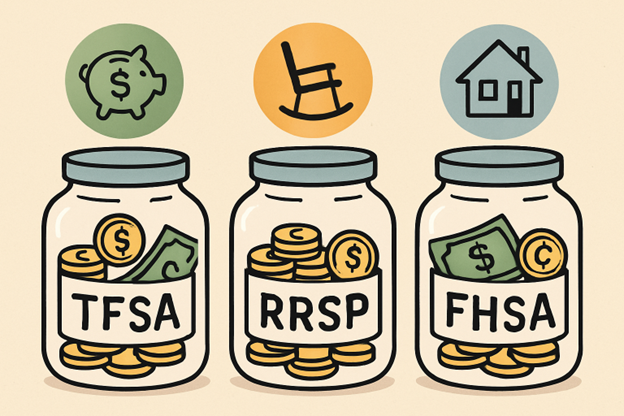
The three account types differ in several important ways, particularly in how contributions, growth, and withdrawals are treated for tax purposes. A Tax-Free Savings Account (TFSA) does not offer tax-deductible contributions, but all investment growth and withdrawals are completely tax-free and can be accessed at any time. A Registered Retirement Savings Plan (RRSP) allows tax-deductible contributions and tax-deferred growth; however, withdrawals are generally taxable unless made under specific programs. The First Home Savings Account (FHSA) combines features of both, offering tax-deductible contributions and tax-free growth, with tax-free withdrawals when used to purchase a first home. Contribution limits also vary, making these distinctions essential when planning for retirement or homeownership.
Strategies for Maximizing Your Savings
-
First-Time Homebuyers:
Start by maximizing your FHSA contributions to lock in both immediate tax savings and future tax-free withdrawals. Consider topping up your RRSP and leveraging the Home Buyers’ Plan to access an additional $35,000 per person towards your home purchase.
-
Retirement Planning:
Prioritize RRSP contributions if your income is high, as the upfront tax deduction offsets your tax bill today, and investments can grow for decades tax-deferred. Supplement this by using a TFSA for growth that remains tax-free, even when you make withdrawals in retirement, which can complement government retirement benefits.
-
Flexible & Short-Term Needs:
Use your TFSA for an emergency fund or other short-term savings. Withdrawals won’t be taxed or impact government benefits, making it an ideal parking spot for accessible, ready cash.
Common Mistakes to Avoid
-
Over-Contributing:
The Contribution room can be complex to track. Exceeding the limits in any account triggers a penalty of 1% per month on the excess amount, so check your available room regularly using the CRA portal or a trusted advisor.
-
Misunderstanding Withdrawal Rules:
RRSP withdrawals outside programs like the HBP are counted as taxable income and can quickly push you into a higher tax bracket. Always understand the implications before you tap these funds.
-
Poor Account Alignment:
Ensure your contributions are directed into the accounts most closely aligned with your goals—TFSA for flexibility and accessibility, RRSP for long-term retirement savings, and FHSA for first-home buyers.
Conclusion
Ultimately, your choice between a TFSA, RRSP, and FHSA should reflect your personal financial picture—your goals, timeline, and income level. Thoroughly understanding the structure and restrictions of each can help you maximize your contributions, avoid tax penalties, and best support major life milestones.
Consulting a financial planner or regularly visiting resources such as MoneySense’s guide on RRSPs and TFSAs can help you stay updated and make informed decisions as your life and goals evolve.
Find a Home-Based Business to Start-Up >>> Hundreds of Business Listings.