











































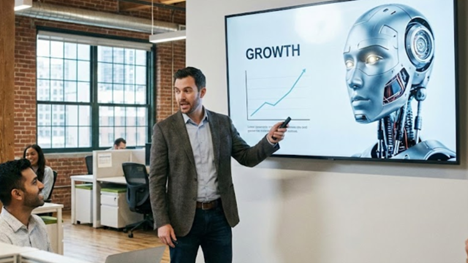
AI assistants are an intriguing part of the fast-evolving AI market. The technology is growing better and better by the day, although it is still very much in its infancy. There are also ethical and practical concerns with giving AI autonomous access to real world systems, which are still being discussed. However, that has not stopped AI developers from making things so far – and AI assistants for marketing are already being used by millions of people worldwide despite the risks and hurdles. The market is worth some $7 billion annually as of 2025, and analysts predict it to hit $30 billion a year by 2030. So, what do you need to know about it?
If this uptake is as expected, the second half of the 2020s could introduce a new kind of online economics – one where marketing is less focused on the human, but the tools that we use to discover products and services online. This is already true to an extent, with the huge growth of search engine optimization, but the changes with AI agents could prove just as big of a jump as to search engines in many ways. This article will look at exactly how we got to this point, and the potential for this technology to massively change the online landscape in all kinds of businesses.
Text Models to Voice Helpers to Autonomous Agents
At the moment, the way most people are aware of AI is through Large Language Models (LLM’s) like ChatGPT, Google’s Gemini or DeepSeek. However, an increasing field of research turns these tools from information agents to active assistants that can actually interact with other systems on the internet or even the web of things.
If you’re an entrepreneur thinking about what this all means for small business branding, you’re not alone. Expert branding agencies can help you navigate the complex world of AI, from how to use it most efficiently to the ethical and practical concerns that come with powerful tool. And, of course, the knowledge to future-proof your business model in this fast evolving market.
The ability to interact with external systems, as well as acting with some autonomy once set to a task, is truly revolutionary. For example, virtual assistants can, right now, perform tasks such as:
- Booking appointments via supported platforms, such as restaurant tables and performance tickets
- Monitor prices of stocks and commodities, or consumer goods, and notify users or even make a purchase at a certain price point
- Control smart home devices, such as turning on music or lights to just before arriving home
- Automatically schedule and send emails, including for organizing events
Agents have the ability to perform multiple of these tasks in combination, and on different schedules. For example, you could prompt an AI assistant to plan a customised birthday party – and then it would be capable of organising, booking and scheduling delivery of everything you need for the big day.
In reality, the rollout of AI agent access has been slower than the above example. Many companies and individuals are wary of allowing agents to actually manage real world tasks, as they do sometimes go wrong or make mistakes – which can be risky with real money and people’s time and work on the line.
Agent Creators and Platforms Could be a Huge Beneficiary of New Economics
Nevertheless, once the kinks have been ironed out and the technology is both ethically sound and practical to roll out – it could well change the online world entirely. In fact, even AI chat models as we currently know them are having a big influence on online marketing.
For example, OpenAI, online marketplace Shopify and payment operator Stripe are working out integration for in-app purchases directly facilitated by ChatGPT, showing the growing role of ai assistants for marketing. This kind of thing could see businesses marketing to AI firms, to get their products placed higher in search results, or even a new kind of SEO where information is specifically crafted to be prioritised by AI when it searches online databases.
Google has recently apparently internally mooted charging users for AI powered searches while leaving the traditional search engine separate and free. This could create a bifocal online economy, with some business concerned with marketing to the old-school manual searchers and others more interested in working with the AI and their developers to target customers finding products through that.
Risks and Regulations to Pay Attention To
Of course, this can lead to risks. While the powerful search algorithms of online giants may be complex, they aren’t quite as unfathomable as the inner working of many AI models. While the technology is improving fast, most people are aware that AI makes mistakes and “hallucinates” – so the risk of that happening when engaged in real world tasks is not completely zero. But, on the other hand, the same can be said of people and AI is already better at some tasks overall.
Nevertheless, its hard to imagine many important day to day services in government – such as social security, taxes and other legally required tasks – would be suitable for handing directly over to AI for many people.
But of course, AI has its evangelists who will use it for almost anything it is capable of. Thousands if not millions of people are right now using these assistants in a limited fashion, and others are working on making them even more integrated and efficient. That market is only set to grow, and it is so potentially revolutionary that being at least aware of the curve is important for any business.
Find a Home-Based Business to Start-Up >>> Hundreds of Business Listings.


