









































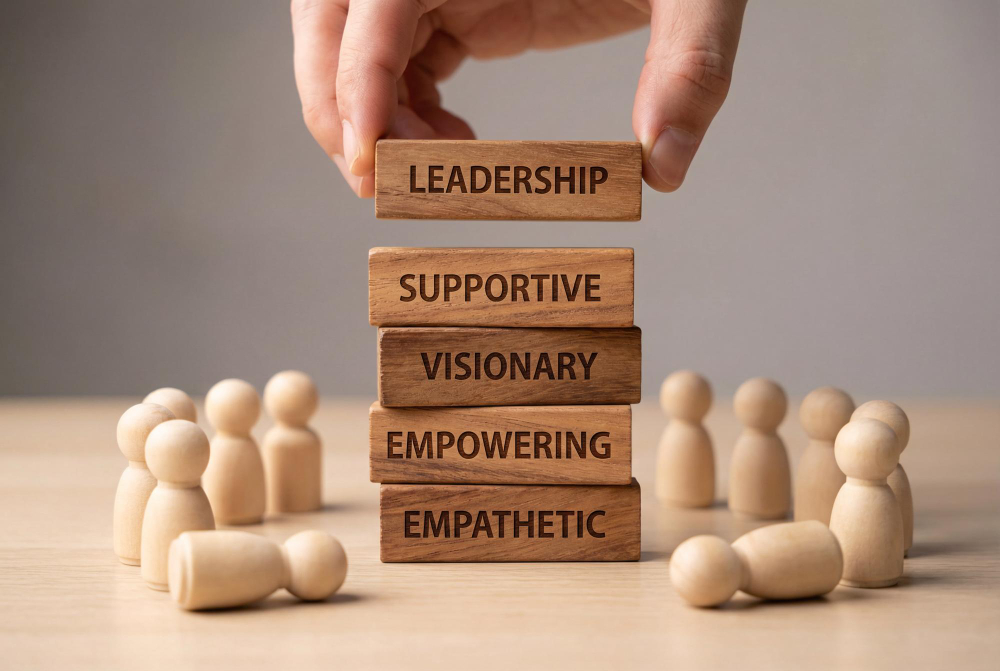
Leadership Qualities is not just about holding a position of authority—it’s about influence, responsibility, and the ability to guide others toward a shared vision. Whether you’re leading a company, a small team, or even managing personal goals, your success largely depends on the qualities you bring to the table.
Great leaders are not born with all the necessary traits; they develop them over time through experience, learning, and self-awareness. From communication and decision-making to empathy and resilience, leadership qualities shape how effectively you inspire and manage others.
If you want to become a better leader or understand what makes leadership effective, this guide covers 100 essential leadership qualities along with practical insights on how to develop them.
Key Takeaways
- Only 10% of people are natural leaders — the remaining 90% can develop these qualities through training and practice.
- According to 2025 Gallup research, hope (56%) and trust (33%) are the two most important qualities followers seek in leaders worldwide.
- Companies that invest in leadership development see 25% better business outcomes.
- Emotional intelligence is rated as a top leadership capability for 2025 by nearly half (47%) of HR professionals surveyed.
- 77% of organizations currently lack sufficient leadership depth across all levels.
- Leadership qualities fall into five core categories: character, communication, cognitive, social, and strategic.
Why Leadership Qualities Matter: The Data
Before exploring the 100 qualities themselves, it is worth understanding the scale of the leadership gap and what is at stake. The numbers tell a sobering story — and a hopeful one.
When leadership quality declines, so does trust. Research from Exec Learn shows that trust in managers dropped from 46% in 2022 to just 29% in 2024 — a troubling decline that directly links to turnover, engagement loss, and reduced productivity. Great leadership qualities are not optional extras; they are business-critical foundations.
The 5 Core Categories of Leadership Qualities
Leadership experts typically cluster leadership traits into five broad domains. Understanding these categories helps you assess where you are strong and where you need to grow.
1. Character Qualities (The Foundation)
Character is the bedrock of leadership. Without it, other skills become instruments of manipulation rather than inspiration. These traits define who a leader is when no one is watching.
2. Communication Qualities (The Connector)
Effective leaders are not always the loudest voices in the room — but they are always the clearest. Communication mastery includes both speaking and the often-undervalued art of listening.
3. Cognitive Qualities (The Thinker)
Leadership requires making complex decisions with incomplete information. Cognitive qualities determine the quality of those decisions and how leaders adapt when circumstances change unexpectedly.
4. Social and Emotional Qualities (The Human Leader)
The shift toward “human leadership” — leading with empathy, authenticity, and relational intelligence — has accelerated significantly. Research from Gartner identifies human leadership as the next evolution of the discipline, and the data strongly supports this direction.
5. Strategic and Operational Qualities (The Executor)
Vision without execution is daydreaming. These qualities ensure that a leader’s ideas translate into tangible outcomes for their organization, team, or community.
The 10 Most Critical Leadership Qualities
While all 100 traits matter, modern research consistently elevates a core group of qualities as the most impactful — especially given today’s hybrid work environments, global teams, and rapidly changing business landscapes.
1. Emotional Intelligence (EQ)
Emotional intelligence — the ability to recognize, understand, and manage your own emotions and those of others — has become the defining leadership quality of the decade. According to the HBR 2025 Global Leadership Development study, 47% of HR professionals rate EQ as more critical than ever before, and 42% of organizations are actively expanding their emotional intelligence training programs in response. Leaders with high EQ create psychologically safe environments where teams perform at their best.
2. Integrity and Trustworthiness
Trust in leadership is in freefall globally. Gallup data shows that trust in managers dropped from 46% in 2022 to just 29% in 2024. The leaders who reverse this trend do so not through programs or policies but through consistent, honest behavior over time. Integrity — doing what you say, saying what you mean, and acknowledging when you are wrong — is the single fastest route back to high-trust relationships with your team.
3. Vision and Strategic Thinking
A leader without vision is simply an administrator. The best leaders paint a clear, compelling picture of where the organization is heading and why each team member’s role matters within that journey. Strategic thinking means not just reacting to today’s pressures but actively shaping tomorrow’s possibilities.
4. Empathy and Compassion
Gallup’s 2025 global study of 52 countries found that hope (56%) and trust (33%) dominate what followers want from leaders — both of which flow directly from empathetic leadership. Empathy is not a “soft” skill; it is a quantifiable performance driver. Teams led by empathetic managers report 37 percentage points higher engagement than those who feel unseen.
5. Communication Mastery
Poor communication is the root cause of most leadership failures. Great leaders communicate with clarity, frequency, and purpose. They give feedback that improves rather than deflates, listen more than they speak, and adapt their message to different audiences without losing its core meaning. Notably, only 27% of employees report that their leader keeps them well-informed — a gap that represents enormous leadership opportunity.
6. Decisiveness
The ability to make timely, well-reasoned decisions — even under uncertainty — separates leaders from followers. Indecisiveness is itself a decision: it defaults authority to circumstance rather than intention. Great leaders gather the available information, weigh the options, commit to a course, and accept responsibility for the outcome regardless of how it unfolds.
7. Accountability
Accountability in leadership means holding yourself to the same standard you hold others. Leaders who model ownership — saying “I made a mistake, here is how we fix it” — build cultures where errors are learning opportunities rather than sources of fear. This single quality has an outsized impact on psychological safety and team performance.
8. Adaptability and Resilience
The pace of change in modern organizations is relentless. Leaders who resist change become obstacles; those who model adaptability inspire their teams to navigate uncertainty with confidence. Resilience — the ability to absorb setbacks and return stronger — is equally crucial in a world where 65% of leaders now report experiencing burnout symptoms at some point in their careers.
9. Coaching and Talent Development
The best leaders multiply themselves by developing others. Research from O.C. Tanner shows that only 52% of leaders regularly introduce employees to mentors, and just 56% encourage cross-team collaboration — meaning most organizations are dramatically under-investing in human development. Leaders who coach, mentor, and invest in their teams see compounding returns in engagement and retention.
10. Inclusive Leadership
Inclusive leaders who actively value diverse perspectives outperform their peers significantly. McKinsey data confirms that organizations with the most inclusive leadership models achieve 4.2 times better financial performance than those that do not prioritize this dimension. Inclusive leadership is not a values statement — it is a competitive strategy.
Expert Insight
“Leadership is not about being in charge. It is about taking care of those in your charge. The qualities that make someone worth following have never changed: honesty, courage, and a genuine concern for the people around them.”
Leadership Styles and Their Core Qualities: A Comparison
Different leadership styles draw on different combinations of qualities. Understanding which style fits your context helps you deploy the right traits at the right time.
| Leadership Style | Core Qualities Emphasized | Best For | Potential Weakness |
|---|---|---|---|
| Transformational | Vision, inspiration, emotional intelligence, charisma | Culture change, innovation, rapid growth | Can overlook operational detail |
| Servant | Empathy, humility, accountability, trust-building | Long-term team development, high-trust cultures | Can seem indecisive in crises |
| Transactional | Goal-setting, performance management, consistency | Process-driven environments, clear objectives | Low creativity and engagement over time |
| Democratic | Active listening, inclusivity, collaboration | Creative teams, complex problem-solving | Decision-making can be slow |
| Coaching | Mentoring, patience, talent development, feedback | Individual growth, career development | Time-intensive; not suited to crisis |
| Agile | Adaptability, decisiveness, systems thinking, speed | Fast-changing markets, digital transformation | Can lack stability and long-term structure |
Common Leadership Mistakes (And How to Avoid Them)
Knowing what great leadership looks like is only half the equation. Understanding the most common pitfalls helps you recognize and correct them before they damage your team’s trust and performance.
Micromanaging
Controlling every detail signals distrust and stifles initiative, causing top performers to disengage or leave.
The Fix
Delegate outcomes, not tasks. Set clear goals, then trust your team to find the best path to reach them.
Avoiding difficult conversations
Letting problems fester is not kindness — it is avoidance that accumulates resentment and reduces accountability.
The Fix
Address issues early with empathy and clarity. Frame feedback around behavior, not identity.
Leading without listeningLeaders who do all the talking miss the intelligence their teams hold. This creates echo chambers and blind spots.
The Fix
Practice the 70/30 rule: let your team do 70% of the talking in one-on-ones and team meetings.
Claiming credit; deflecting blame
This is one of the fastest ways to destroy trust. Research shows 79% of employees leave leaders who make them feel undervalued.
The Fix
Publicly recognize your team’s contributions. Own mistakes privately and publicly — then focus on solutions.
Best Practices for Developing Leadership Qualities
Leadership quality development is not an event — it is a continuous practice. Organizations that build development into their operational rhythm outperform those that treat it as an occasional training program.
- Conduct a personal leadership audit every quarter, rating yourself honestly across all five quality categories.
- Seek 360-degree feedback from peers, direct reports, and supervisors — and act visibly on what you learn.
- Find a mentor or executive coach who will challenge your blind spots, not just validate your strengths.
- Study leaders you admire and those you do not — both provide equally valuable lessons about the qualities that build and erode trust.
- Create psychological safety in your team by openly sharing your own learning edge and development areas.
- Apply the 70-20-10 development model: 70% on-the-job experiences, 20% coaching and mentoring, 10% formal training.
- Prioritize emotional intelligence development — it is the single most transferable leadership quality across every role, industry, and level.
- Measure leadership impact through team engagement scores, retention data, and performance outcomes — not just self-perception.
Real-World Examples of Leadership Qualities in Action
Case 1: Integrity in a Crisis
When Johnson & Johnson faced the 1982 Tylenol crisis, CEO James Burke demonstrated decisive integrity by immediately recalling 31 million bottles despite enormous financial cost. This single act of transparent, values-driven leadership rebuilt consumer trust and became a textbook example of how character-based leadership sustains organizations through crises that would otherwise destroy them.
Case 2: Empathy at Scale
Satya Nadella’s transformation of Microsoft after becoming CEO in 2014 is fundamentally a story about empathy and growth mindset — two leadership qualities he has written and spoken about extensively. By shifting the organizational culture from competitive internal politics to collaborative curiosity, Nadella oversaw a company resurgence that added more than $2 trillion in market value over a decade.
Case 3: Inclusive Leadership and Business Results
Companies like Accenture and Unilever that have invested most deeply in inclusive leadership development consistently outperform sector peers. McKinsey’s research attributes this directly to the quality of decision-making that emerges when diverse perspectives are genuinely valued and incorporated — not just represented on organizational charts.
Frequently Asked Questions About Leadership Qualities
What are the most important leadership qualities?
Can leadership qualities be learned, or are they innate?
What leadership qualities do employees value most?
Find a Home-Based Business to Start-Up >>> Hundreds of Business Listings.