










































Picture this: at 9:02 a.m. your Zoom gallery fills—but the contract you just perfected won’t upload, and the client is watching. For the 18 percent of U.S. employees who now work entirely from home, reliable home office internet is payroll, reputation, and sanity rolled into one.
That’s why we’re pitting Spectrum’s nationwide cable network against WOW!’s rising fiber lines. Over the next few minutes we’ll unpack speed, price, uptime, equipment, and support so your home office hums—not hiccups—and you know exactly which installer to trust before the next big file is due.
Spectrum vs. WOW! at a glance
Network & Reach
A stalled upload during a client video call shows how critical reliable home office internet has become.
- Spectrum’s hybrid fiber-coax (HFC) network already passes more than 57 million homes across 41 states.
- WOW! serves 19 metro markets in six Southeastern and Midwestern states (Michigan, Alabama, Tennessee, South Carolina, Georgia, and Florida) and is rapidly overlaying each area with all-fiber builds.
Pricing Basics
- Spectrum advertises 500 Mbps for $50 per month and 1 Gbps for $70 per month on a 12-month promo, with no contracts and no data caps.
- WOW!’s list price for 300 Mbps is $40 per month; limited-time promos in new fiber cities have dipped to $25. Its 1 Gbps fiber tier is $50 per month, and multi-gig options top out at 5 Gbps.
Speed Ceilings
- Spectrum: up to 1 Gbps down / 35 Mbps up for most homes, with a 2 Gbps option rolling out in select ZIP codes.
- WOW!: 1.2 Gbps down / 50 Mbps up on legacy cable; 2–5 Gbps symmetrical in active fiber markets.
Plan Flexibility
- Both home office internet providers keep data unlimited. Spectrum stays strictly month-to-month, while WOW! lets you lock promo pricing with an optional two-year contract.
| Spectrum | WOW! | |
| Network type | Cable (HFC) | Cable + Fiber |
| Max download speed | 1 Gbps (2 Gbps limited) | 1.2 Gbps cable / 5 Gbps fiber |
| Max upload speed | 35 Mbps | 50 Mbps cable / 5 Gbps fiber |
| Promo price* | $50 for 500 Mbps | $40 for 300 Mbps (promos as low as $25) |
| Contracts | None | Optional 24-month price-lock |
| Data caps | None | None on 300 Mbps and above |
| Homes / states | 57 million homes, 41 states | 19 markets, 6 states |
First-year rates shown. Always confirm current offers at your address.
Internet Speed & Performance
Download and Upload Headroom
For everyday video calls and cloud docs, 500 Mbps is more than most home offices need, but the gap between Spectrum and WOW! widens once you sprint past that baseline.
- Spectrum now starts at 500 Mbps down / 10 Mbps up for $50 per month and tops out at 1 Gbps down / 35 Mbps up. A 2 Gbps option is appearing in select ZIP codes.
- WOW! still offers 300 Mbps cable plans, yet new fiber cities unlock 2 Gbps, 3 Gbps, and 5 Gbps (all with symmetrical uploads).
Why Uploads and Latency Matter
Sending a 1 GB design file:
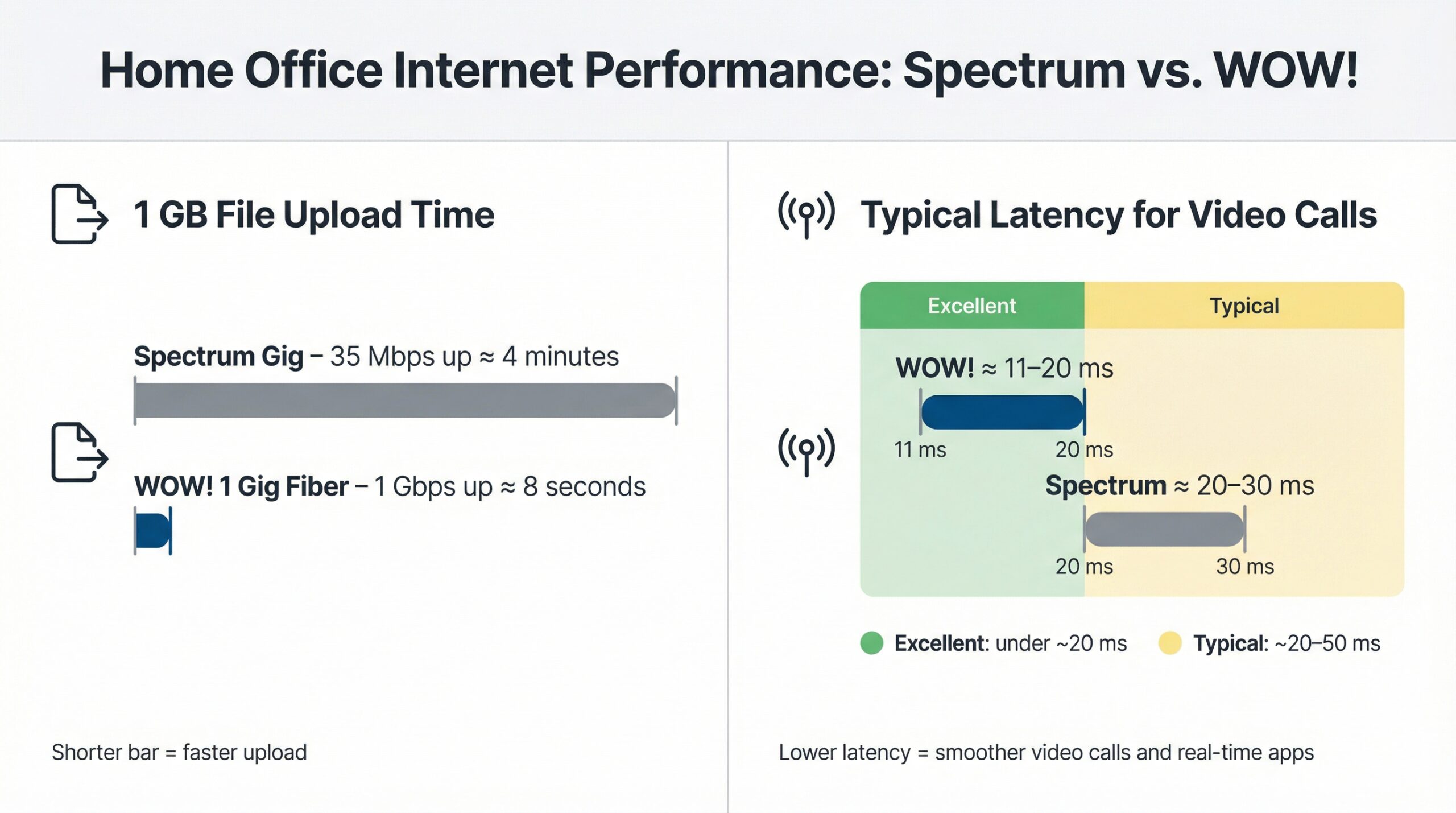
WOW’s 1 Gig fiber uploads a 1 GB file in seconds and typically delivers lower latency than Spectrum Gig.
- on Spectrum Gig (35 Mbps up) ≈ 4 minutes
- on WOW! 1 Gig fiber (1 Gbps up) ≈ 8 seconds
Lower ping keeps video calls crisp.
Independent tests place WOW!’s average latency at about 11–20 ms compared with Spectrum’s 20–30 ms, a small edge you may notice when screen-sharing or gaming after hours.
WOW!’s own speed-test results guide for home office internet notes that ping under roughly 20 milliseconds is excellent for real-time apps and that 20–50 milliseconds is typical, with higher numbers more likely to cause choppy calls and delays.
Framed that way, both home office internet providers land in the “excellent to good” range for most home offices, with WOW!’s slightly lower latency giving heavy Zoom users and cloud creators a bit more breathing room.
Real-World Takeaway
If your workday rarely leaves the browser, Spectrum’s gig tier is plenty. When you regularly push multi-gig backups or edit in the cloud, WOW!’s symmetrical fiber cuts wait time to seconds and leaves bandwidth free while the household streams 4K. Less waiting equals more billable work.
Pricing, Plans & Value for Money
Promo Rates vs. the Real Two-Year Bill
Sticker prices look sweet until month 13. Here’s how the math looks today:
- Spectrum advertises 500 Mbps for $50 per month and 1 Gbps for $70 per month during the first year. After the promo, WhistleOut notes rates typically rise $20 to $30, depending on market.
- WOW! lists 300 Mbps for $40 per month and 1 Gbps cable or fiber for $50 per month on its FCC broadband labels. New fiber markets sometimes launch a $25 introductory offer, but $40 is the standard rate.
A Sample 24-month Comparison (1 Gbps tier, Equipment Included)
| Year 1 | Year 2* | Two-year total | |
| Spectrum Gig | $70 × 12 = $840 | ~$90 × 12 = $1,080 | $1,920 |
| WOW! 1 Gig | $50 × 12 = $600 | $60 × 12 = $720 | $1,320 |
Second-year figures use the midpoint of Spectrum’s usual $20–$30 bump and WOW!’s $10 increase reported on recent bills.
That $600 difference buys a Wi-Fi 6E mesh kit or an extra year of cloud-backup storage, upgrades that directly safeguard your billable hours.
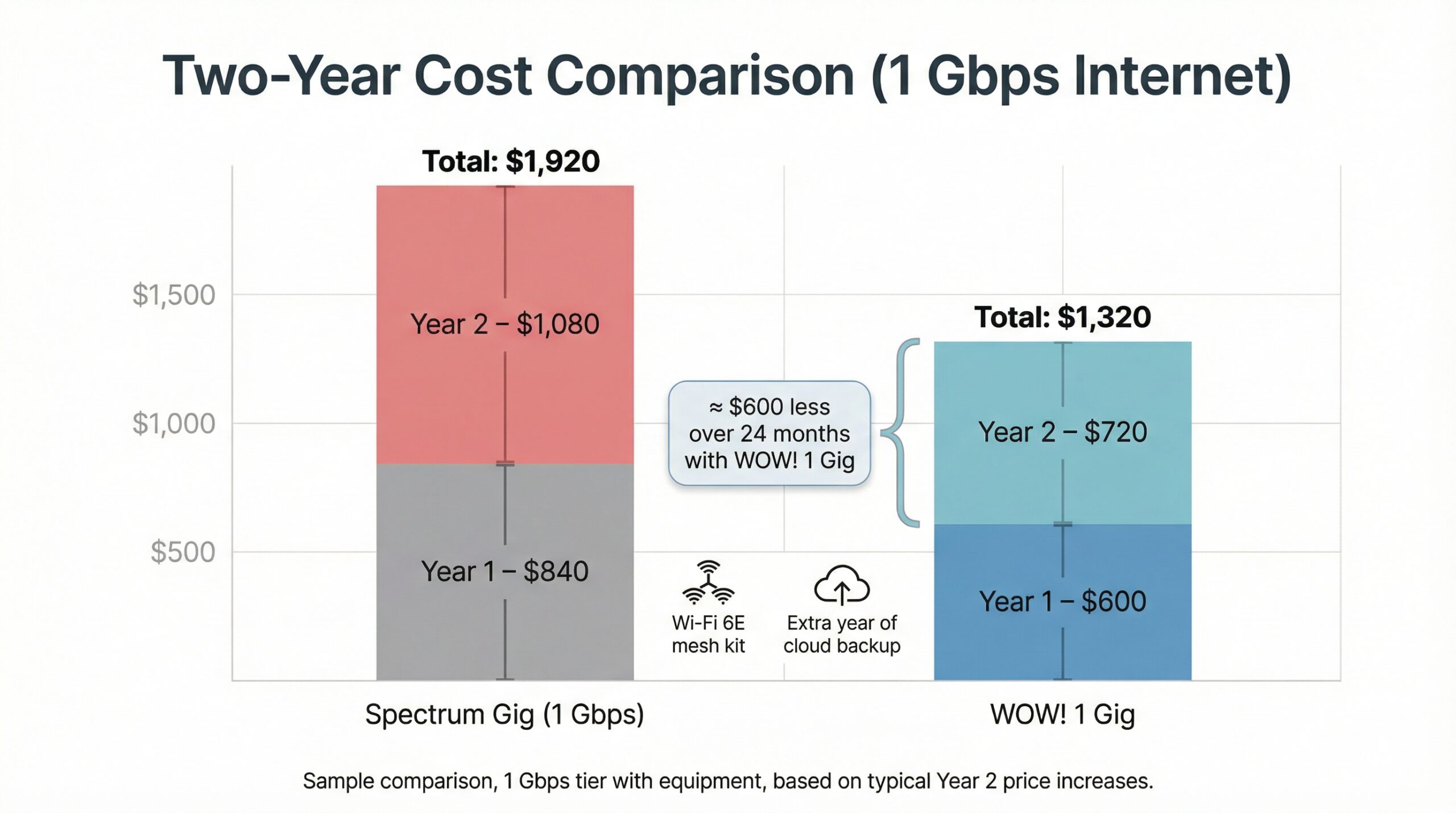
Over 24 months, WOW’s 1 Gig plan costs about $600 less than Spectrum Gig, enough to fund a mesh kit or extra backup.
A few fine-print wrinkles to keep in mind:
- Equipment fees: Spectrum’s modem is free, but Advanced WiFi adds $10 per month. WOW! includes the modem and Wi-Fi in the base price.
- Contracts: Spectrum never requires one. WOW! offers an optional two-year price-lock that freezes your bill at sign-up rates, helpful if you value predictability.
- Install charges: Spectrum ships a self-install kit for $25. WOW! lists $10 for self-install on the FCC label, while pro install costs about $99 in most areas.
Bottom line: If both home office internet providers reach your address, WOW!’s lower second-year price and included Wi-Fi leave more cash for gear. Spectrum counters with month-to-month flexibility and generous bundle promos. Choose the lever—certainty or freedom—that best fits your balance sheet.
Reliability & Uptime
One Dropped Call can Sink a Deal
Both ISPs advertise “99 percent+” availability, but 99.9 percent uptime still allows about 8 hours, 45 minutes of potential downtime each year. The real test is how quickly a provider repairs the cut line when it happens.
Spectrum: Muscle and Redundancy
Charter’s nationwide backbone and thousands of field technicians let it swarm major cuts. That scale shows in the 2024 ACSI Telecom Study, where Spectrum’s customer-satisfaction score rose six points to 68 / 100, tying Cox for the largest jump among cable peers.
WOW!: Smaller, Quicker on its Feet
Serving 19 metro markets means local crews know every mile of plant. In J.D. Power’s North-Central region, WOW! earned a 733 / 1,000 reliability score, outranking larger cable brands such as Cox. Review sites also report hold times under five minutes for routine support calls.
Congestion and Peak Hours
Both home office internet networks see the heaviest traffic after 7 p.m., so daytime Zoom sessions rarely sputter. Independent latency tests show Spectrum’s average ping near 24 ms, while WOW! averages 15 to 20 ms, giving the regional provider a modest edge during screen-sharing or VPN work.
Reality Check
No residential ISP promises five-nines uptime; even fiber lines can be cut. Keep a prepaid 5G hotspot ready for mission-critical uploads, and you will glide through the rare cable hiccup regardless of the logo on the modem.
Customer Service & Support
When the Wi-Fi Icon Turns Red
Speed is pointless if no one picks up the phone. Here’s how each provider scores on help and hand-holding.
Spectrum: Big-Box Resources
Charter offers 24/7 phone and chat support plus more than 500 walk-in stores nationwide. That scale shows in the 2024 ACSI Telecom Study, where Spectrum climbed to 68 / 100, its best mark yet and ahead of most cable peers. Hold times can stretch during major storms, but once a ticket is logged the company can dispatch one of its 30,000 technicians quickly.
WOW!: Familiar Voices
With only 19 metro markets to cover, WOW! reps often know the local plant by street name. In J.D. Power’s 2021 North-Central survey, WOW! tied for second place with a 716 / 1,000 reliability score, edging out several national brands. Review sites report hold times under five minutes for routine questions, a relief when you are minutes from a client demo.
Self-Service Tools
Spectrum’s MySpectrum app lets you reboot the modem, change Wi-Fi settings, and schedule a tech visit without a call. WOW!’s portal is leaner but puts outage maps and password changes up front, exactly what frantic home workers need first.
Need More Assurance?
Both companies upsell business-class tiers that add priority routing and, in Spectrum’s case, a dedicated business support line that J.D. Power ranked number one for small-business satisfaction in 2024. Most home offices do fine on residential plans, but it is good to know an escalator exists.
Equipment, Wi-Fi & Whole-Home Coverage
Your Gear is Half the Battle
A gig plan will never feel like a gig if your router tops out at 300 Mbps. Here’s what each provider ships to your door and what it costs.
Spectrum: Free Modem, Paid Wi-Fi
Every plan includes a DOCSIS 3.1 modem at no charge, but adding Advanced WiFi costs $10 per month. The fee drops to $0 on the Gig tier, or you can skip it by bringing your own router; ConnectCalifornia pegs the DIY savings at $84 per year.
WOW!: All-in-one Gateway or DIY
WOW! rents a combined modem and router for $14 per month. Power users can provide an approved modem to remove the fee.
Need whole-home reach? The WOW! Whole-Home WiFi add-on pairs eero 6 or Pro 6E mesh nodes—each blanketing up to 2,500 square feet—with an app that maps every device and dead spot.
The service runs about $10 per month (check your market).
Mesh on Spectrum
Spectrum now sells “Advanced WiFi Pods” that plug into the company router for mesh coverage; pricing mirrors the $10 Advanced WiFi fee, so many users buy a third-party kit for flexibility.
Quick Tips
- Hard-wire desktop PCs or NAS boxes with Gig-Ethernet; Wi-Fi 6 or 6E still drops to roughly 600 Mbps at range.
- If you rent, run the numbers: buying a $200 Wi-Fi 6E mesh pays for itself in about 18 months versus either ISP’s rental.
Bottom line: Spectrum is cheaper if you already own a strong router, while WOW! is turnkey if you want mesh coverage included. Either way, invest in hardware that can actually move the bits you are paying for.
Availability & Regional Considerations
The Factor you Cannot Control
Spectrum’s National Footprint
Charter reports that Spectrum now passes 58 million homes and businesses in 41 states. If cable service already reaches your block, Spectrum can usually activate the line within days.
WOW!’s Focused Footprint
WOW! serves about 2 million homes across 19 metro markets in six states: Michigan, Alabama, Tennessee, South Carolina, Georgia, and Florida. The company is in the middle of a “Greenfield” expansion, having added 100,000 new fiber passings since 2023 and targeting 400,000 additional passings by 2027.
What this Means for You
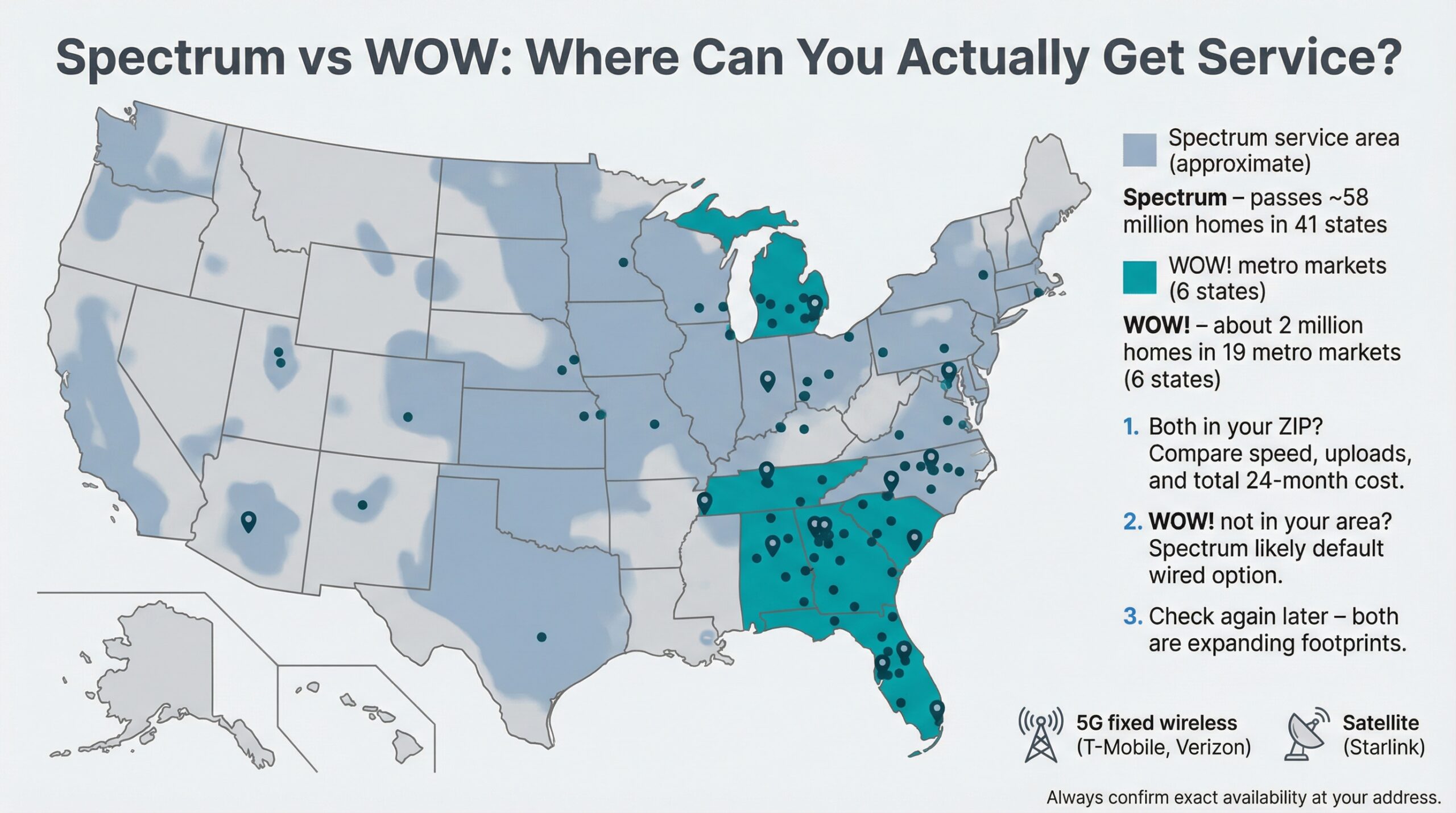
Spectrum reaches most U.S. states, while WOW! focuses on select metro markets in six states—always confirm availability at your address.
- If both ISPs show up in your ZIP checker, use the overlap to negotiate or simply pick the plan that matches your upload needs and budget.
- If WOW! does not reach your street, Spectrum likely becomes the default wired option, with 5G fixed-wireless (T-Mobile, Verizon) or satellite (Starlink) as alternatives.
- Check soon, then check again. WOW! crews are hanging new fiber every quarter, and Spectrum is building subsidized rural extensions. A “no” today may become a “yes” before your lease renews.
Before you sign, plug your address into each provider’s availability tool and ask neighbors how often their lines drop. Nothing beats local insight when uptime protects your income.
Which Provider Fits Your Home Office?
You have seen the speeds, prices, and service quirks. Here is the 30-second decision tree.
Pick Spectrum if you Care Most About:
- Covers 58 million passings in 41 states.
- No strings. Month-to-month terms with no early-termination fees.
- One-stop bundles. Add Spectrum Mobile or TV on the same bill.
- Walk-in help. More than 500 retail stores for same-day gear swaps.
Pick WOW! if you Care Most About:
- Symmetrical uploads. Up to 5 Gbps both ways on fiber, nearly 30 times Spectrum’s 35 Mbps ceiling.
- Lower long-term cost. About $600 less over two years for the 1 Gbps tier, even after promo increases.
- Personalized support.D. Power placed WOW! in the top tier for Midwest reliability.
- Plug-and-play mesh. Whole-Home WiFi with eero nodes for about $10 per month.
Either line will run a thriving home office; the right one matches your ZIP code, your upload habits, and your comfort with risk. Check each provider’s availability tool, total the 24-month bill (including equipment), and choose the path that keeps you working—not waiting.
Conclusion
Choosing the right home-office internet provider is about more than speed—it’s about reliability, support, and long-term value. Whether you prioritize Spectrum’s nationwide coverage and month-to-month flexibility or WOW!’s ultra-fast symmetrical fiber and personalized support, your decision impacts productivity, client satisfaction, and peace of mind. For businesses looking to scale or optimize remote operations, investing in high-quality connectivity is a key component of broader IT solutions for businesses, ensuring teams stay connected, data flows smoothly, and downtime never interrupts growth.
Find a Home-Based Business to Start-Up >>> Hundreds of Business Listings.