









































Hardware is having a moment again. Edge devices, IoT rollouts, and custom embedded builds are driving it. But the hard part is not the PCB itself. It’s getting the whole thing to work as a product: firmware, testing, certification, and a design that can actually be manufactured. That’s why the partner choice matters. You’re not buying a one-off build. You’re picking a team that can take a device from idea to production.
Hardware Development in a Product-Driven Market
Hardware now affects core product decisions. Parts, firmware structure, and manufacturing choices set the ceiling on cost, performance, and reliability. That’s why you need a partner who thinks in systems and can support a device after launch, not just ship a prototype.
You need true hardware engineering companies that think in systems, not just schematics. They must navigate extended lifecycles where a device might need firmware updates for years and spare parts for a decade. Supply chain volatility adds another layer. This environment elevates the role of expert hardware development companies from simple contractors to essential strategic allies.
How We Evaluated Hardware Development Companies
We looked past marketing claims to assess real operational capability. The goal was to identify firms that don’t just design in a lab but shepherd a product all the way to a user’s hands, and then support it. Our evaluation focused on execution, not just ideas.
The framework we used prioritized:
- Experience with end-to-end hardware product delivery;
- Ability to move from prototype to manufacturing;
- Integration of hardware, firmware, and system design;
- Readiness for certification, testing, and scaling.
These points separate the dreamers from the doers. A beautiful prototype is meaningless if it can’t be produced reliably or pass regulatory muster. We think that’s the baseline.
Hardware Development Companies to Watch
The following firms represent this product-oriented engineering approach. They are examples of partners who can navigate the full journey from concept to volume production. Each brings a distinct focus to the complex discipline of bringing hardware to life.
Yalantis
Yalantis works as a product engineering partner with a strong focus on custom hardware development. Instead of treating hardware as a standalone task, their teams build it as part of a broader system that includes firmware, connectivity, and long-term product decisions. For companies working with Yalantis, this usually means dealing with one team across the full build, not a chain of separate vendors. Their work typically covers:
- Full-cycle hardware product engineering, from early concepts to manufacturing handoff;
- Integration of hardware, firmware, and system-level architecture;
- Experience with custom devices across IoT and embedded systems;
- Focus on long-term maintainability, testing, and certification.
This setup fits hardware product development companies that want fewer handoffs and clearer ownership. The emphasis is on devices that stay reliable after launch, can be updated over time, and hold up once they reach real production environments.
InTechHouse
InTechHouse focuses deeply on embedded systems and IoT hardware. Their work leans into complex, often safety-critical engineering challenges that require serious R&D rigor.
Their key competencies are:
- Embedded systems and IoT-focused hardware engineering;
- PCB design, prototyping, and R&D-heavy projects;
- Experience with complex, safety-critical systems.
They’re the kind of partner you call when the problem is genuinely tough, not just standard.
Softeq
Softeq provides end-to-end hardware and low-level firmware development. They connect device-level engineering with the cloud infrastructure that makes it useful.
Their work often involves:
- Hardware and low-level firmware development;
- Device-to-cloud integration and embedded platforms;
- Support for scalable, production-ready hardware systems.
This full-stack capability is crucial for connected products that can’t afford communication breakdowns between the physical and digital layers.
AJProTech
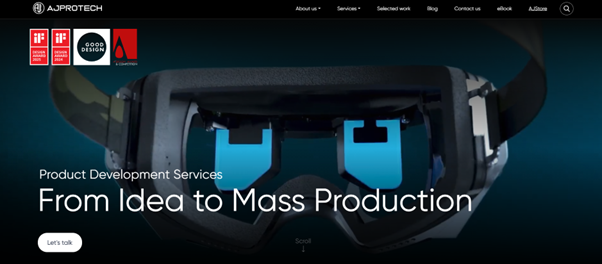
AJProTech blends industrial design with hardware engineering. They move quickly from early concepts to tangible prototypes you can test and validate.
Their process emphasizes:
- Hardware product development with industrial design;
- Rapid prototyping and validation workflows;
- Support from early concept through production.
They help de-risk ideas fast by getting a functional model in your hands early in the process.
Silicon Signals
Silicon Signals concentrates on IoT and connected device development. Their work ensures hardware is designed for reliable communication from the start.
Their typical project scope includes:
- Embedded hardware and IoT device development;
- PCB design and device connectivity;
- Focus on scalable, connected hardware products.
They are a fit for products where the value is unlocked by being online and interoperable.
What to Look for in a Hardware Development Partner
Selecting a partner is about judging their stamina, not just their sprint speed. You need a team committed to the marathon of product lifecycle management, from the first napkin sketch to the tenth production batch.
The checklist should be practical:
- Ability to support hardware beyond early prototypes;
- Experience with manufacturing constraints and supply chains;
- Clear ownership across hardware, firmware, and testing;
- Proven delivery of hardware design and development services.
A true partner talks frankly about factory lead times, certification costs, and design-for-manufacturing trade-offs. They prepare you for the hard parts, not just the fun ideation phase.
Why Hardware Projects Fail After the Prototype
Hardware projects rarely fail at the idea stage. Most problems appear later, when early design decisions collide with manufacturing limits, certification requirements, or supply chain realities. A partner who understands this from the start helps avoid painful redesigns and delays. They raise these constraints early, even when it complicates planning, because ignoring them is far more expensive once production begins.
This is where experience shows. Teams that have already taken devices through testing, certification, and real production cycles know where things usually break. They plan for component availability, firmware updates, and long term support instead of treating delivery as the finish line. That mindset reduces risk and makes hardware development more predictable for product teams.
Conclusion
Hardware development is a strategic, long-term investment. It commits your company to a physical asset with a multi-year lifespan, supply chain dependencies, and recurring support needs. It is not a one-off development project you can easily walk away from.
The companies listed here, including Yalantis, operate as engineering partners for that entire journey. They provide the technical depth and process discipline to navigate from prototype to volume production and beyond. This partnership model transforms hardware from a risky capital expense into a manageable, scalable component of your product portfolio.
Find a Home-Based Business to Start-Up >>> Hundreds of Business Listings.