







































Introduction
Work with children in a dance school is traditionally built around mastering basic technique, stretching, coordination, and musicality. However, practice shows that for a generation raised in a visual and digital environment, “correct movement” alone is not enough to maintain motivation and deep engagement.
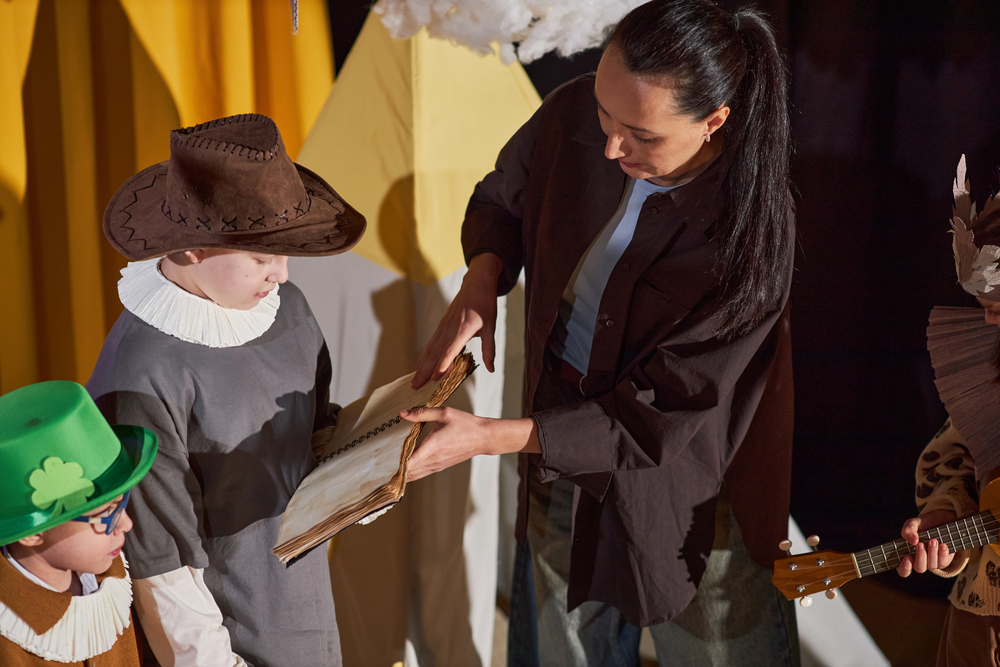
The staged learning methodology is based on the idea that for children aged 5–12, the most natural form of learning is participation in a performance. The child does not simply repeat combinations, but becomes part of a story, understands who their character is, why they appear on stage, and what emotion they convey. As a result, not only technique improves, but also self-confidence, the ability to work in a team, and awareness of one’s own contribution.
1. The Principle of “Story First, Movement Second”
The core principle of the methodology is to begin not with pure technique, but with imagery and narrative.
For younger children, these may be fairy tales, fantasy worlds, and simple metaphors (“the city of rain,” “a journey across the sea,” “the forest of candles”).
For older children, more complex themes are introduced: friendship and betrayal, fear and overcoming it, searching for oneself within a group.
After discussing the theme and the characters, movements are introduced that “serve” the story:
- a gesture explains an emotion;
- a trajectory supports the narrative;
- the group formation reflects relationships between characters.
In this way, the child initially perceives movement as a language rather than as a set of commands.
2. Production-Based Learning as a System of Small Tasks
Work on a performance is broken down into many small, achievable tasks:
- learn a short fragment;
- enter the stage at the right moment;
- interact with a partner or a group;
- change the pattern or formation on cue.
Each such task is perceived by the child as a concrete step toward the premiere rather than an abstract exercise. The choreographer:
- tracks progress through small steps;
- acknowledges successes even when the overall result is still far from ideal;
- builds a trajectory of increasing complexity—from simple entrances to complex ensemble scenes.
The production becomes a “development project” in which each participant has their own path of growth.
3. Roles and Responsibility: From Group Scenes to Personal Participation
An important part of the staged learning methodology is the conscious distribution of roles. Even in group scenes, every child should understand why they are on stage.
Several levels of participation are used:
- group roles (a unified movement and task for the entire line or subgroup);
- micro-parts within the group (a slightly more complex trajectory, an accent, a short solo fragment);
- clearly defined characters for children who are ready for a higher level of responsibility.
This creates a sense that everyone has an important part of the story. It increases motivation, reduces anxiety, and forms an experience of personal responsibility to the collective.
4. Emotional Safety and Working with “Challenging” Themes
Even when a performance touches on serious subjects, the staged learning methodology is built around the emotional safety of children.
Key principles include:
-
Adapting the Theme to The Age
Historical and social topics are translated into the language of images: light and darkness, a choice between two paths, helping the weak, staying true to one’s word.
-
Separating the Character From the Child
The teacher regularly reminds children that emotions on stage are part of the role and not a personal evaluation of the child or their real life.
-
Discussion After Rehearsals and Performances
Children are given the opportunity to ask questions, share impressions, and talk through fears and joys.
This approach turns the production into a space for safely experiencing complex emotions and narratives rather than a traumatic experience.
5. Developing Soft Skills Through Work on a Show
Production-based learning develops not only dance technique but also a wide range of soft skills:
-
Teamwork
Children learn to adapt to a shared rhythm, listen to their partners, and support those who make mistakes.
-
Discipline and Time Management
Rehearsals, fittings, run-throughs, and the premiere all require keeping to a schedule, taking responsibility for attendance, and being prepared.
-
Public Speaking and Self-Presentation
Going on stage builds experience of being in the spotlight, managing nervousness, and maintaining focus.
-
Creativity and Initiative
In older groups, children are encouraged to contribute ideas—movement options, character details, and solutions for scenes.
As a result, the performance becomes a platform for holistic development rather than just a final “checkmark” at the end of the training season.
6. Scaling the Methodology: From One School to a Network of Projects
The production-based learning methodology, developed and refined at the Skazka Dance Space school and in other projects, has proven transferable across different contexts.
When working with other schools and groups in Russia and Portugal, the following elements are used:
- a basic process structure (idea — script — casting — rehearsals — run-throughs — premiere);
- a set of pedagogical tools for working with children of different ages;
- script and methodological templates that enable partner schools to launch their own productions;
- consultations for teachers who may not have extensive directing experience but want to work in a show-based format.
Thus, the experience of a single school is transformed into a scalable methodology that can be adapted to a specific studio, city, or country.
Conclusion
Production-based learning for children aged 5–12 through choreographic performances makes it possible to address several goals at once:
- accelerated technical development through a meaningful context;
- the formation of emotional intelligence and interaction skills;
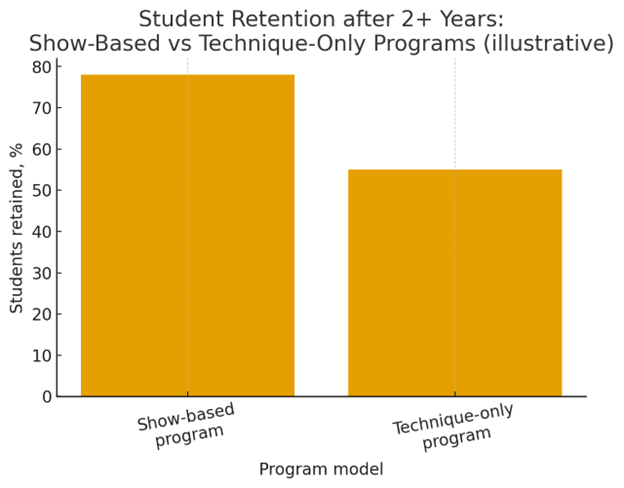
- increased motivation and engagement in the learning process;
- the creation of a strong, memorable product for the school in the form of a show.
A teacher and choreographer working with children can think like an artistic director and a product manager—designing not only movement, but also the educational trajectory, emotional safety, and team experience. For dance schools, this opens the way to a deeper format of work in which the performance becomes not a one-time event, but the core of the learning process.
Find a Home-Based Business to Start-Up >>> Hundreds of Business Listings.