










































ABSTRACT
The article explores a data-driven approach to strategic communications in international nonprofit consulting based on the integration of business analytics, stakeholder segmentation, and message design. The purpose of the study is to systematize data-driven methodologies for developing proposals, presentations, and communication campaigns that enhance trust, improve the perceived value of services, and support business growth.
The methodological framework includes an analysis of academic literature on marketing analytics, stakeholder relationship management, and communication effectiveness, as well as a synthesis of practices used by international organizations. The study demonstrates that the application of predictive demand models, message testing, channel effectiveness analysis, and transparent visualization of results can increase decision conversion rates and reduce the risk of manipulative framing.
The practical contribution of the article is the proposed “data — insight — narrative — proof — metric” model, which can be applied by teams responsible for positioning, service sales, and reputation management in nonprofit and related sectors.
Introduction
The contemporary environment of international nonprofit consulting is characterized by intense competition for stakeholder attention, growing demands for transparency and evidence-based decision-making, and increasing complexity of communication contexts. Organizations and their partners make decisions not only on the basis of mission alignment, but also on the clarity of the value proposition, the persuasiveness of arguments, and the manageability of risks.
Under these conditions, strategic communications move beyond “text and visuals” and become an integral component of business strategy – they build trust, accelerate decision-making processes, and support long-term relationships. In practice, tools borrowed from commercial-sector business analytics are increasingly applied, including audience segmentation, channel effectiveness measurement, A/B testing of messaging, conversion analysis, and predictive modeling.
However, within the nonprofit context these methods require adaptation. Communication must remain ethical and account for the sensitivity of social and humanitarian issues. The objective of this article is to examine the potential for integrating data-driven analytics into strategic communications (including proposals and presentations) and to propose a model that enhances persuasiveness and measurability without undermining trust.
Materials and Methods
The methodological basis of the study includes:
- a review of academic publications on marketing analytics, stakeholder relationship management, and communication effectiveness;
- a synthesis of practices used by international organizations that apply measurable approaches to communications and positioning;
- the development of an applied model describing the transition from data to communication decisions.
The study employs the following groups of methods:
- strategic stakeholder segmentation based on behavioral and contextual indicators;
- channel effectiveness analytics (attribution models, comparison of CAC/CPA in terms of lead generation and decision conversion);
- message testing, including A/B approaches to wording, proposal structure, and visualization;
- predictive analytics to assess the likelihood of positive decisions or stakeholder interest (in an applied interpretation);
- metric decomposition of objectives (KPI trees) linking business outcomes with communication performance indicators.
Fig. 1. Adoption of Data Analytics in Nonprofit Strategic Communications (2021–2025)
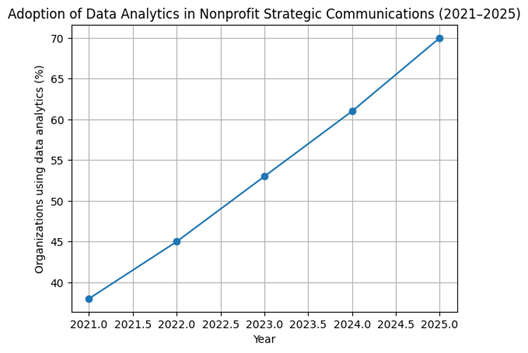
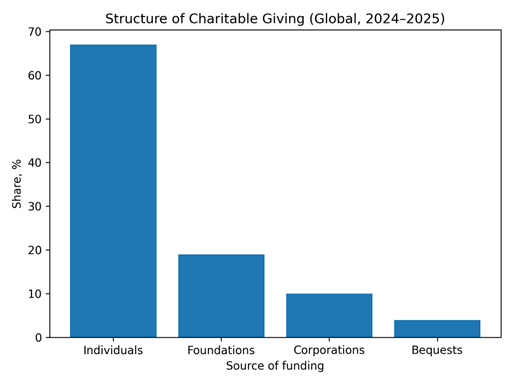
Fig. 2. Structure of charitable giving by source, global nonprofit sector, 2024–2025
Results and Discussion
1. Communications as a Business System: From “Message” to “Decision”
In international consulting, the core product of communications is not an individual text or presentation, but a managed decision-making process: understanding the problem, recognizing the value of the proposed solution, and demonstrating readiness to move to the next step (meeting, pilot project, or contract). Therefore, communication outcomes should be measured not only through reach-based metrics, but also through decision-conversion indicators, such as response rates, meeting-setting rates, stage progression speed, and the share of approved proposals.
This perspective aligns the communication function with business strategy logic, where reproducibility, predictability, and quality control are essential.
2. Data-Driven Stakeholder Segmentation and Message Design
Unlike mass outreach and generic presentations, a data-driven approach focuses on identifying segments that differ in motivation and trust criteria. In international practice, micro-segments are commonly formed based on combinations of parameters such as organization type, geography, stakeholder role, process maturity, regulatory context, topic sensitivity, and the level of evidence expected by the audience.
Segmentation is required not only for channel selection, but also for structuring arguments. For example, one segment may expect an emphasis on measurable metrics and operational efficiency, another on reputational risk and compliance, and a third on mission-driven narratives and social value. Integrating analytics at the segmentation stage enables a shift from intuitive assumptions to formally testable hypotheses.
3. The “Data — Insight — Narrative — Proof — Metric” Model
To standardize practice, the article proposes a five-component model for developing proposals and presentations:
● Data. Market, client, and request data; results of previous campaigns; communication channel effectiveness; pipeline dynamics; and contextual constraints.
● Insight. Analytical interpretation of data: identifying stakeholder problems, trust gaps, and factors that accelerate or slow decision-making.
● Narrative. Structured storytelling: problem → consequences of inaction → solution logic → roadmap → expected outcomes.
● Proof. Case-based arguments, causal logic, transparent metrics, benchmarks, source references, limitations, and risks.
● Metric. Predefined communication effectiveness indicators: stage conversion rates, response rates, win rates, time to decision, as well as qualitative trust metrics (surveys and feedback).
The key advantage of the model lies in reducing the risk of manipulative storytelling: data and evidence become mandatory layers, while metrics allow for validation of communication hypotheses.
4. Measuring Effectiveness: From “Reach” to “Trust Conversion”
Traditional communication metrics (views, clicks, open rates) are insufficient in a B2B context. More relevant indicators include:
● conversion from presentation to next step;
● conversion of proposals into approval;
● funnel velocity;
● share of repeat engagements or renewals;
● quality of questions and feedback as indicators of engagement.
To improve measurement accuracy, multichannel analytics is applied, linking lead sources, content types, and decision stages. International studies show that audiences engaging across multiple channels demonstrate higher involvement and a greater likelihood of relationship continuation than those interacting through a single channel [2]. This supports the value of building a coherent communication ecosystem.
5. Ethical Dimension: Boundaries of Influence and Transparency as an Asset
The use of analytics enhances the capacity to influence decisions, raising ethical considerations. In the nonprofit sector, trust is a critical intangible asset, and non-transparent data interpretations or overstated promises can result in reputational damage. Consequently, data-driven communications should include:
● explicit acknowledgment of data limitations;
● accurate comparisons and benchmarks;
● avoidance of metric manipulation to support predetermined conclusions;
● documentation of measurement methodologies.
This approach aligns with contemporary standards of professional responsibility for communicators and consultants, where the quality of argumentation becomes an integral element of risk and reputation management [1].
Conclusion
The analysis demonstrates that integrating business analytics into strategic communications enhances the manageability and reproducibility of outcomes in international nonprofit consulting. A data-driven approach transforms communications from a collection of isolated materials into a decision-support system in which measurable hypotheses, stakeholder segmentation, and message testing foster trust and improve key business results.
A key conclusion is the need for balance: while data strengthens communicative influence, the absence of an ethical framework and transparent methodology increases the risk of manipulation. The proposed “data — insight — narrative — proof — metric” model can be adapted for organizations of varying scale and focus, including consulting teams responsible for positioning, service sales, and business planning.
Future research directions include assessing the impact of artificial intelligence on message design, advancing predictive models in communications, and developing standards for ethical data use in stakeholder communications within an international context.
References:
- Waters, R. D. Measuring ROI in Public Relations and Communication: A Data-Driven Approach for Nonprofits.New York: Routledge, 2018. 245 p.
- Sargeant, A., Shang, J. Fundraising Principles and Practice. 2nd ed. San Francisco: Jossey-Bass, 2017. 320 p.
- Kumar, V., Petersen, J. A. Using a Customer-Level Marketing Strategy to Enhance Firm Performance: A Review of Theoretical Perspectives // Journal of the Academy of Marketing Science. 2019. Vol. 47. P. 165–183.
- Bekkers, R., Wiepking, P. A Literature Review of Empirical Studies of Philanthropy: Eight Mechanisms That Drive Charitable Giving // Nonprofit and Voluntary Sector Quarterly. 2020. Vol. 40, No. 5. P. 924–973.
- NTEN. Nonprofit Technology Trends Report. (latest available editions).
- M+R. Benchmarks Study: The M+R Benchmarks Report. (latest available editions).
- Salesforce. Nonprofit Trends Report. (latest available editions).
- Giving USA Foundation. Giving USA: The Annual Report on Philanthropy. (latest available edition).
- Charities Aid Foundation (CAF). CAF World Giving Index. (latest available edition).
- Candid (Foundation Center). Philanthropy / Foundation giving briefings and data resources. (latest available materials).
Find a Home-Based Business to Start-Up >>> Hundreds of Business Listings.