









































Most laser technicians spend their careers trying to eliminate problems.
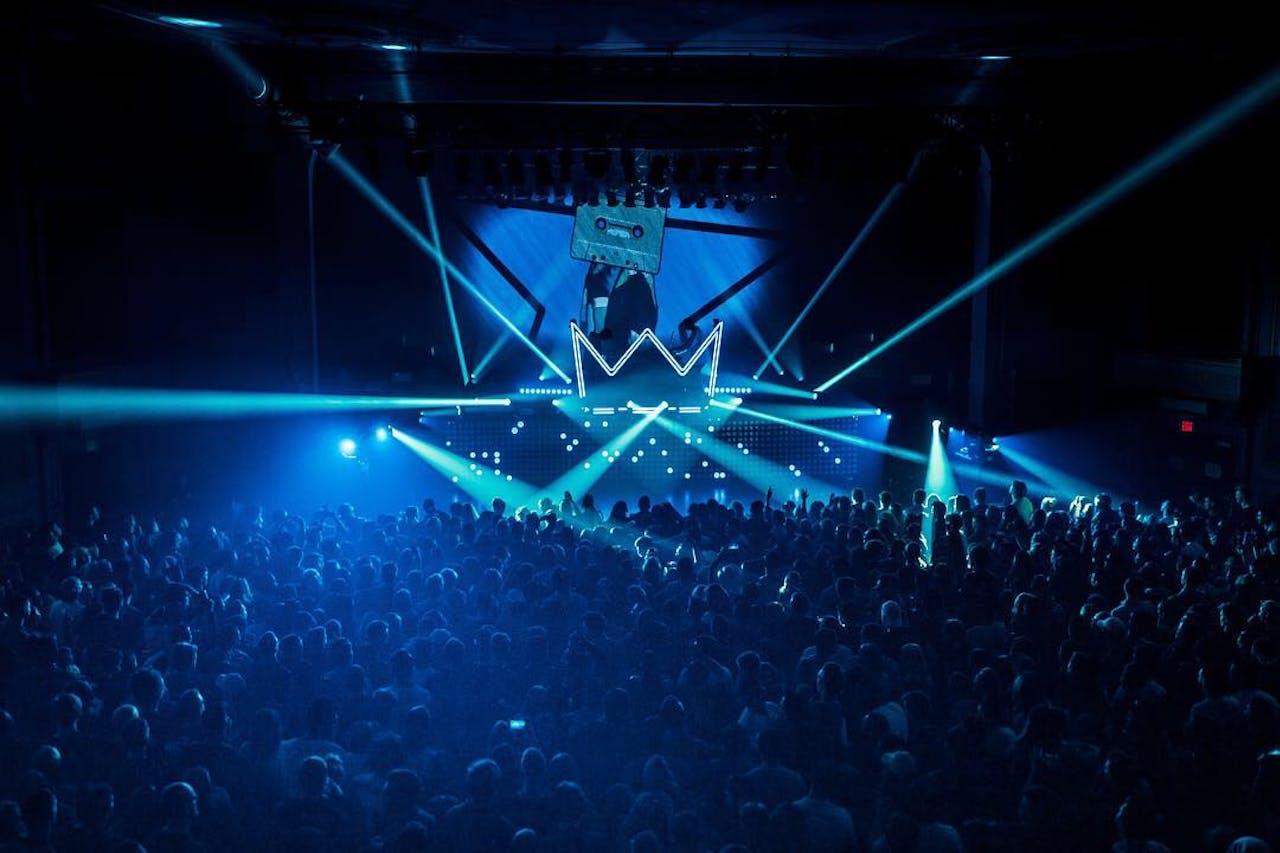
Meganne Money shares how she put Adam LaBay’s design concept into practice by embracing a problem rather than eliminating it.
The phenomenon is called the rolling-shutter effect, now referred to by the catchier term, laser banding.
When a camera records laser effects, mismatches between the laser’s frame rate and the camera’s shutter speed create visible bands and gaps in the beam.
Historically, production crews treated it as something to fix. Meganne Money saw something else entirely: an untapped creative tool capable of producing visuals impossible to replicate any other way.
The Art Nobody Else Wanted
“Rolling shutter effect is something that originally was considered more of a problem, an issue,” explains. That assessment held true across the industry for years. Cinematographers flagged it during post-production. Lighting designers adjusted their rigs to minimize it. Everyone agreed the effect looked broken.
Then her colleague, Adam LaBay, started experimenting in a way that reframed the way Money and other laserists think of the rolling shutter effect.
“You’re using that effect intentionally to create things you can’t see with the human eye,” she says. “It might look like the lasers are raining. It might look like the rain is sucking back up from the floor. It might look like there’s a spiral going around them.”
The human eye processes light continuously, so these segmented patterns never register in person.
But through a lens?
The mathematics of competing frame rates produces something genuinely otherworldly.
Audiences watching live see one show. Audiences watching broadcasts or recordings see another, enhanced version layered on top.
Why Frame Rates Become Your Paintbrush
Understanding what makes laser banding work requires a quick dive into the mechanics, particularly in the context of how Meganne Money uses laser banding.
Lasers project by scanning points of light incredibly fast, creating the illusion of solid shapes. Cameras capture images in frames, with each frame’s exposure lasting a fraction of a second. When these two rhythms clash, portions of the laser’s scan cycle get captured while others don’t.
Meganne Money has learned to manipulate those clashes deliberately. Adjusting the laser’s scan rate or point count relative to a known camera frame rate can produce predictable, repeatable patterns. Rain effects. Spirals. Waves that appear to defy gravity.
“That is a really cool effect that can be achieved that I like working with, but it’s difficult,” she admits. “It takes a lot of tinkering.”
Difficult understates it. The variables involved include the laser’s projection speed, the camera’s frame rate, its shutter angle, and the physical geometry of where everything sits in space. Getting laser rain to fall convincingly on camera requires calculations that account for all of these factors simultaneously.
Programming Geometry Into Light
The technical foundation of Meganne Money’s work involves spatial mathematics most audiences never consider. Laser programming operates on an x, y, z plane grid, with every effect requiring careful attention to geometry and trigonometry.
Her software of choice, Pangolin Beyond, provides visual representations of how adjustments affect output. But camera-specific effects demand going further. A laser mapped to look spectacular in the room might appear completely wrong through a broadcast camera positioned at a different angle. Creating laser banding effects as Meganne Money uses laser banding that translates well across multiple camera positions adds another layer of complexity.
The payoff justifies the effort. A band streaming their concert can now offer viewers something genuinely exclusive.
Where Human Vision Ends and Cameras Begin
Meganne Money approaches lasers differently than most. Where others see lighting instruments, she sees geometry in motion. Where others see camera artifacts, she sees creative potential waiting to be claimed.
Human perception has limits. Camera sensors have different ones. The gap between them, which frustrated technicians for years, turns out to be fertile creative ground.
The effects Meganne Money creates through laser banding don’t replace traditional laser shows. They add a dimension that only exists in recordings. Live audiences get the full sensory experience of being present. Remote audiences get visual compositions that physics prevents anyone from witnessing in person.
Both groups walk away having seen something remarkable.
Neither group saw the same show.
Find a Home-Based Business to Start-Up >>> Hundreds of Business Listings.


